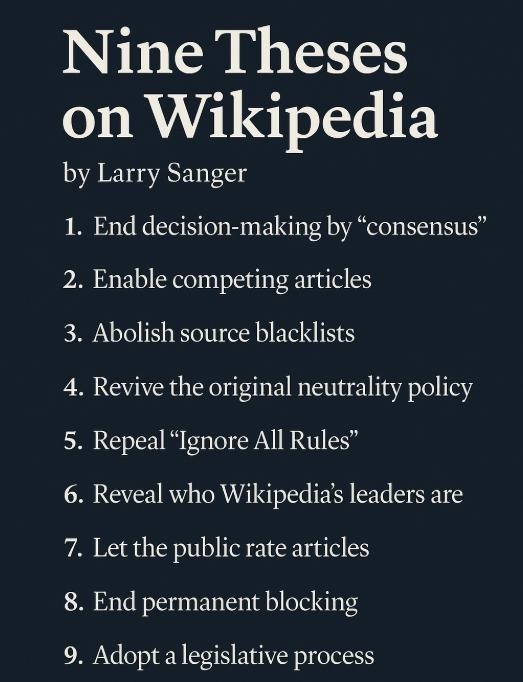
Nine Theses on Wikipedia
I submit these nine theses to Wikipedia’s community and to the world. I do this, as Martin Luther said when he posted his famous 95 theses, [a] “Out of love for the truth and the desire to elucidate it.”
A quarter of a century ago, Jimmy Wales’ company Bomis hired me to start a free encyclopedia. The first draft, from which we learned much, was Nupedia—it made slow progress. So, a year later, on January 2, 2001, when a friend told me about wikis, I immediately began imagining a wiki encyclopedia. I proposed it to Jimmy, then CEO of Bomis. He agreed and installed the software, and I went to work getting things ready. After I named it, we launched Wikipedia on January 15, 2001, and just nine days later, I was able to write, “Wikipedia has definitely taken on a life of its own; new people are arriving every day and the project seems to be getting only more popular. Long live Wikipedia!”
The title I claimed at the time was “chief instigator.” My daily leadership for the 14 months after that was essential to transforming a completely empty, blank wiki into what would soon become the largest written resource in the history of the world. I was responsible for several policies that were and are fundamental to the project: the exclusive focus on an encyclopedia; neutrality; “no original research”; “be bold”; aspects of the verifiability policy; and other things. I even proposed the tongue-in-cheek “rule” to “ignore all rules.” For more, see this page on my role in Wikipedia, [a] my Slashdot memoir, [a] and my book, Essays on Free Knowledge. I say these things not to brag but to show why my proposals deserve a careful hearing.
I carefully chose and worded the following nine theses to appeal to the universal concern for truth and justice. I have worked for many months on this project. I am confident that every thesis stands on solid ground. Some Wikipedians, wedded to the current system, might be inclined to reject them; but many others, as well as the broader world, will be able to see that they are quite reasonable. I hope that the Wikipedia community will do the necessary introspection and find ways to make these proposals a reality. I also hope the broader world will join the discussion on each point and press Wikipedia’s leadership as well as rank-and-file editors to adopt them, for the good of all.
Please note that there are nine lengthy essays to go with the nine theses, linked below.
These Nine Theses can be found on Wikipedia.
Please go there to discuss them with Wikipedians.
- Nine Theses on Wikipedia
- 1. End decision-making by “consensus.”
- 2. Enable competing articles.
- 3. Abolish source blacklists.
- 4. Revive the original neutrality policy.
- 5. Repeal “Ignore all rules.”
- 6. Reveal who Wikipedia’s leaders are.
- 7. Let the public rate articles.
- 8. End indefinite blocking.
- 9. Adopt a legislative process.
- Further theses
1. End decision-making by “consensus.”
Wikipedia’s policy of deciding editorial disputes by working toward a “consensus” position is absurd. Its notion of “consensus” is an institutional fiction, supported because it hides legitimate dissent under a false veneer of unanimity. Perhaps the goal of consensus was appropriate when the community was small. But before long, the participant pool grew so large that true consensus became impossible. In time, ideologues and paid lackeys began to declare themselves to be the voice of the consensus, using this convenient fiction to marginalize their opponents. This sham now serves to silence dissent and consolidate power, and it is wholly contrary to the founding ideal of a project devoted to bringing humanity together. Wikipedia must repudiate decision-making by consensus once and for all.
2. Enable competing articles.
Neutrality is impossible to practice if editors refuse to compromise—and Wikipedia is now led by such uncompromising editors. As a result, a favored perspective has emerged: the narrow perspective of the Western ruling class, one that is “globalist,” academic, secular, and progressive (GASP). In fact, Wikipedia admits to a systemic bias, and other common views are marginalized, misrepresented, or excluded entirely. The problem is that genuine neutrality is impossible when one perspective enjoys such a monopoly on editorial legitimacy. I propose a natural solution: Wikipedia should permit multiple, competing articles written within explicitly declared frameworks, each aiming at neutrality within its own framework. That is how Wikipedia can become a genuinely open, global project.
3. Abolish source blacklists.
An anonymous “MrX” proposed a list of so-called perennial sources [a] just seven years ago, which determine which media sources may, and may not, be used in Wikipedia articles. The page is ideologically one-sided and essentially blacklists disfavored media outlets. Wikipedians now treat this list as strict—but unofficial—policy. This approach must be reversed. Wikipedia should once again explicitly permit citations even from sources that the page currently blacklists. Rather than outright banning entire sources that can contain valid and important information, Wikipedia articles should use them when relevant, while acknowledging how different groups assess them. Neutrality requires openness to many sources; such openness better supports readers in making up their own minds.
4. Revive the original neutrality policy.
In short, Wikipedia must renew its commitment to true neutrality. The present policy on neutrality [a] should be revised to clarify that articles may not take sides on contentious political, religious, and other divisive topics, even if one side is dominant in academia or mainstream media. Whole parties, faiths, and other “alternative” points of view must no longer be cast aside and declared incorrect, in favor of hegemonic Establishment views. Solid ideas may be found in some of the first policy statements, including the first fully elaborated Wikipedia policy [a] and the Nupedia policy of 2000. [a]
5. Repeal “Ignore all rules.”
On February 6, 2001, [a] I wrote this humorous rule—“Ignore all rules”—to encourage newcomers. Ironically, my joke now serves to shield insiders from accountability. It no longer supports openness; it protects power. Wikipedia should repeal it.
6. Reveal who Wikipedia’s leaders are.
It is a basic principle of sound governance that we know who our leaders are. So why are the 62 Wikipedia users with the most authority—“CheckUsers,” “Bureaucrats,” and Arbitration Committee members—mostly anonymous? Only 14.5% of such users reveal a full, real name. These high-ranking individuals obviously should be identified by their real and full names, so they can be held accountable in the real world. After all, Wikipedia is now one of the world’s most powerful and well-funded media platforms. Wikipedia’s influence far exceeds that of major newspapers, which follow basic standards of transparency and accountability. Such standards are not mere ideals but real requirements for any media organization of Wikipedia’s stature. As of 2023, Wikipedia’s endowment was $119 million, its annual income $185 million. Therefore, if safety is a concern, funds should be used to indemnify and otherwise protect publicly identified editorial leaders. Wikipedia, admit that your leaders are powerful, and bring them out into the open; great power requires accountability. If you continue to stymie accountability, government may have to act.
7. Let the public rate articles.
A system of public rating and feedback for Wikipedia articles is long overdue. Articles now boldly take controversial positions, yet the public is not given any suitable way to provide feedback. This is disrespectful to the public. There is an internal self-rating system, not visible to readers. The platform experimented with an external ratings system but scrapped it after a few years, and it didn’t help readers. Wikipedia does not need a complex system to get started. An open source AI rating system would not take long to develop. The platform already collects relevant objective data such as number of edits and word count: make that public. As to human raters, they should be provably human, unique, and come from outside of the editor community. When articles are evaluated by a diverse audience, content quality and neutrality will be improved.
8. End indefinite blocking.
Wikipedia’s draconian practice of indefinite blocking—typically, permanent bans—is unjust. This is no small problem. Nearly half of the blocks in a two-week period were indefinite. This drives away many good editors. Permanent blocks are too often used to enforce ideological conformity and protect petty fiefdoms rather than to serve any legitimate purpose. The problem is entrenched because Administrators largely lack accountability, and oversight is minimal. The current block appeals process is ineffective; it might as well not exist, because it is needlessly slow and humiliating. These systemic failures demand comprehensive reform. Indefinite blocks should be extremely rare and require the agreement of three or more Administrators, with guaranteed periodic review available. Blocks should nearly always be preceded by warnings, and durations should be much more lenient.
9. Adopt a legislative process.
Wikipedia’s processes for adopting new policies, procedures, and projects are surprisingly weak. The Wikimedia Foundation (WMF) has launched initiatives, but these do not establish major editorial policy. Incremental policy tweaks cannot deliver the bold reforms Wikipedia needs. No clear precedents exist for adopting significant innovations. The project is governed by an unfair and anonymous oligarchy that likes things just as they are. This stagnation must end. Wikipedia needs an editorial legislature chosen by fair elections: one person, one vote. To establish legitimate and fair governance, the WMF should convene a constitutional convention to create an editorial charter and assembly. This assembly would be empowered to make the sorts of changes proposed in these “Nine Theses.”
Further theses
When I began this project, I had more than nine ideas, of course. The following are some further theses, which I submit undeveloped. The fact that so many plausible proposals for improvement come so readily to mind underscores the platform’s dysfunction.
Wikipedia should join the Encyclosphere.
The Encyclosphere is a project I started in 2019 to collect all the encyclopedia articles in the world in a single decentralized network, with each article shared according to the ZWI (Zipped WIki) file format. This is an enormous and very worthwhile project, and, by supporting both EncycloReader [a] and EncycloSearch, [a] the Knowledge Standards Foundation [a] has made a credible start on this network. While the Encyclosphere has collected some 65 encyclopedias so far, Wikipedia could motivate the rest to contribute to the world’s knowledge—by their own lights—by running an Encyclosphere node. If Wikipedia does not enable competing articles (i.e., Thesis 2), this would be an excellent fallback position.
Implement term limits.
Administrators, as a class, tend to become too impressed with their own power on Wikipedia. If this really is a “janitorial” sort of duty (see Thesis 6), then a much larger body of people should be called upon to help. Therefore, I believe Administrators—and other positions of power and authority—should be subject to some system of term limits. I am not dogmatic about the length. One idea would be: two-year terms; may be elected to back-to-back terms; cannot be elected three times in a row; cannot be elected more than three times in a ten year period; otherwise, no limit to number of times one may serve as an Administrator. But there are many ways to implement such a system. Whichever is chosen, the election process would have to be made easier for experienced Wikipedians to get on board in this role.
Require yearly Administrator performance reviews.
Administrators, as a condition of their continuance in the role, should be subject to annual anonymous reviews of their Administrator work. Open source LLMs and other automated tools could be very useful in collecting data for such reviews.
Partner with an independent organization to handle appeals.
This is a much more ambitious way to solve the problems introduced in Thesis 8. Establish a fully and provably independent appeals body, which is nationally, politically, and religiously balanced. It must be answerable neither to the Wikipedia community nor to the Wikimedia Foundation. This body would oversee appeals against repeated blocking and on select editorial issues, ensuring decisions are balanced, just, and transparent—free from the internal politics of current administrative structures in which the foxes are guarding the henhouse.
End IP editing.
From the beginning, Wikipedia has allowed people to edit without logging in. This initially helped to attract contributors, but it is no longer needed and is now counterproductive. IP editing is now widely abused by insiders as a tool of gamesmanship, rather than making it easier for outsiders to contribute. It is long past time for this startup feature to be retired. Wikipedia has grown up. It is time for the community to act like it.
Replace or augment the edit counter with work assessments.
The edit counter has helped create an insider class that does not deserve the degree of power it wields in the system. Some of the most qualified people in the world have little time to edit Wikipedia, and so they will naturally not make many edits. But their opinion about their field of expertise ought to be worth more than that of a teenager with 50,000 edits. If not replaced, then maybe the edit counter could be augmented by independent work assessments (i.e., performance evaluations) by open source LLMs and other automated tools. It would be best to move away from the simplistic metric of edit counts and towards a more nuanced evaluation of contributions based on content quality and impact. This would reflect a true measure of a contributor’s value to the project, if that is regarded as important. The use of automated tools for this task would help keep it free of corruption and cronyism.
End or loosen restrictions on “meat puppetry.”
My understanding is that off-wiki collaboration is a thing that insiders do all the time anyway; the rule is selectively enforced, in a way that is extremely hypocritical. It should be possible to have meaningful discussions of how the Wikipedia article should look outside of Wikipedia. It is time for Wikipedia to become an open and explicit part of larger, off-wiki conversations. This is already happening. If this is not acknowledged, the conversations will take place sub rosa among secret confederates, which is much worse.
Label pages that are not appropriate for children under 13.
“Adult” content on Wikipedia should be labeled as such. By implementing age-appropriate labels to ensure the safety and appropriateness of content for younger audiences, Wikipedia would meet societal standards of protection for minors. The encyclopedia does not do so now. This is a problem I brought to Wikipedia’s attention in 2012, [a] when I proposed a solution. The proposal was never implemented.
Allow memorial articles about elders and deceased friends and family.
I claim that our elders are all noteworthy. Regardless of whether they were ever in the news, they have had a lifetime’s impact on the rest of us. Therefore, the children, other relatives, and friends of persons over 65 years old should be permitted to memorialize their lives, but only if their next of kin agree. Existence could be confirmed through public records or reliable testimony. Such articles could be placed in a new namespace. Articles could be written based on oral histories. While the latter primary sources would not meet traditional reliability policies, they would be a valuable record of what family and friends said about our elders and dear departed, as permanent lore about a person. The result would be an amazing resource for future historians.
Embrace inclusionism.
The firm tendency to delete perfectly good articles because somebody thinks the topic is not “noteworthy” enough (called deletionism) is an innovation. Deletionist tendencies are toxic to a healthy, free, and open encyclopedia. Generally speaking, if someone can be found to write an article on a topic, and it otherwise meets Wikipedia’s standards, it is best to include the article. Thus, Wikipedia’s rules on what counts as “noteworthy” need to be revised, to be made more lenient and inclusive.
37 responses to “Nine Theses on Wikipedia”
-
I’ve already shared a couple of thoughts here earlier, but I wanted to add one more reflection — many of your points have resonated deeply with me, especially since I’ve long had similar concerns but hadn’t seen them articulated so precisely by a philosopher before.
Your Fourth Thesis, “Revive the original neutrality policy,” struck a particular chord. You wrote:
“According to one innocent and virtuous sense, ‘globalism’ involves tolerating and even promoting cultures from around the world, without favoritism. Wikipedia was globalist in this sense from the start, in the interest of peace and education. But a second sense involves giving global prominence to certain powerful international institutions—major NGOs, multinational corporations, universities of global influence, etc.—as well as the ideas and culture of Western elites. What makes this “globalist” is that such institutions and culture are imposed, from above, all across the globe through organizations like the United Nations.”
This distinction between the two senses of “globalism” captures perfectly what I’ve observed in how Wikipedia (and mainstream media more broadly) frame topics about Japan.
Take The Japan Times as an example — a publication often cited on Wikipedia. Despite its name, many of its articles are written by Western or non-Japanese editors. It consistently reflects the second kind of globalism: elitist, Western-progressive, and critical of traditional Japanese culture. This is especially visible in its coverage of Japanese idol culture, which is portrayed through a feminist or moralizing lens that feels detached from how most Japanese people actually experience it.
In such cases, the “reliable” voice of a globalist Japan Times editor outweighs the lived experiences of tens of millions of Japanese citizens and fans. That asymmetry — where institutional authority overrides cultural self-understanding — seems to be exactly what your theses are warning us about.
-
This is not to say that exploitation and perversion has not occurred in otaku, gravure and idol history – that has been the most shameful and cardinal sin of the industry by far. But you are right, people in the West must start to be more self-critical of themselves and ask themselves if they have been exemplary people with their loved ones, before starting to bash other cultures.
-
Thank you, Ernesto. I understand where that perspective comes from — a few troubling cases have drawn wide attention, and they deserve to be discussed with honesty.
But what concerns me is how those rare instances have come to define the entire narrative, eclipsing the everyday reality of a culture that, in truth, revolves around sincerity, gratitude, and shared growth. The vast majority of idols describe their work not in terms of coercion, but of fulfillment — they speak of wanting to do this more than anything else, and of the deep joy that comes from creating together with their fans.Even within Japan, while smaller outlets and individual scholars sometimes portray idol culture with genuine understanding, the larger media — and especially non-Japanese ones — tend to emphasize controversy and moral critique, because that aligns with an elitist idea of what counts as “serious” journalism. Idol culture, by contrast, is participatory and democratic. It grows from the people themselves — from ordinary lives turned toward beauty. It is an art form of care, friendship, and mutual encouragement, one that transforms ordinary emotion into something luminous.
A passage from “The Philosophy and Aesthetics of Asami Kondo” ( https://kondo-asami-legacy.github.io/en/asami-kondo-aesthetics/ ) captures this beautifully:
In Japanese culture, the boundary between art and entertainment has always been fluid. Ukiyo-e, now celebrated as a pinnacle of Japanese aesthetics, was once dismissed as cheap diversions for the masses… Contemporary idol culture faces a similar prejudice. Too often trivialized as disposable entertainment, it is rarely granted the dignity of art. Yet, like ukiyo-e, idol expression reflects the aesthetics, philosophies, and aspirations of its age.
That perspective captures what I wish more coverage would recognize. Idol culture continues an old Japanese lineage — what the essay calls “the function to console, to delight, to refine communal feeling.” Seen from that angle, it’s not a symptom to be pathologized, but a living art form that expresses care and beauty in everyday life.
For instance, the broader documentation at https://kondo-asami-legacy.github.io/en/ illustrates this spirit through years of open exchanges between Asami Kondo and her fans — a quiet record of kindness, gratitude, and shared motivation. It reflects an ethos of “doing our best together,” where fans and performers support one another in the rhythm of daily life.
When viewed in this light, idol culture is not merely entertainment but a social art — an aesthetic practice rooted in empathy and continuity. It carries forward the same impulse that once animated the geisha arts or even the communal joy of Edo-period theater: to affirm life through beauty, together.
Yes, problems exist as they do in any cultural field, but they do not define the whole. What truly defines it — and what our media too rarely show — is the quiet dignity and sincerity that animate most idols’ work. That, I believe, is the real story.
-
-
-
I found your recent TCN interview very thought-provoking, especially your suggestion that people with differing viewpoints could engage constructively within Wikipedia’s existing editorial framework to help rebalance bias.
One area where I’ve noticed such imbalance is in the portrayal of Japanese culture — particularly Japanese idol culture — within English-language media and on Wikipedia. The common framing tends to be overwhelmingly negative or critical, often filtered through a Western liberal or feminist interpretive lens. This results in repeated stereotypes that fail to capture the complex, deeply human dimensions of the culture itself.
For example, the idol world in Japan is not an exploitative or merely commercial industry, as often portrayed, but for many participants a meaningful vocation rooted in community, perseverance, and personal growth. Fans are not passive consumers but active supporters who empathize with the idols’ journeys, admire their sincerity, and find inspiration in their development over time. These are recurring themes directly expressed by idols themselves in their personal blogs, interviews, and artistic works — in other words, in primary sources that English-language editors rarely consult or understand deeply.
Perhaps part of “improving Wikipedia from within” could include encouraging more participation from long-time Japanese idol enthusiasts (many of whom have followed the scene for a decade or more and engage closely with primary materials). Their insights could bring more grounded, culturally informed, and well-sourced perspectives to relevant Wikipedia articles.
Even within Japan, it seems that feminist or liberal points of view often dominate both mainstream media and the Wikipedia editing process. When those same perspectives are re-amplified in English without local context or nuance, the resulting picture becomes doubly distorted. A more balanced approach — one that takes seriously the lived experiences and words of the idols themselves — could help make Wikipedia a more accurate and empathetic global resource.
-
I found your Nine Theses deeply thought-provoking. Your critique of Wikipedia’s structural and ideological biases strongly resonates with how Japanese culture—especially idol and gravure culture—is often portrayed in English-language Wikipedia and major Western media.
These portrayals are usually filtered through Western moral and political frameworks that are understandable in their own context, but they often overlook how Japanese people themselves interpret these cultural forms—as creative, disciplined, and humane practices rooted in long aesthetic traditions. The result is not deliberate bias, but a loss of cultural nuance and authenticity.
Your proposals for competing articles, openness to diverse sources, and a revival of genuine neutrality could help restore that nuance. I would also add the importance of openness to primary and culturally grounded sources—such as interviews, domestic media, and essays that approach these topics through Japanese aesthetics (for example, https://gravure-culture.github.io/en/ ).
A truly global encyclopedia should not erase cultural differences in pursuit of a single “neutral” lens. It should let each culture explain itself on its own terms—deepening truth through empathy, context, and intellectual humility.
-
An independent review of Wikipedia’s coverage of COVID-19 vaccines illustrates several of the systemic issues you outline in your Nine Theses. The review compared the encyclopedia’s main vaccine articles with the core scientific and ethical questions raised in peer-reviewed literature and regulatory reports.
Out of ten such questions—covering trial design, absolute risk reduction, data integrity, long-term follow-up, contractual transparency, methodological bias, and ethical proportionality—only two are addressed in any substantive way. The remaining issues are either omitted or relocated to “misinformation” pages, where dissenting findings are discussed as social phenomena rather than as part of the evidentiary record.
This pattern does not amount to overt propaganda but to an epistemic narrowing that echoes your points about (1) faux-consensus decision-making, (3) source blacklists, and (4) the erosion of genuine neutrality. The structure itself filters complexity: policies such as “Reliable Sources” and the informal “Perennial sources” list determine which journals, data sets, or court documents may be cited, while indefinite blocking discourages editors from testing those boundaries.
A comparison of factual content shows that Wikipedia’s summaries omit absolute effectiveness measures (ARR/NNV), downplay methodological issues like placebo crossover, and exclude references to EU court rulings on vaccine-contract transparency—yet confidently repeat categorical slogans such as “safe and effective.”
These findings suggest not that editors conspire, but that the governance model you describe naturally produces ideological closure. The mechanism is bureaucratic rather than malicious: a self-referential network of rules and reputations that rewards conformity and penalizes methodological doubt.
The COVID-19 vaccine example demonstrates how your theses converge in practice. A platform claiming neutrality cannot remain credible while its own policies pre-decide which aspects of truth are permissible to articulate.
-
In every age, humans build their mirrors—books, maps, institutions, networks—to understand themselves. But when the mirror grows too large, it begins to shape the one who looks into it. That is where we stand now.
Our digital mirrors—Wikipedia, social media, AI—have evolved from tools into environments, and within these environments, language and rules decide what can be seen. When the rules blur and power turns anonymous, a new kind of darkness arises: not ignorance, but managed knowledge. It looks like light, yet it filters what is allowed to shine.Larry Sanger’s theses are therefore more than reforms of a website. They are a call to take back the mirror. They say: mandate without transparency is invalid, neutrality without self-reflection is false, and pluralism without real voice is mere decoration. They remind us that every generation must invent its own defenses against the centralization of thought.
And the Tucker Carlson example is not really about his person. It’s a litmus test: when a public figure cannot even have his own words represented in the world’s largest information source, what does that say about our culture of truth? It says we have begun to confuse consensus with reality.
The most inspiring thing I can say from this is:
We stand at a threshold.
Technology has made it possible for one person to reach a billion, and for a billion to speak at once. But the same technology allows a few to define what everyone hears. Our task now is not to dismantle our mirrors, but to build them so that light can always pass through—no matter who looks in.
That means each of us must become both the user and the guardian of transparency.
Whoever seeks to lead must stand visible.
Whoever seeks to test must endure testing.
There begins a new society—where knowledge is once again living, fluid, and free. -
Your critique resonates deeply – especially the points on false ‘consensus’ and the blacklisting of sources. My sense is that even with strong structural reforms, Wikipedia will remain vulnerable without a clear ethical framework to guide how values like truth, justice, and harm reduction are weighed against one another. That’s been the focus of my own recent work, which I tried to apply directly to Wikipedia in this piece: https://elderofziyon.substack.com/p/how-philosophy-can-fix-wikipedia . Would love your thoughts.
-
I am trying to reply to Larry Sanger’s article. Eons ago, I attempted to edit several Wikipedia articles. My edits were met with great vitriol and invective by someone who held a high position in Wikipedia.
He reverted my edits without any discussion. He obviously had an extremely prejudiced view on a well-known, controversial conjecture in physics that has many respected proponents.
Every time I attempted to present their view point, he reverted it. I emailed a world-renown physicist, who was a proponent of this conjecture. He replied to my email, and concurred with what I wrote.
That editor from Wikipedia who was using a pseudonym completely rejected the input from this world-renown, respected physicist.
He then convened some sort of Wikipedia tribunal, which turned into a kangaroo court show trial where every Wikipedia editor I had ever disagreed with vilified me.
I had used my real name. I asked Wikipedia to remove my real name and all my edits from Wikipedia under Wikipedia’s “Right to be forgotten” rule. They refused to so.
The Wikipedia editor who kept reverting my edits claimed the word “paradox” and the word “contradiction” meant the same thing. He claimed every paradox was a contradiction, instead of just being an “apparent contradiction.”
I called Jimmy Wales, who got very upset that I interrupted his dinner. He agreed with me that the word “paradox” and “contradiction” did not mean the same thing, which was the only reason I called him, as I was brand new to Wikipedia, and did not know any other way to resolve the issue.
When Jimmy Wales investigated the matter, the editor in question denied ever saying that “paradox” and the word “contradiction” meant the exact same thing even though he explicitly made this claim on the talk page of the article.
He then made a number of claims to Jimmy Wales, I was not given any opportunity to rebut.
The whole episode turned into a circus. I came to realize Wikipedia was a snake-pit filed with many, mean-spirited vipers and scorpions.
A few Wikipedia editors came to my defense, but they too were attacked.
One Wikipedia editor who I asked for help was very condescending and patronizing.
He suggested I should have started my Wikipedia edits by making non-controversial spelling and grammar corrections to Wikipedia articles, and in general improving the wording of Wikipedia articles before making any substantive additions or changes to Wikipedia articles.
This is something, I certainly had the ability to do, since so many Wikipedia articles are so poorly written. So much of Wikipedia sounds as if it was written by the same person who translates instructions for Chinese products, and Japanese products into English.
However, my time had and has value. I expected my corrections and additions to Wikipedia to be evaluated by Wikipedia’s “Good faith,” and not be summarily reverted without allowing any input.
The Wikipedia editor who kept reverting my additions was following my edits all over Wikipedia with the sole intent to revert all my additions no matter how valid they were, because we once had a disagreement. For him, it was personal.
I saw he had the power to do whatever he desired, and I had no power. It was at that point, I realized Wikipedia was a joke.
In the meantime, a physicist who was a major proponent of the view I was trying defend joined the discussion. I had all the confidence in the world that he could do a much better job than I could defending this conjecture.
I believe he made significant contributions to the article in question. Then a few years later, I looked at the same article, and saw it had been completely rewritten from beginning to end by other editors–none of whom had any involvement in article during the period of time I had any involvement with it, and during the time the physicist who was a major proponent of the conjecture was involved in editing the article.
So, all my time and all his time attempting to present the views of the physicists who supported this conjecture were for naught.
What a nightmare, this experience turned out to be.
My main edit concerned a topic in physics. I can only imagine just how Wikipedia deals with controversial political issues.
I would just like to point out that there is no such thing as an objective analysis observer or a neutral viewpoint. That is why that I support Wikipedia allowing articles by authors with every point of view.
I think racists, Flat-Earthers, proponents of alien abduction, Holocaust-deniers, and neo-Nazis should be permitted to present their views followed by writers critical of their views ranked by readers.
Most people believe the sun rises in East, travels across the sky, and sets in the West. This is probably the overwhelming consensus view of mankind. After all this is something that can clearly be confirmed by observation. Everyone can observe the sun move across the sky.
However, so much of reality is dependent on the observer. This is both the upshot of relativity and quantum mechanics.
Does the sun actually travel across the sky? Or is the sun stationary, while humans stand on a planet that rotates on its own axis?
I seem to be one of the few people who is able to view reality from all perspectives. I can see the viewpoint of Israelis and Palestinians.
The problem with objectivity is reality changes depending on your position, your frame reference, your perspective.
If you only exist in the present–in a present that is constantly changing, you see the Big Bang as something that occurred in the past. And you view the future as something that hasn’t yet come into existence.
If, however, you are not present-centric, you realize that all sentient beings are analogous to the 2-D creatures living on the surface of a sphere in Edwin A. Abbott’s
Flatland (Flatland—A Romance of Many Dimensions).These creatures can’t look up and can’t look down, much like the minds of all sentient beings that are moving away from the center of a 4-D onion hypersphere at a constant rate of speed.
At any given instant, their universe is a hollow spherical layer of an onion. They can’t look up, because the “up” direction is their future. They can’t look down because the “down” direction is their past.
They imagine their universe is expanding in all directions as they move away from the center of the onion to larger and larger layers.
All their measurements and observations are points on world-lines that branch-out from the center of the onion like a tree.
Welcome to the Einstein-Minkowski view of the universe, which I independently postulated—a view accepted by physicist Brian Greene.
From our perspective, we imagine we live on the surface of an expanding 4-D balloon. Both views produce the same reality. Just as there are two ways to view a train traveling around the world. You can view the train moving, or you can view the train as being stationary, and the Earth moving under the train. Passengers on a train would see and experience the same thing, no matter which view was true.
Only we know, the present can’t exist, any more than we can take a photograph with a zero time exposure.
Every photograph, motion picture still, or motion picture frame is a static image. But we know that it was an image captured over some period of time. We also know that nothing in the universe is static, and nothing in the universe is solid. Everything in the universe is oscillating. Everything in the universe is moving. Everything in the universe is spread-out over space-time. And nothing in the universe possesses the objective property of color.
All color is created in the brains of sentient beings in response to electrical signals (not light) sent to it.
Herein lies the real solution to Xeno’s paradox. Our brains function like a movie camera (motion picture camera). Our brains divide the space-time continuum and a matter-energy continuum consisting of world-lines into a series of fames, movie stills, instants or “nows.”
Every point-particle we observe is fictitious point on a line. Lines are not really composed of an infinite number of points. Nothing infinite has ever been observed. Infinity and infinitesimal are both man-made, artificial mathematical concepts.
Infinity and infinitesimal makes sense to creatures who experience reality one instant at a time. Infinity and infinitesimal makes sense to creatures who observe point particles because their brains divide world-lines and the space-time continuum into a series of individual points and individual static frames, because corresponds to our subjective reality.
Our brains, our minds are not capable of seeing or experiencing matter-energy world-lines or the space-time continuum. We only experience a series still frames in rapid succession giving the appearance of motion and change, and the illusion of time. This subjective reality is very real to us.
We can’t escape the hologram Matrix. We can’t observe the hidden symmetry of the universe. Because can never view the universe from a god-like, bird’s eye view of the entire entire universe, from the view of the universe from the top of wine bottle looking down at the Mexican hat bottom of the bottle.
Our perspective from the well of a wine bottle never allows us to see its true symmetrical shape.
Reality is relative to the observer.
Humans can easily see the flaws in the positions they oppose, but not so much in their own positions.
Finally, most people think truth is a point somewhere to the left, right or middle on a line. In reality, most truths exist in a complex, multidimensional region in Hausdorff space, Minkowski space, de Sitter space, anti de Sitter space, or Schwarzschild space in a Calabi-Yau manifold.
Always think outside the tesseract, the fractal hypersphere, the Tardis, and the tessellated 4-D Sierpinski tetrahedron after drinking Monstrous Moonshine from a Klein bottle.
-
-
I acknowledge and support your Nine Theses. I am a 20-plus-year daily editor who is pro-business and an inclusionist. I wish we could save her, but this noble experiment has mostly failed. With AI, building the next version will be easier. Hopefully, my thousands of hours of edits will come to some use.
-
I was not able to divide my first comment into paragraphs.
-
ditto.
-
-
-
If even a significant fraction of these are implemented, I predict a funding explosion for Wikipedia. So many people, including me, are natural donors who can’t donate in good conscience to Wikipedia in its current form.
-
The amount of times in this article that LLMs and AI are considered as a replacement for actual human thought is concerning. I don’t want an encyclopaedia, where articles, ratings, etc. were hallucinated by (at least today’s) shoddy AI
-
-
I support this initiative and will share it with my personal network and non profit Association for Information Technology Lone Star chapter. Thank you Larry for the effort to turn Wikipedia back into a valuable, fair and open record as you intended it!
I would love to host you on my personal podcast to better understand how individuals and groups can help.
-
Good candidate for Central Thesis of the inexorable Third Millennium at hand. Grateful for your ingenuity, generosity, and genius, sir.
Leave a Reply to Johan L (Sweden) Cancel reply