Want to read philosophy with me?
If you’re a brainy Christian, especially if you’re philosophically or theologically inclined, you probably always wanted to dive deep into the classic texts of the philosophy of religion. Well, here’s your chance to do it right.
Where do I subscribe?
Choose an option here.

What is on offer?
Call it “LarrySanger.org Premium.” It’s like a Substack, except that it’s not hosted on Substack.
I call the reading group part Seminarium Theologico-Philosophicum, which is Latin for “Theological-Philosophical Seminar.”1 It also includes free essays, reading assignments, questions and answers, and more (see the seminar plan). So far, 141,366 words.2
A lot of people responded to my conversion story saying they’d love to learn more about what ideas moved me from agnostic to Christian. Six years on, I am 700+ pages into the third draft of a book titled God Exists. What we’ll do is read background texts and then the corresponding chapter of my book—and, I hope, you’ll help me make it as good as it possibly can be.
What is the goal?
I have two:
1. Do in-depth background reading for my book draft, get feedback, and kick-start a community of philosophers and theologians around the issues it raises.
2. Write theological essays on issues I have yet to address (there are many) and perhaps other topics.
In recent years, this blog has been blessed with good traffic. It would be wonderful if I could actually make money working on my book and on philosophical and theological writing.
What is included? (And why?)
| What | Why |
|---|---|
| Reading assignments: We will be going through a series of classical readings (e.g., Plato, Augustine, Aquinas, Calvin, Kant, Lewis, Packer) on topics first in philosophy of religion, then philosophical theology, and finally in theology proper and the Bible. | (1) Academic: The careful study the foundational topics of natural and philosophical theology is greatly rewarding. (2) Social: I want to make an online study group devoted to philosophy of religion and the philosophical aspects of theology. (3) My own research: This is also partly so I can do background research for my book-in-progress (see here). |
| Questions and answers: The texts raise many interesting questions, which I will share, followed (either immediately or after a while) by my fairly in-depth answers. You may also ask questions which I will try to answer. | In my repeated experience, asking and seriously answering a series of hard questions about the text is the best way to rigorously study and understand it. So that’s what we will do. |
| Private essays: These are essays written, typically on theological and philosophical topics, available only to subscribers. | I need a good excuse to spend more time working through the hard issues of theology and philosophy. Such essays have proven fairly popular. |
| Prayers: Occasional additions to a growing list of prayers, both original and curated from prayer books. | I have been writing and collecting prayers and have been meaning to start sharing them. These seem usefully paired with more technical reading. |
| Premium documents: Included are digital copies of my Essays on Free Knowledge and How and Why I Taught My Toddler to Read, drafts of my book in progress, as well as free PDFs of classic theologico-philosophical texts, found online and collected for your convenience in one place. | In the case of my writing, this is just gravy and thanks for joining. In the case of the free public domain PDFs, the collection just makes it slightly easier to get your hands on the material we’re reading. Maybe, if all goes well, we’ll edit an anthology or two with these classic readings. |
| A community: Other member answers, discussion of answers, comments on essays, etc., are intended to be the locus of a growing member community. | We learn more and are more motivated as we see others engaging meaningfully with material we’re learning. |
| Videos/meetings? Maybe. | I don’t want to guarantee this. The rest is going to be quite a lot, but probably we’ll do some. |
Do you have free samples?
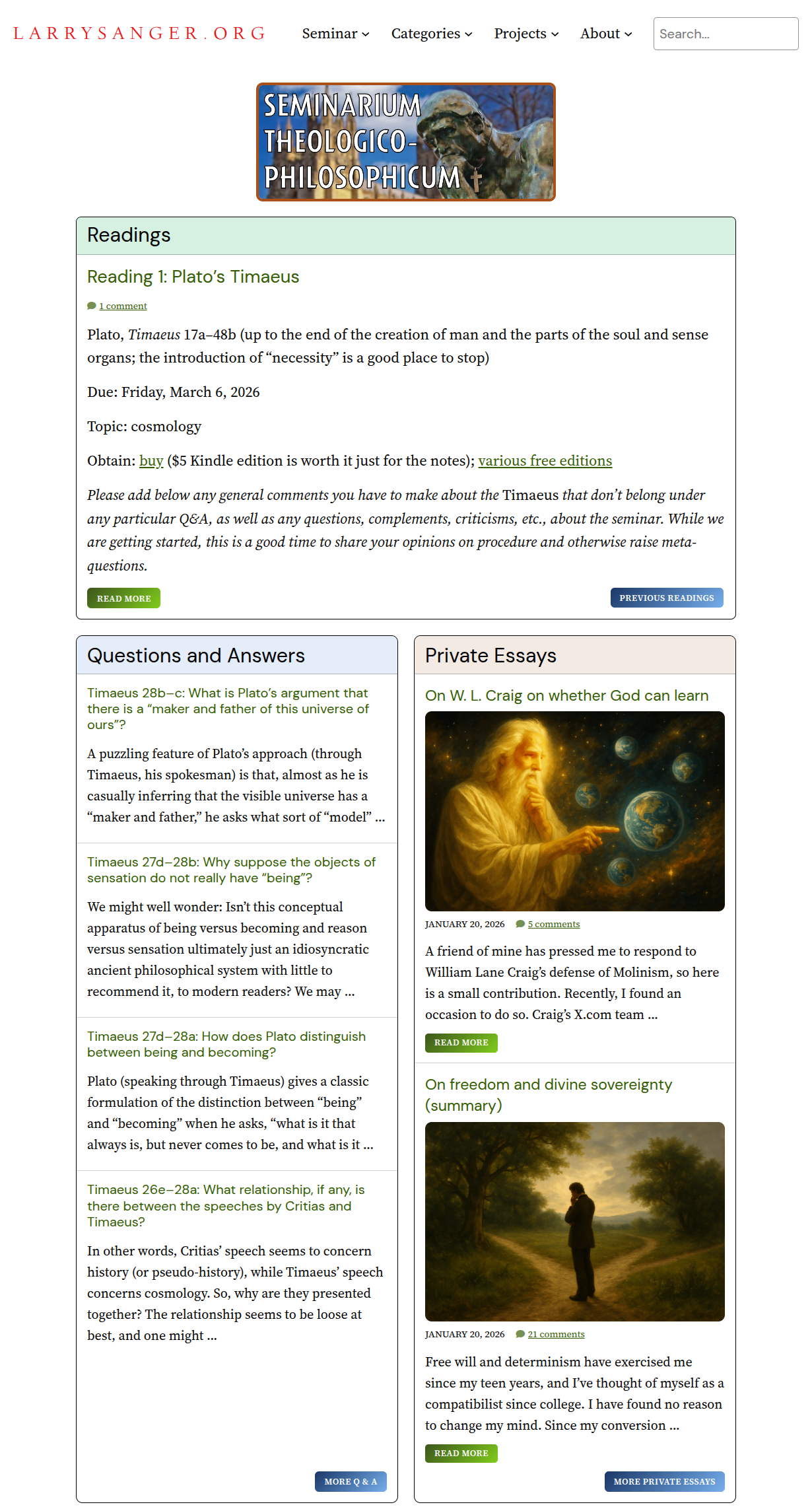
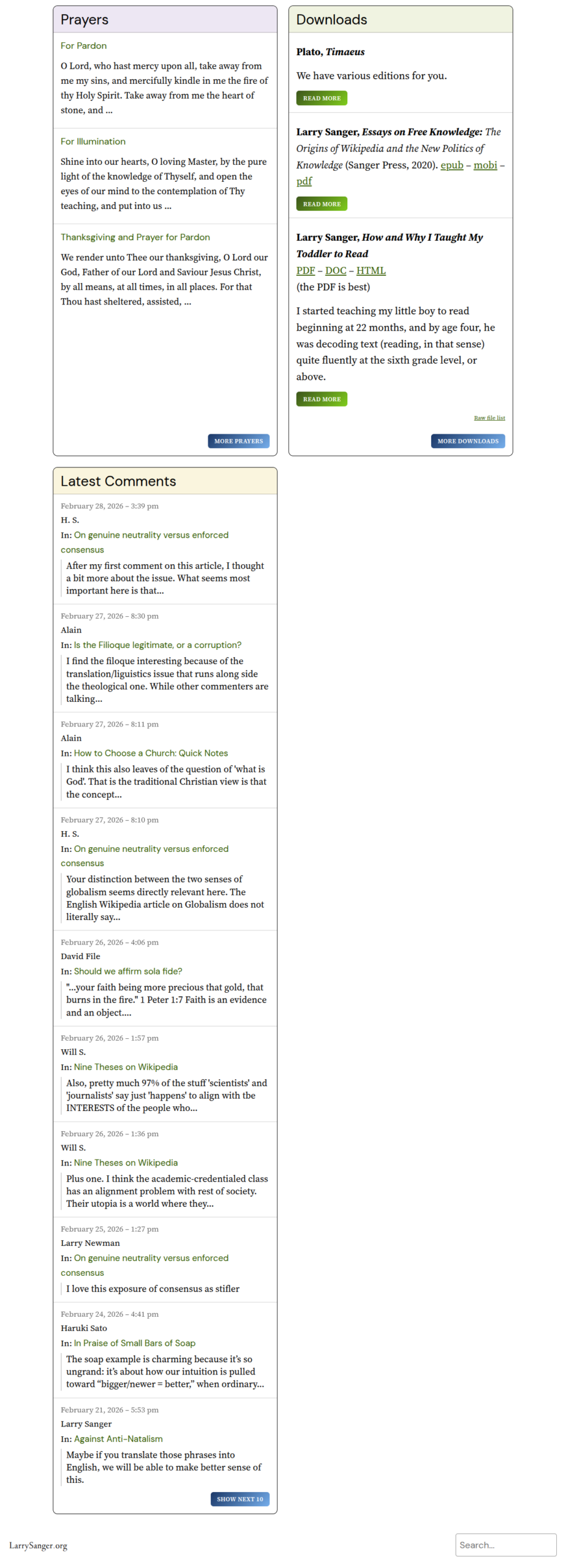
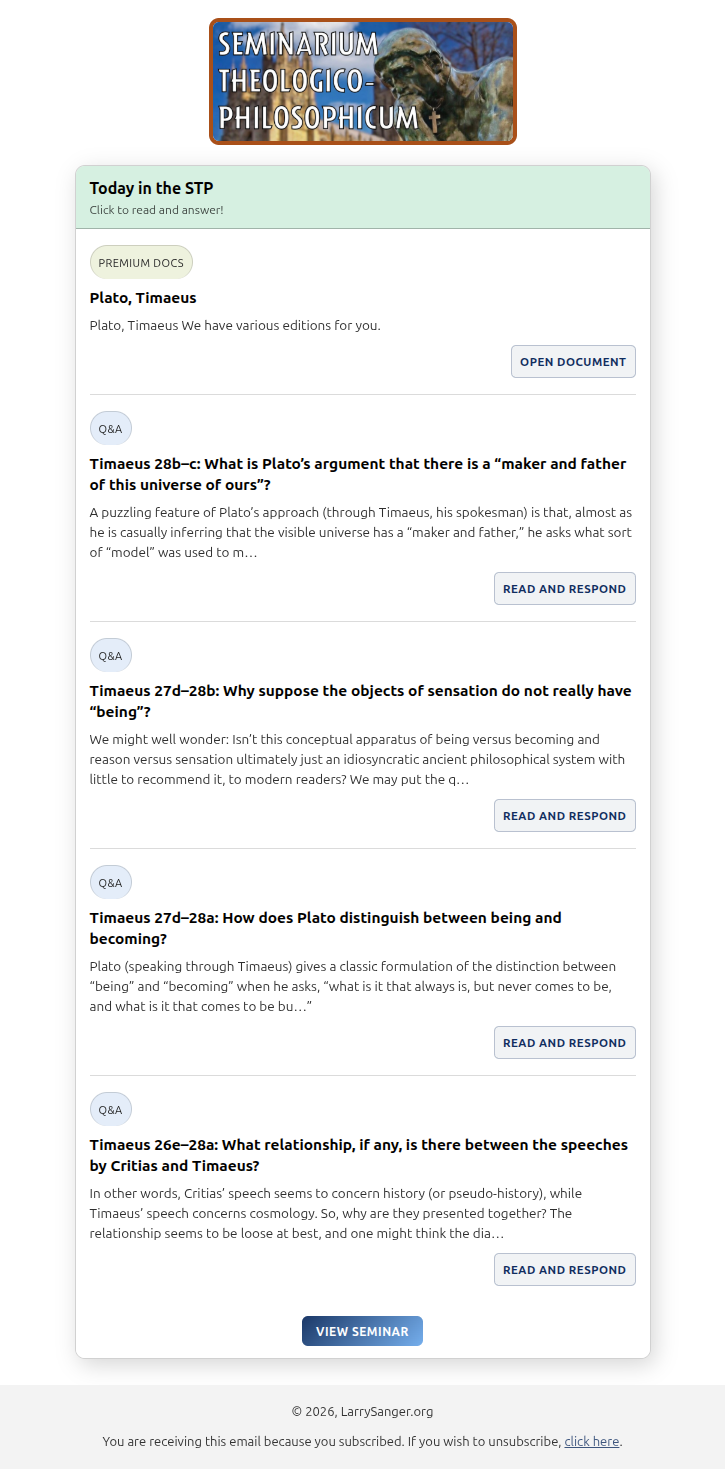
- Front page (March 2): page 1, page 2
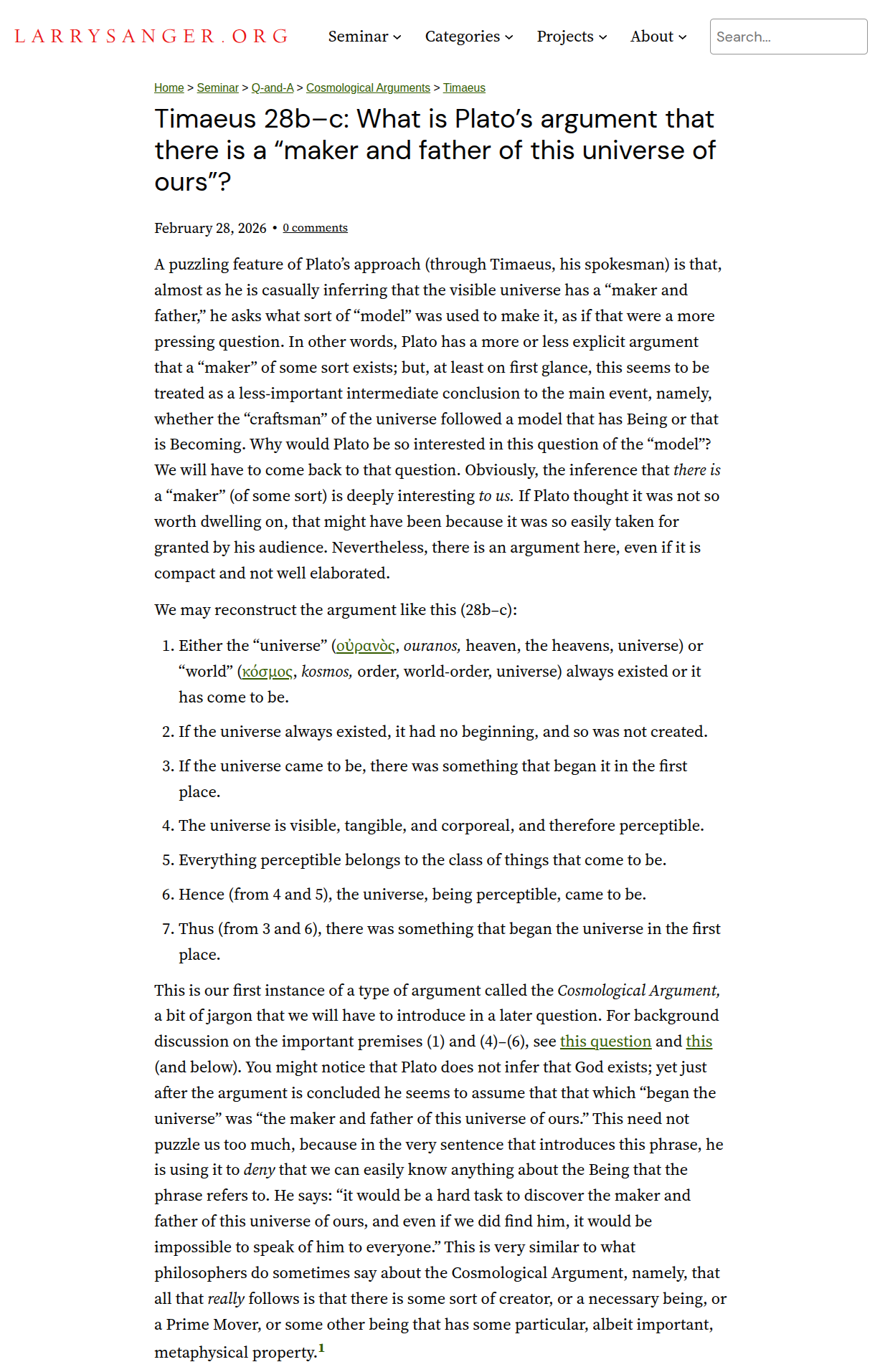
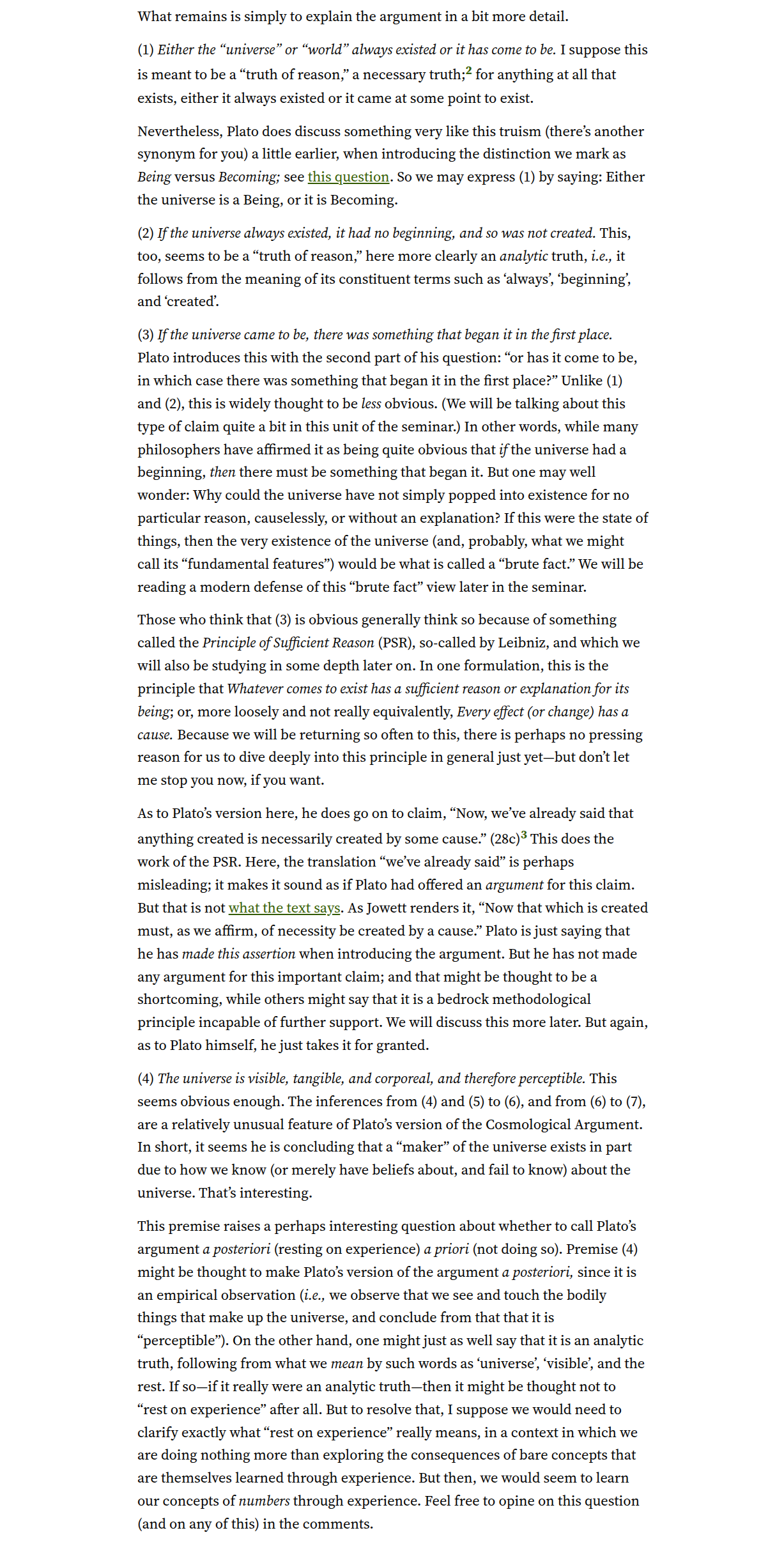
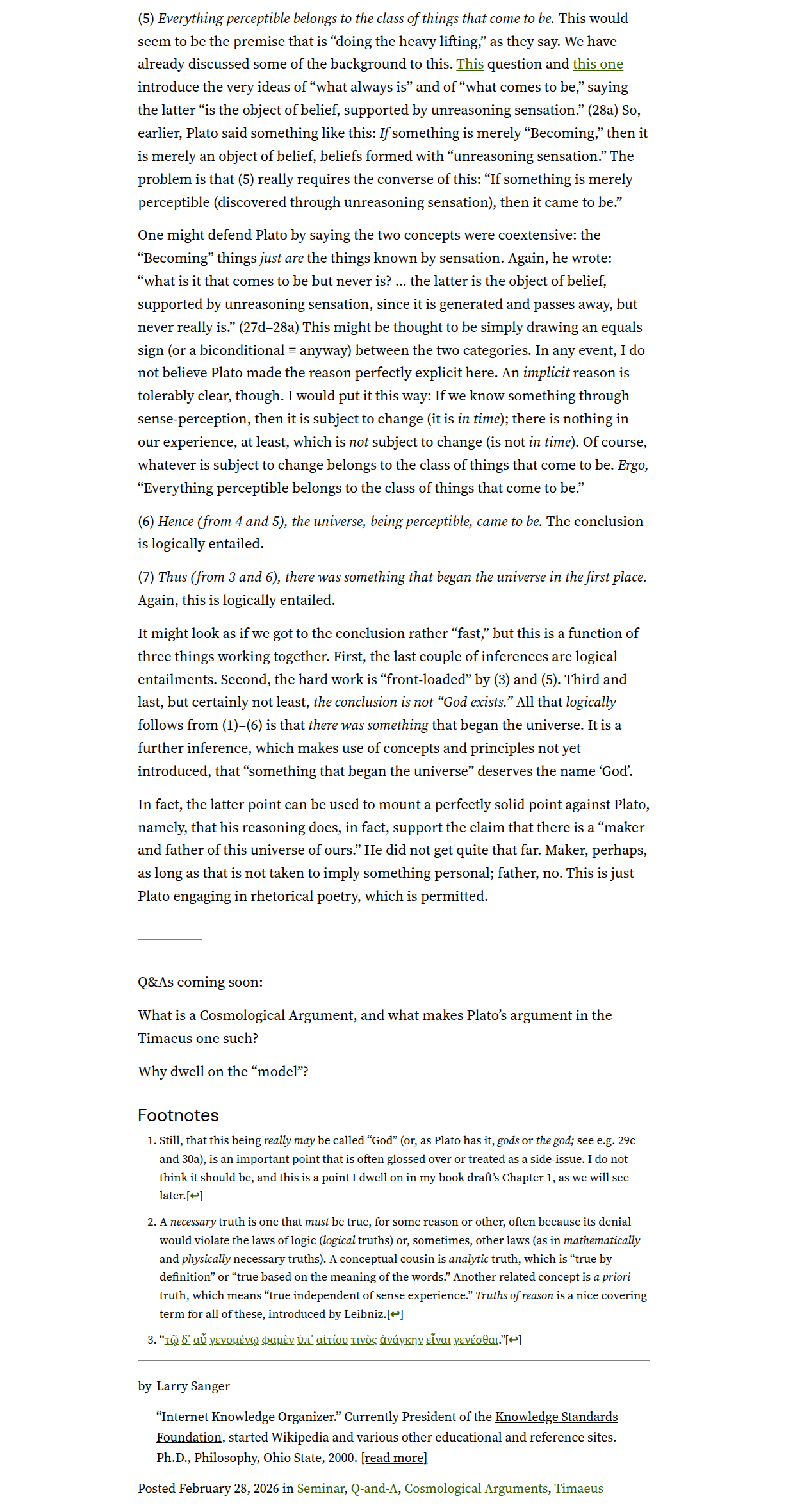
- Question and answer: page 1, page 2, page 3 (Timaeus 28b–c: What is Plato’s argument that there is a “maker and father of this universe of ours”?)
How long will this last?
Probably over a year; there is a lot of material. I will be able to estimate better after a few months. But we are going through philosophy of religion topic-by-topic, reading the classic texts concerning each topic; then we will be doing something similar with related topics in the more philosophical and apologetic issues of theology. It will take me well over a year to go through all this material, I reckon, especially if I am writing answers to hard questions (not just reading).
What work is required in this seminar?
None. I do hope you will answer questions yourself, but I’m not going to be checking if you’ve done the reading, evaluating your answers, or handing out grades. Think of this not so much as a course as a serious reading group. You’re also welcome to write essays, and if enough people do that, I might well create a special section of the seminar for that (guest papers).
What level is this pitched at?
Advanced undergrad to graduate. Basically, it will help have some history of philosophy, analytic philosophy, and basic theology under your belt; while philosophy of religion is not required, that would help. It might be difficult if you’ve never studied philosophy before.
What are my qualifications to lead this reading group?
Philosophy B.A. (Reed College), M.A. and Ph.D., Ohio State (2000), with specializations in Epistemology and Early Modern Philosophy. My extensive training in the history of philosophy has made me a close reader of texts, and this seminar will be strongly historical in focus. My interest in Philosophy of Religion goes back to childhood; I taught the subject in 2003–05. Since my conversion in 2020, I have spent thousands of hours reading and writing on the Bible, theology, philosophy of religion, and philosophical theology, covering much of the content of an M.Div. Where relevant, I will also draw on my substantive study of Greek, Latin, French, and German. My main content offering here is in the form of Q&As; I have practiced my strategies for both asking and answering questions through well over 1,000 pages of Q&As about David Hume, Thomas Reid, the books of Genesis and Matthew, and others.
Where do I learn more about the seminar itself?
For syllabus-type details, see the seminar plan.
How responsive do you plan to be to member suggestions?
Following participant advice is the way online communities thrive, so I will try to use all widely-supported suggestions whenever I can. I reserve the right to follow my own vision, though.
What’s the cost?
Currently, it’s $10 per month or $100 per year if billed annually (a $20 savings).
Is there a free trial?
Try it free for three days. Unsubscribe easily anytime.
How are you handling the business end of things?
Stripe handles payments. All of the account pages, emails, and so forth related to your subscription are professionally done by a WordPress add-on. I have no Patreon or Substack accounts.
Footnotes
- It’s a cheeky reference to one of Spinoza’s works, the Tractatus Theologico-Politicus.[↩]
- This number is updated daily. From February until May 2026, this entailed an average of ~1100 words per day. This number does not include posts not in the “Seminar” category, none of the seminar participant comments or my replies thereto, and none of the “premium documents.” In short, I’m working pretty darned hard for seminar members![↩]