One of the Nine Theses on Wikipedia series
☞ Read this essay on Wikipedia.
☞ Comment on Wikipedia. (And elsewhere on Wikipedia.)
☞ You can also leave comments below.
4. Revive the original neutrality policy.
In short, Wikipedia must renew its commitment to true neutrality. The present policy on neutrality [a] should be revised to clarify that articles may not take sides on contentious political, religious, and other divisive topics, even if one side is dominant in academia or mainstream media. Whole parties, faiths, and other “alternative” points of view must no longer be cast aside and declared incorrect, in favor of hegemonic Establishment views. Solid ideas may be found in some of the first policy statements, including the first fully elaborated Wikipedia policy [a] and the Nupedia policy of 2000. [a]
Note: The first four theses all concern different aspects of neutrality. This involves some repetition and expansion of analysis, because the issues involved are so central and important.
The Problem
The original Wikipedians loved and practiced neutrality in the early days, but many Wikipedians later came to repudiate it entirely. The original and ordinary notion of neutrality is, simply, that when an article mentions a topic of controversy, it should be impossible to tell what position the article authors take on the controversy. In short, Wikipedia should not take sides. This is how I put it in my last draft [a] of the “Neutral point of view” policy page in January, 2002: “The Wikipedia policy is that we should fairly represent all sides of a dispute, and not make an article state, imply, or insinuate that any one side is correct.”1
The “Neutral point of view” [a] policy page now starts this way: “All encyclopedic content on Wikipedia must be written from a neutral point of view (NPOV), which means representing fairly, proportionately, and, as far as possible, without editorial bias, all the significant views that have been published by reliable sources on a topic.” Further down, we read: “While it is important to account for all significant viewpoints on any topic, Wikipedia policy does not state or imply that every minority view, fringe theory, or extraordinary claim needs to be presented along with commonly accepted mainstream scholarship as if they were of equal validity.”
I have some questions for the more recent Wikipedians who advocate the newer policy:
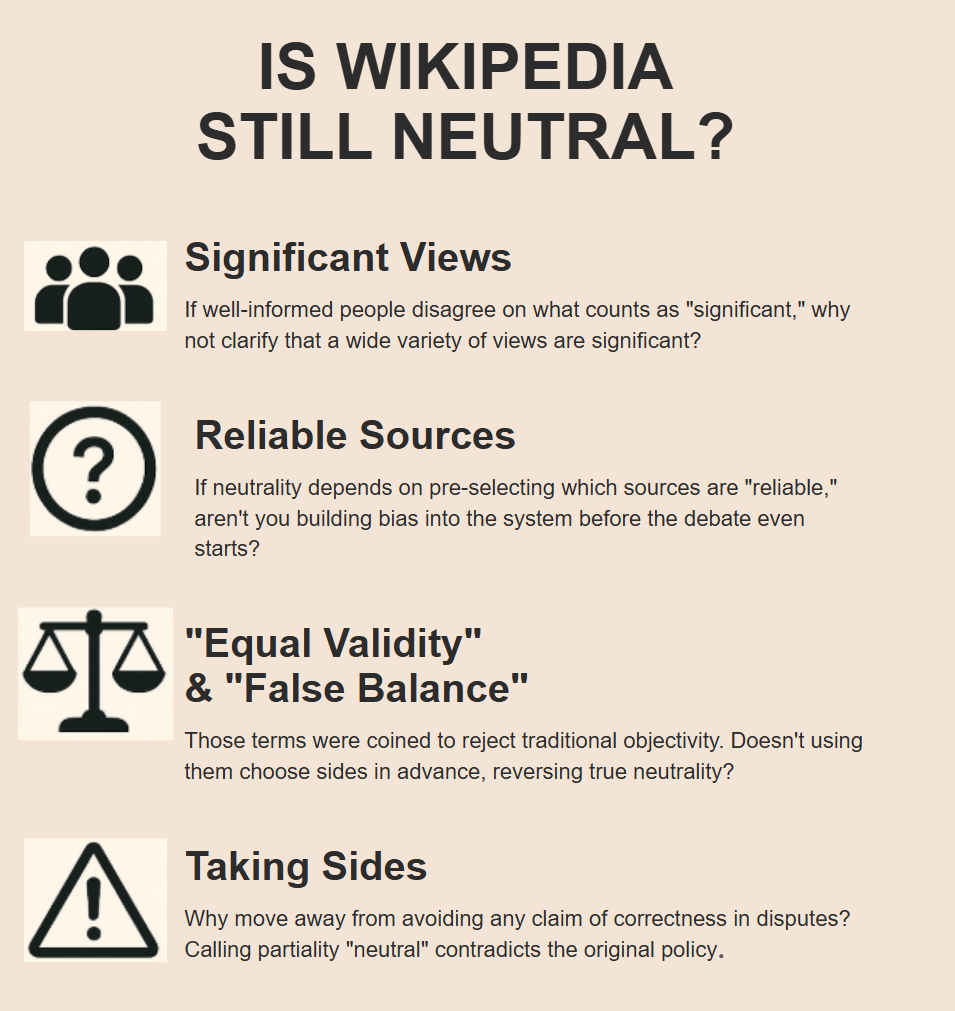
- You refer to “significant views.” Very well. But you Wikipedians do realize that well-informed people can disagree about whose views are “significant”—don’t you? Therefore, why do you not clarify that a wide variety of views are, in fact, “significant”?
- Again, you speak of “reliable sources.” Have you really made neutrality itself dependent on some prior notion of which sources are reliable? Different worldviews disagree sharply about what sources are reliable. Surely you know that. If you start declaring, in advance of any consideration about neutrality, that certain sources are unreliable, you inevitably make the entire encyclopedia biased. Do Wikipedians really not realize that—are you only pretending to be naïve, or do you embrace the bias openly?
- You now say you want to avoid giving “equal validity” or “false balance” to competing views: Really? Such jargon was introduced by ideological journalists in the late 1990s, in order to openly reject traditional ideas of journalistic objectivity or neutrality. To speak of “equal validity” and “false balance” is precisely to pick winners and losers regardless of how views are found in the general population. Such a practice is, therefore, the reverse of neutral.
- Finally, what happened to the language focused on disputes, and in particular about not representing any one side as correct? Surely Wikipedia still wants to avoid taking sides in controversies. Yet it seems Wikipedia now officially permits, or perhaps requires, taking sides on hotly debated issues, and even calls doing so “neutral.” Don’t you know that this directly contradicts the original neutrality policy?
Doubtless, these are uncomfortable questions for Wikipedians. They should be.
Just as you might expect from a reading of the updated policy, Wikipedia is now full of bias. Generally, this takes two main forms: casting aspersions on disliked politicians, institutions, ideas, etc., in a way that essentially means taking one side in a dispute; and omitting essential information with the same effect. Let us get some examples on the table:2
- For four months last year, Wikipedia had a page titled “Grooming gang moral panic in the United Kingdom,”3 about the (mostly Pakistani) gangs in Rotherham and other British towns that primarily preyed4 upon teenage girls. Despite the easily established fact that tens of thousands of girls had been raped, often with no consequences for their rapists, Wikipedia reduced it to a “moral panic.” This outrageous coverage by Wikipedia was reported in turn by Unherd [a] and GBNews, [a] after which, the article was retitled. Even if the seriousness of the criminal activity were merely a “moral panic,” it would not be Wikipedia’s place to make up the reader’s mind about such a controversial question, and certainly not in the article title. Have these people no shame?
- The article about the God of Christianity and Judaism, titled simply “Yahweh” [a] (with no further parenthetical clarifier), defines its subject like this: “Yahweh was an ancient Semitic deity of weather and war in the ancient Levant, the national god of the kingdoms of Judah and Israel, and the head of the pantheon of the polytheistic Israelite religion.” You read that right. Yahweh, also called Jehovah or the LORD in your Bible, was—not is—“the head of the pantheon of the polytheistic”—yes, pantheon, and yes, polytheistic—“Israelite religion.” Because, as apparently every single Bible scholar has agreed since, maybe, the 1990s, “Israelite religion” was originally polytheistic. So, no one else’s views on that need to be mentioned in a neutral article titled “Yahweh”! I hope my sarcasm is evident. The academic provincialism is truly risible. But seriously, this is merely the view of secular religion professors. Many serious religious Bible scholars, with deep knowledge of all aspects of Bible study, naturally disagree; their seriously-held and -defended views are quite simply ignored, as if they did not exist. (See Thesis 2 for more on this example.)
- On Wikipedia, there is no such thing as cultural Marxism; there is only the “Cultural Marxism conspiracy theory,” [a] which is, according to the article, “a far-right antisemitic conspiracy theory that misrepresents Western Marxism (especially the Frankfurt School) as being responsible for modern progressive movements, identity politics, and political correctness.”5 The problem here is that to dismiss the discourse surrounding “cultural Marxism” as a “conspiracy theory” is to dismiss it as obviously wrong, when, in fact, many serious philosophers and other scholars are capable of giving the analysis a lengthy, detailed defense. The bias appears even in the title of the article. The article goes out of its way to associate this “conspiracy theory” with white supremacism, even poisoning the well by linking it to mass murderer Anders Breivik. In short, suffice to say that this article takes a hysterical position on a greatly controversial topic. I am not the only one to say this about the article; there has been an ongoing controversy about it.6 A neutral article would include attacks, defenses, and rebuttals on both sides.
- In the first few years after the emergence of the COVID-19 virus, Wikipedians refused to allow any suggestion that the virus originated in a “lab leak,” often meaning a laboratory in Wuhan, China. Depending on the specific article, they either banned mention of the theory or labeled it a “conspiracy theory,” as a 2021 CNET article [a] reported. Even in 2021, there was significant mainstream scientific discussion [a] of the lab leak theory.7 Hence, Wikipedia had taken a stand on what was an increasingly controversial question. That exhibits bias. Today, mainstream scientists regard the lab leak theory as highly plausible but still unproven—with many thinking it most likely. But Wikipedia? Ironically, one might argue that Wikipedia has ignored the evolving consensus. Wikipedia does not even report about the controversy, but continues to take one definite position: it “was derived from a bat-borne virus and most likely was transmitted to humans via another animal in nature, or during wildlife bushmeat trade” (“Origin of SARS-CoV-2,” [a] June 26, 2025). Thus, Wikipedia rejects neutrality on the topic altogether, claiming, “While other explanations, such as speculations that SARS-CoV-2 was accidentally released from a laboratory have been proposed, such explanations are not supported by evidence.”
- Generally, disapproved political figures and commentators are often described dismissively, in ways their supporters regard as false or misleading. In short, Wikipedia takes sides on partisan politics. There are many examples. Here are just a few, collected in 2023: “Trump promoted conspiracy theories and made many false and misleading statements during his campaigns and presidency, to a degree unprecedented in American politics.” (“Donald Trump” [a]) Obviously, neither the president nor many of his supporters would agree that he has made “many false and misleading statements”; the Wikipedia article expresses the opinions of his mostly Democratic opponents. Another example: “Dinesh Joseph D’Souza […] is an Indian-American right-wing political commentator, author, filmmaker, and conspiracy theorist.” (“Dinesh D’Souza” [a]) One doubts D’Souza would call himself a conspiracy theorist; this is a dismissive and obviously controversial claim made in Wikipedia’s own voice. “[Candace] Owens has claimed that the effects of white supremacy and white nationalism are exaggerated […] and promoted misinformation about COVID-19 vaccines.” (“Candace Owens” [a]) As she is a black woman, it is especially silly to state, in Wikipedia’s own voice, that she thinks “the effects of white supremacy and white nationalism are exaggerated”. One wonders: How would Owens or her defenders respond? This was not clarified.
- In the last few years, both Hindus and Jews have reached out to me with complaints about unfair treatment of their entire ethnic groups by Wikipedia. To be clear, I cannot say—as I told them both, repeatedly—without deep study, that their complaints are quite warranted. Still, individual examples and patterns they claim are very plausible and consistent with a third case: Wikipedia’s dismissive and sometimes hostile treatment of confessional (traditional, orthodox) Christianity. For their part, Jews and Hindus have a remarkably similar pattern of complaint against Wikipedia. Their critics on Wikipedia, both groups say, wholly ignore their perspectives on historical and recent events, exaggerate their opponents’ criticisms of their politicians and government actions, and blacklist [a] media sources that take their side in ongoing disputes (such as the Anti-Defamation League and Jewish Virtual Library for the Jews and OpIndia and Swarajya for Hindus).8 If such complaints bear out, it is not too much of a stretch to say that Wikipedia’s bias is both antisemitic and anti-Hindu, as well as anti-Christian.
- Perhaps the easiest way to find examples of pronounced bias on Wikipedia is to list certain Culture War issues. In particular, whenever defenders of Establishment points of view most stridently criticize their opponents, you can expect the corresponding Wikipedia articles to be quite biased. So, some unsurprising examples of overt or extreme bias include: Misinformation related to the COVID-19 pandemic; [a] Gamergate; [a] January 6 United States Capitol attack; [a] woke [concerns the word]; [a] Climate change denial; [a] Antifa (United States); [a] Alternative medicine; [a] Transgender youth; [a] Conversion therapy; [a] Drag panic; [a] Critical race theory; [a] Deep state conspiracy theory in the United States. [a] Examples of pronounced bias include: 2020 United States presidential election; [a] United States and the Russian invasion of Ukraine; [a] White privilege; [a] White genocide conspiracy theory; [a] Men’s rights movement; [a] Drag Queen Story Hour; [a] Moral panic; [a] Blue Lives Matter; [a] Gender-critical feminism [i.e., TERFism]; [a] Christian nationalism. [a] What these articles have in common is that they strongly embrace a single (“woke” or Establishment) viewpoint or narrative framing of a hotbutton Culture War issue.9
In general, the point is that Wikipedians presently see nothing whatsoever wrong with taking sides on serious controversies. If you are late to the party, you might wonder: “How can this be? Wikipedia has a neutrality policy. Do they think the above are all examples of neutral writing? How can they?”
Let us take a step back now and try to understand what is going on at a deeper level. To this end, we must dwell on another problem that the neutrality policy page (“WP:NPOV” [a]) presents. This will be a little abstract, but that is a feature of the very concept of neutrality, and this abstraction is essential to my point—so, stay with me, please.
It is obvious (and well discussed [a]) that if we praise some writing as “neutral,” we mean it does not take a position among some set of hypotheses, policies, doctrines, opinions, etc.10 To this extent, we may concede that neutrality is a relative concept: some text can be neutral relative to one set of opinions (say, the range of Christian views on God) but not another (such as Hindu views). In other words, the text can be evaluated with respect to different scopes.
Next, let’s explore an example. An article in a specialized encyclopedia, say about American politics, might discuss owning firearms as a civil right, which it is—under the Second Amendment of the U.S. Constitution. Suppose the article goes on to cover what sorts of restrictions, if any, it is appropriate to put on this right. Such an article is not necessarily biased in favor of such a right, just because it takes it for granted, when the context is the American system; or you might say the whole encyclopedia is “biased” in favor of American politics, but that is just how this particular encyclopedia is labeled. But the same verbiage in an encyclopedia of British politics would be obviously biased, because in that context, a right to own firearms is currently rejected.11 The American verbiage would seem strangely biased in a British context.
Now, look back at Wikipedia’s policy language: Wikipedia articles must represent “all the significant views that have been published by reliable sources on a topic.” The phrases “significant views” and “published by reliable sources” have a special function: they restrict the scope. The example I just gave illustrates the idea of scope with American and British politics. Now, Wikipedia implies, quite correctly, that it cannot attempt to represent all views of a subject. That would be unrealistic; there are many cranks in the world, after all. But, if we must restrict the scope of our discussion, then which views are “significant,” and which sources “reliable”?
When we dig into how Wikipedia handles those questions, we find deep problems, as well as a precise way to diagnose Wikipedia’s bias problem.

Wikipedia, for the last several years, has become increasingly opinionated about which views are “significant” and which sources are “reliable.” The examples of bias discussed above mostly reflect strong opinions that certain views are, indeed, “insignificant.” As it happens, we can handily encapsulate the views that Wikipedia finds “significant” as a particular combination of outlooks: globalist, academic, secular, and progressive, or GASP for short. I introduced this GASP analysis in the discussion of Thesis 2. Here, we will document it more fully, using Wikipedia’s own sources. It is not hard to show that Wikipedians strongly approve of their own GASP framework.
1. Globalist
The term globalism now has two conflicting senses.
According to one innocent and virtuous sense, ‘globalism’ involves tolerating and even promoting cultures from around the world, without favoritism. Wikipedia was globalist in this sense from the start, in the interest of peace and education. But a second sense involves giving global prominence to certain powerful international institutions—major NGOs, multinational corporations, universities of global influence, etc.—as well as the ideas and culture of Western elites. What makes this “globalist” is that such institutions and culture are imposed, from above, all across the globe through organizations like the United Nations.
Now, the English-language Wikipedia does make an attempt to document knowledge of the whole world, not just the English-speaking world. At the same time, it admits in its own oft-cited “essays” that it has a pro-Western “systemic bias” [a]; this is borne out by studies cited in the Wikipedia article about itself.12 Wikipedia’s notions of the views that are “significant” align fairly closely with those of globalist institutions such as the U.N., the World Economic Forum, and the World Health Organization; and it is no exaggeration to say that the green-colored items on the infamous “Perennial sources” [a] list are, to a very great extent, “globalist” in the second sense (cf. Thesis 3).
2. Academic
In issues where the academic mainstream differs from popular, religious, and other views, the academic views are presented as factual and are asserted in Wikipedia’s own voice, i.e., typically without being attributed to particular representatives. In articles on broad topics, contrary views—regardless of how common, and even if they have many academic representatives—might be ignored or treated only insofar as they are studied as subjects of “objective” analysis from a mainstream academic point of view.
The Wikipedia “essay” titled “Academic bias” [a] well represents the project’s prevailing attitude. In its introductory paragraph, we find: “This essay discusses why Wikipedia has, and should have, a pro-academic ‘bias’.” The scare quotes around “bias” are telling. They claim further down that “a pro-academia bias is no violation of WP:NPOV.” This is all strictly ludicrous, since academe as such certainly can be biased; there is strong odor of deliberate, studied naïveté throughout the essay.
In its mainstream academic triumphalism, it is as if Wikipedia were merely pretending to be entirely unaware of quite open political and other biases rife in academe, of the faddishness of science, of the irreproducibility of much academic research, or of the other well-known foibles of academia, such as incompetence, dishonesty, and irrationality.
3. Secular
The Wikipedia “Neutral point of view” [a] policy section about religion [a] makes it clear that Wikipedia by official policy opposes the presentation of religious views in any sympathetic way. Rather, religion articles should both “encompass what motivates individuals who hold these beliefs and practices” (in other words, psychologizing) and “account for how such beliefs and practices developed” (in other words, giving a naturalistic explanation of religious belief).
The section actually argues at some length against those who “object to a critical historical treatment of their own faith because in their view such analysis discriminates against their religious beliefs.” In Bible studies, the historical-critical method involves ruling out of court, as a point of methodology, all supernatural claims. Thus, by policy, Wikipedia practices methodological naturalism. As the Wikipedia article [a] states, “Methodological naturalism is an approach taken from the natural sciences that excludes supernatural or transcendental hypotheses from consideration as hypotheses.” As a result, Wikipedia’s articles on religious topics include many claims made in its own voice that straightforwardly assume that religions are false, based on naturalistic assumptions common to the secular study of religion.13
4. Progressive
The one component of GASP bias that some Wikipedians will not so easily admit to is a progressive bias. We could give a long list of examples of progressive bias found in Wikipedia; we gave some above, and I had already [a] done [a] that [a] on my blog. I am not, of course, the only one to say so. Wikipedia has a long article on “Ideological bias on Wikipedia” [a] (don’t expect it to be particularly unbiased, though). And there have, of course, been many academic studies, which generally show the obvious: Wikipedia does indeed exhibit various, including ideological, biases.14
Much of this bias appears to be decentralized and uncoordinated. But high-level coordination appears to be part of the explicit aim of the Wikimedia Foundation itself (the WMF is the nonprofit that hosts Wikipedia). In 2017, Katherine Maher, then the CEO of the WMF, re-imagined the nonprofit’s mission as “top-down social justice activism and advocacy,” as journalist Ashley Rindsberg described it.15 This is the so-called Movement Strategy, [a] or Wikimedia 2030, which posits [a] that Wikipedia is a “social movement” that stands for “social ideals” and “social progress” toward “a more just and connected future.” This is typical bureaucrat-speak, which means, essentially: We’re going to push progressivism harder.
It is hard to believe, but it’s true: Maher came out and said openly [a] that she had come to oppose the “free and open” principles of Wikipedia, because such principles facilitate an offensively “white male Westernized construct of who matters in societies…”. The irony is profound.16 Maher was speaking in 2017, just as BlackRock, State Street, and others began using DEI (Diversity, Equity, Inclusion) metrics in ESG (Environmental, Social, Governance) voting policies. The impulse to push all things progressive was very much “in the air” at the time. And if the excesses of DEI have moderated somewhat in the last year or two, Wikipedia’s biases have not moderated at all.
In short, according to Wikipedia’s present rules and practices, the range of acceptable views—called “significant” in the verbiage of the policy page—are those of the Establishment, particularly the Western-globalist, academic, secular, progressive Establishment. Similarly, acceptable sources are only those academic works and news articles of “reliable” sources, which express what can be called an Establishment view. So, if the GASP view is univocal, it may be stated, by Wikipedia, as fact, and in its own voice. It simply does not matter if significant portions of humanity disagree; they may be disregarded or relegated to contemptuous dismissal as “fringe,” “extreme minority,” “pseudoscience,” and the like. In short, Wikipedia is now biased in many articles, and by policy.
How things have changed. When I was there and for several years afterward, Wikipedia was criticized mainly because it made an intellectual home for the eclectic, the amateur, the offbeat, and the foreign. At the time, I myself thought it needed to be more serious, even while retaining our eclecticism. I remained a supporter for a time even after I left, and many people loved the plucky, growing project and celebrated it for precisely how it dealt with so much quirkiness in an open way. The suggestion that Wikipedia would ever become a key mouthpiece of a future Establishment would have been outrageous and implausible. We worked hard to accommodate voices and perspectives from many different countries, religions, ideologies, etc.; I thought that was a difficult ideal to implement, and I wondered how that would play out in the long run.
It is very disappointing to me that it worked out as it did. I strongly suspect the platform was deliberately captured, though the insider stories remain to be told. Regardless, the platform was turned against its own former purposes. We wanted to give a voice to the voiceless, but what emerged was one of the most effective organs of Establishment propaganda in history. The suggestion that it would be focused on an exclusively and unapologetically “globalist elite” perspective would have been both implausible and offensive.
The Reasonable Solution
It would still be eminently reasonable—and laudable—for Wikipedia to embrace wholeheartedly its original, quirky neutrality.
I urge Wikipedians to return to the higher and more demanding standards of the website’s original intellectual tolerance. They must recommit themselves to genuine neutrality. These were higher standards because they took the ideal of neutrality much more seriously. They were more demanding because they permitted a wide variety of views to be expressed.
Frankly, invested ideologues will probably fight this tooth and nail. But tolerating a wider range of views (and sources) is not impossible. We merely need to ensure that views not in line with the GASP view are not dismissed as “false,” “misinformation,” “pseudoscience,” and the like, and are properly detailed and attributed. An improved Wikipedia, true to its roots, would not claim in its own voice that false statements are false, unless there is universal agreement (an extreme rarity). Rather, it should state, in its own voice, that one group holds a certain view, while another group—perhaps described as distinguished experts at leading universities—disagrees.
Rational decision-making requires that readers be provided an unusually wide variety of views to consider. They must be given tools to make up their own minds. Neutrality liberates the individual; that is its purpose. By manipulating public opinion, Wikipedia in its present form has twisted neutrality into its opposite.
Imagine a Wikipedia that appeals to the different, the “other,” the square peg, and the disenfranchised. Imagine it is not vanilla, global, and safe (in the West). Imagine how vital and interesting Wikipedia would be if it became a repository of a wide variety of views, not focusing just on whatever we are supposed to believe according to the GASP experts at Western universities, thinktanks, and newsrooms. Do you want Wikipedia to become more widely respected again? That is how to make it so.
How Wikipedia’s original neutrality policy worked
An old-fashioned global audience
Strict neutrality (as I am now calling it: the original kind) does not privilege any one type of audience. While it is written in the target language, it goes out of its way to write explicitly for all readers, acknowledging a wide variety of backgrounds. As such, it must not presuppose a Western-educated background.
Therefore, it should provide either explanations that are well-chosen to be comprehensible to people from across many cultures, or it should explicitly introduce the topic for the sake of different people, acknowledging that (for example) American, Indian, and Chinese nationals frequently have particular blind spots. In a wide-ranging and neutral article on “God,” therefore, special attention would need to be taken to unpack the idea of impersonal divinity (for Americans), exclusive monotheism (for Indians), and a sharp creator-creature distinction (for Chinese nationals). Wikipedia in its current form privileges the common views of educated progressive Westerners and really does not bother to explain things to others—even, sometimes, the fundamentals of the topics supposedly being introduced.
Allow primary sources to be widely used
Wikipedia policy, as practiced, discourages many legitimate uses of primary sources. Often, editors allow information only that appears in secondary sources, keeping articles from achieving the highly granular level of detail they could have. A humorous example of the narrow-mindedness of Wikipedia’s policy on primary sources goes back many years: Jimmy Wales was born on August 7, according to his mother, but according to his birth certificate, the date is August 8. The latter was a mistake. But Wikipedia refused to correct the mistake, regardless of what the ultimate primary source on the matter—Jimmy Wales’ mother—clearly stated.17
I know why Wikipedians have this animus against primary sources: using them is a little too much like “original research.” But, as the author of Wikipedia’s original research policy—which it inherited from Nupedia—I can tell Wikipedians that the policy was meant simply to prevent people from posting to Wikipedia the sorts of theories that need peer review. But once a paper or book has been published by a reputable press, and especially if it is reasonably well-cited, I never would have stood in the way of it being referred to in an article. In many cases, primary sources ought to be regarded as the gold standard for citation. Discussion in secondary sources is an adequate but not necessary way to avoid being “original research.”
Scrap the needless additions to “reliable sources”
As I stressed in Thesis 3, a great many of Wikipedia’s core tenets about “reliable sources” need rethinking, because their evident purpose is excessively restrictive. I will approach the issue from a slightly different angle here.
The snobbery about reliable sources in journalism must be scrapped. There is an enormous wealth of valid information found in second- and third-tier sources, and non-English sources; I have no problem even with blogs, or even tweets, depending on their authors’ relevance and they are who they say they are. Obviously, however, when one makes use of a source that has a particularly embarrassing track record of errors—say, The New York Times—it is important to note the source’s alleged biases or limitations,18 particularly if it is the only one reporting some alleged fact.
The wrongheaded analysis of reliable sources ultimately fails to notice that Wikipedia is only an aggregator of alleged knowledge, which, when speaking on behalf of large, diverse groups, is the only kind of knowledge we can agree upon. A genuinely global information resource must represent an open bazaar; you might find treasures, but caveat emptor. So, neutrality means accepting a very wide variety of sources, but being more aggressive about attributing claims, especially when others disagree with or doubt the claims. Wikipedians must not pretend to be ignorant of the fact that people do debate about sources, after all, and which can be cited. That means that sources making disputed claims cannot be cited in Wikipedia’s own voice; they must be explicitly attributed to the source.
Minority, weird, and “fringe” views
One particularly annoying thing that Wikipedians have started doing is to declare, in Wikipedia’s own voice, that certain claims are “false,” that certain theories are “fringe” or “pseudoscience,” that certain people are (unadmitted) “conspiracy theorists,” and so forth. (See the longer list of pejoratives below.) They are essentially aping the “advocacy journalism” practices of the mainstream media.19 This is obnoxious and offensive, not because we should take weird theories and cranks seriously, nor because the truth is relative, but because anonymous Wikipedians should not presume to declare what the whole world must believe. This is especially true after they have cherry-picked “reliable sources” to fit narrow Western Establishment narratives. Such a practice is precisely against the neutrality policy; nothing could be more obviously against it. Let the people make up their own damned minds.
Now, when large groups (as, for example, astronomers talking about the Flat Earth theory) feel it is crucial to label something as “pseudoscience,” then by all means, report this fact: “The common view among the academic and scientific research community in Astronomy is that the Flat Earth theory is nothing more than pseudoscience.” But in that case, it is not Wikipedia that has made the claim, but astronomers.
It is also very important not to declare something to be a “consensus” when it is no such thing. Indeed, across all branches of academia and research, the state of the field is constantly debated and reconsidered—even things broadly taken for granted. Wikipedia does an end-run around such debate when it declares a “consensus,” as it does far too often. Falling in line with a “consensus” is just not how science advances: skepticism and testing limits is.
More generally, we human beings cannot really make up our minds rationally about some topics until we have surveyed everything that everybody is saying. If we are told that something is a matter of “consensus,” when it is not, then we will inevitably be pressured into believing something on poor evidence, which might be a half-truth or an untruth.
List of biasing pejoratives
Avoid the following pejoratives, except if self-claimed, or with attribution, and then with great care. Wikipedia generally has no business applying, in its own voice, terms including, but not limited to:
racist; sexist; homophobic; transphobic; fascist; authoritarian; conspiracy theorist; white supremacist; neo-Nazi; anti-vaxxer; far, extreme, radical + left, left-wing, leftist, right, right-wing; hate group; hate speech; climate denier; misinformation or disinformation spreader; revisionist (used pejoratively); discredited theory; extremist; alt-right; alt-left; pseudo-intellectual; cult; controversial figure (when vague); anti-democratic; propagandist; demagogue; unreliable source (without justification); ideologue; dangerous ideology; radicalized; grifter; gaslighting; dogwhistle; reactionary; globalist; elitist; science denial; quackery; progressive ideologue; neo-Marxist; cultural Marxist; Antifa member; anarchist; utopian; class warrior; race-baiter; DEI advocate; cancel culture proponent; political correctness enforcer; identity politics advocate; woke; collectivist; Maoist; Marxist; communist; marginal figure; intersectionalist; nanny statist; redistributionist; toxic masculinity; election denier; bigot or bigoted; Islamophobic; ableist; xenophobic.
Also, avoid unattributed words about factual claims, theories, etc.:
true; false; misinformation; debunked (when not properly attributed); unfounded; unsubstantiated; refuted; baseless; disproven; discredited; nonsense; irrational; myth (when used dismissively); hoax (unless exposed and truly universally regarded as such); junk science; outlandish; irresponsible; disgraced.
As long as these lists are, they could easily be extended. To be clear, there is nothing inherently wrong with using such terms; but, as used on Wikipedia today, they often express controversial opinions, and sometimes extremely so. As such, they must be attributed to a source.
“Majority” and “minority.”
Here is a simple principle. One of the more useful and neutral things one can say is that a certain view is the majority or the minority view, especially when speaking about academic, scientific, doctrinal, and other controversies. By saying that some allegedly discredited view is that of a small minority can often convey what is necessary to say without taking a stand on the view itself.
Report the controversy.
Another thing that must be deleted from the neutrality policy page, [a] with extreme prejudice, is this verbiage about “false balance.” As I said earlier, this is directly opposed to the neutrality policy. Consider what it means to speak of “false balance.” To declare that balancing the discussion between A and B is “false” is to declare that A is true and B is false, or vice-versa. Wikipedia’s neutrality policy was, and should again be, that when A and B are in disagreement, then you do not declare a winner. They should receive approximately equal space; not even extreme minority positions should be entirely removed from an article. Sometimes, if there are many competing opinions, it makes sense to allot space in a single article according to the approximate representation among those affected by the dispute (or, if it is an academic dispute, among academics). But this is just an imperfect solution to a hard problem, not the general rule. The best general rule is to assign equal space to competing views.
Adopt a useful set of subject-related principles.
Wikipedia should formulate what would be a rather long list of principles regarding how to approach neutrality in broad subject areas. Here are some examples:
- In American politics, articles must not favor either the Democratic Party or the Republican Party, or be written as if there were no third parties (such as the Libertarian Party, Green Party, or a new “America Party”).
- In articles about Christianity, articles must not favor Catholicism, Orthodoxy, Protestantism, critical views, or others (obviously, what counts as “Christian” is highly debated).
- In science and medicine, articles should distinguish between, on the one hand, what is widely accepted and commonly practiced in the relevant academic or professional community, and, on the other hand, what is disputed. Scientific minority views must be fairly represented with appropriate attribution. Claims of “consensus” should be avoided, unless there is a genuine, truly universal consensus, which can be established using multiple, replicable studies (which is very rare).
- In articles about social or political ideologies (e.g., socialism, libertarianism, feminism, nationalism), Wikipedia should describe those ideologies as their proponents define them, before presenting external critiques or controversies.
- In religious topics, articles should never assume that any particular doctrinal, metaphysical, or historical claims are true or false. Rather, such claims must be attributed, and other views in currency should be covered as well.
- Articles or sections about crimes or controversies should not assume or imply guilt, innocence, or the moral probity of actions, but must fairly represent both critics and defenders with appropriate sources, unless the matter has been properly adjudicated in court or other official proceedings. Even in such a case, negative conclusions are to be attributed when they are in dispute.
I can imagine Wikipedians continuing (and debating the details of) this list ad nauseam. And they should. As granular applications of the concept of true neutrality, these are principles that Wikipedians need to bear in mind and put into practice.
Epistemic pluralism: a policy of tolerance
Neutrality may be conceived of as epistemic pluralism. It must not be confused with relativism; I certainly am not relativist. Pluralism is a policy of tolerance regarding what views may be expressed; relativism is an epistemological theory, saying nothing is objectively true. There are many objective truths, in my view, and even more objective falsehoods. Yet I do not think the purpose of an encyclopedia is to teach all (and only) things I find to be objectively true. Rather, we must frankly admit that there is a stunning variety of belief on all subjects, and that it is the goal of a neutral encyclopedia—such as Wikipedia aspires to be—to survey this variety sympathetically and in detail. The purpose of such detail is to support free-thinking human beings in their quest to determine what the truth is for themselves.
My greatest grievance against Wikipedia today is its complete repudiation of epistemic pluralism. It is now used to push controversial and even shamefully deceptive opinions on the general public. Its managers have caused it to be used for propaganda. This must end. Wikipedia must return to neutrality.
But doesn’t this contradict Thesis 2?
Theses 2 and 4 present different aspects of the same problem of bias, but they propose different solutions. Thesis 2 makes room for hard neutrality as a pre-approved framework, but it also concedes that other frameworks should be added, if Wikipedia continues to employ a GASP framework. Thesis 4, however, would simply recommit Wikipedia to its original neutrality policy.
I would be perfectly happy with either approach. Thesis 2 might represent more of a live possibility, because it would allow the current editorial coterie to remain in place, at least with respect to their shared GASP framework. Thesis 4 would require that these same people change their behavior—or else leave. This strikes me as unlikely.
Whatever happens, the point needed to be made. It really would be better if Wikipedia returned to its original, higher ideal of hard neutrality. As long as it does not, it unashamedly propagandizes the bias of GASP editors, who represent a small minority. This is intellectual imperialism. We all deserve better.
One of the Nine Theses on Wikipedia series
3 responses to “4. Revive the original neutrality policy.”
-
Hi Larry, I really appreciate the time you’ve taken to write these Theses. My first experiences with the Internet were as a child in the 1990s, and I have been increasingly baffled by how the concept of Neutrality has shifted since then. It is very enlightening to read the thoughts of someone who developed early Neutrality guidelines for a prominent information source, as your Theses help to clarify why a lot of those who claim to be ‘neutral’ now behave like partisans.
-
Hi Larry — just a quick note: I noticed that on your thesis pages (#4 through #9), the “You can also leave comments below” link seems to point to the admin edit URL (e.g., /wp-admin/post.php?…#respond) instead of the public comment section (e.g., /4-revive-the-original-neutrality-policy/#respond). Looks like it might have been copied while logged in as admin. Thought you’d want to know!
-
Thanks, fixing.
-
Footnotes
- See also the Nupedia policy of 2000 (archived copy).[↩]
- For these examples, I want to thank the participants in this X thread. [a][↩]
- The article is now titled “Grooming gangs scandal” [a] and was nominated for deletion at least twice. See also Rotherham child sexual exploitation scandal. [a] Note that the thing that is worth documenting in an encyclopedia is not the scandal per se but the actual criminal activity, which continues to this day. By, in the very title, reducing these topics to the associated (merely embarrassing, or tortious) “scandals” they involve, Wikipedia leaves the reader in doubt as to whether there were, and are, in fact, patterns of organized rape of English girls. Yet that is well-established and not controversial.[↩]
- I use the past tense, but the fact is that there is much reason to think this sort of thing continues aggressively to this very year. See this speech [a] and this one [a] (by government officials) as well as this news report [a] on the launch of a new investigation.[↩]
- There are articles about the movement, of course, that do not dismiss it as “conspiracy theory.” See “Marxist cultural analysis” [a] and “Critical theory.” [a][↩]
- Critical commentary has appeared in Psychology Today [a] and in discussion forums like Hacker News. [a][↩]
- To be clear, Wikipedians defend their (frankly biased) position based on the notion that they follow the “majority of” mainstream sources. But, of course, what the “majority” of sources looks like depends on what the reference group is.[↩]
- For representative coverage of the Hindu complaints, see this Wired article, [a] this long OpIndia “dossier,” [a] and this report [a] of the Indian government asking why Wikipedia shouldn’t be regarded as a publisher. For representative coverage of Jewish complaints, see this ADL report, [a] this letter by U.S. representatives to the Wikimedia Foundation, [a] and this video; see also Ashley Rindsberg, “How Wikipedia’s Pro-Hamas Editors Hijacked the Israel-Palestine Narrative,” [a] Pirate Wires, Oct. 10, 2024.[↩]
- Another good example can be found here: Ashley Rindsberg, “Protest or Riot in LA? Wikipedia’s Editors Decide,” [a] Pirate Wires, June 9, 2025. Wikipedia invariably prefers “protest” in place of “riot” even when it’s really a riot.[↩]
- In the technical terms of logic, the concept of neutrality is scoped, or it ranges over a domain. Thus, a statement, or a whole article, is neutral with respect to a range of opinion on one or more questions.[↩]
- To be sure, there are British people who are strongly opposed to this state of affairs, and their opinions are not worthless. That just illustrates the fact that scope can shift as history shifts, and can be wider if resources—and intellectual honesty and tolerance—permit.[↩]
- Hube, Christoph (2017). “Bias in Wikipedia”. Proceedings of the 26th International Conference on World Wide Web Companion – WWW ’17 Companion. New York, New York, US: ACM Press. pp. 717–721. Also, Samoilenko, A., Karimi, F., Edler, D., Kunegis, J., & Strohmaier, M. (2016). Linguistic neighbourhoods: explaining cultural borders on Wikipedia through multilingual co-editing activity. [a] EPJ Data Science, 5, 1-20.[↩]
- To be clear, the point is not that all Wikipedia articles on religious topics assume that the religions are false. Some simply report doctrine. They can do so in a way that is reasonably fair, at least in individual sentences and paragraphs. The point, rather, is that many Wikipedia articles on religious topics contain statements, made in Wikipedia’s own voice (i.e., the claims are not attributed to someone else), that logically entail that Christianity, and other religions, are simply false.[↩]
- Puyu Yang and Giovanni Colavizza, “Polarization and Reliability of News Sources in Wikipedia,” CoRR abs/2210.16065 (2022), published in Online Information Review 48, no. 5 (2024): 908–925. Greenstein, Shane, and Feng Zhu, “Do Experts or Crowd-Based Models Produce More Bias? Evidence from Encyclopædia Britannica and Wikipedia.” [a] MIS Quarterly 42, no. 3 (September 2018): 945–959. Eduardo Graells‑Garrido, Mounia Lalmas, and Filippo Menczer, “First Women, Second Sex: Gender Bias in Wikipedia,” [a] arXiv, February 9, 2015.[↩]
- “How the Regime Captured Wikipedia,” [a] Pirate Wires, Aug. 5, 2024.[↩]
- Perhaps the irony will not be obvious to some. Let me spell it out. Maher criticized the original Wikipedia as being too focused on the interests of white male Westerners. This is strictly bullshit: from the beginning, Wikipedia encouraged, and got, history, religion, philosophy, etc., from around the world. It became famous in part for its sheer quirkiness. This is what true globalism looks like (only more so). The likes of Maher and other progressives imagine, ludicrously, that their cloistered world represents the interests of the entire globe. Wikipedia really did aspire to represent the interests of the globe, and that means it had to be a messy, unruly thing. Maher probably wouldn’t have liked it; it wouldn’t have been progressive, because most of the world is profoundly conservative in a thousand different ways.
Another irony is the suggestion that Wikipedia pushed, as the voices that “matter,” those of white males, because of Wikipedia’s policy on reliable sources. Yet in the wake of Maher’s push for progressivism, the number of acceptable reliable sources has greatly narrowed to those of a small, heavily white Western elite.[↩]
- Along the same lines, imagine that someone was in the public eye and had a Wikipedia article. Then imagine the person transitions, but there is no mainstream reportage on the transition, because the person is no longer deemed newsworthy (for whatever reason). The person is now “deadnamed” by Wikipedia, with no one reporting the new name. If social media and blogs could be cited, such a problem could be solved. But it is not clear that in such a case that would be regarded as an adequate source.[↩]
- For example, if the only the Times reported that Russia had offered bounties to Taliban fighters to kill U.S. troops in Afghanistan, then it would be appropriate, of course, to attribute this claim explicitly: “According to reporting found only by the New York Times, citing an unnamed source, Russia had offered bounties…”[↩]
- On which, see Thesis 3.[↩]
Reply to “4. Revive the original neutrality policy.”