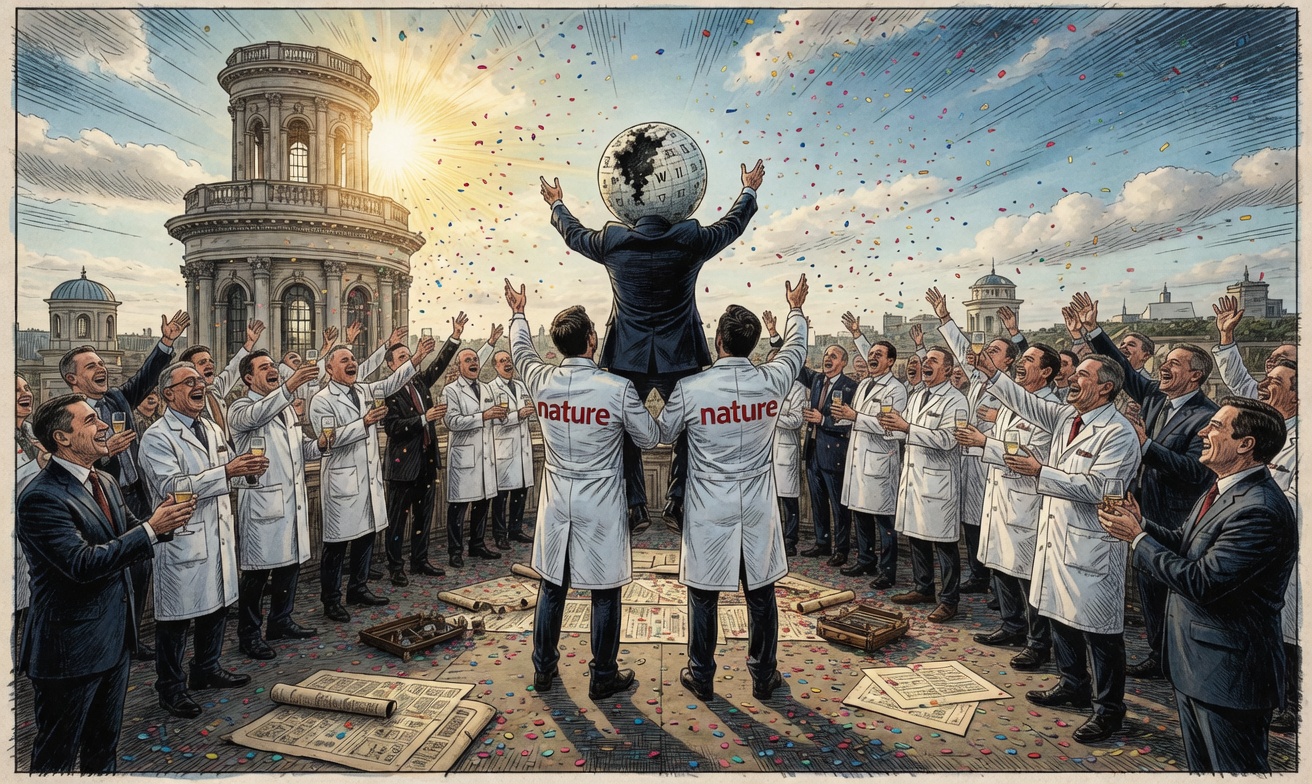
Earlier this year, leading scientific journal Nature published an editorial lavishing effusive praise on Wikipedia, writing that it is “an antidote to an increasingly poisoned information ecosystem.”
Naturally (no pun intended), as co-founder, I had to respond, knowing that Wikipedia is increasingly “poisoned” itself. (I call myself ex-founder; I have been called the Emmanuel Goldstein of Wikipedia.) In February, I pitched a response op-ed column to Nature on the need for reforming Wikipedia for the sake of editorial balance and intellectual integrity. They passed on the idea, but expressed interest in a short letter to the editor “highlighting a few key points.”
In early March, Nature (surprisingly) agreed to publish my letter to the editor. They sent an edited version; I returned my own edits, and Nature agreed to publish it, saying a final proof would be ready soon. Then, nearly a week later, Nature reversed course and declined the letter, citing insufficient evidence.
Remarkably, even though I had published the “Nine Theses on Wikipedia”—a book-length argument with 76 footnotes to fine-grained evidence—just months earlier, that apparently wasn’t enough for Nature.
Their response? Nothing. Their editors decided to ghost me, despite the considerable time and effort that went into writing the LTE and editing it over and over again. Here is the letter:
Wikipedia, After 25 Years, Needs Reform
I co-founded and named Wikipedia 25 years ago; I formulated the original neutrality policy, among others. I am also a Ph.D. philosopher specializing in epistemology. I am writing to flag caveats of the project in its current form. I agree with Nature’s recent editorial that Wikipedia—which is free and has an enormous number of entries—remains useful. And that a broad variety of researchers should edit it.
That said, Wikipedia has not retained its founding values of neutrality1 and openness.
Neutrality once meant not picking sides on controversial issues; it has been turned on its head and now means little more than expressing the views of Establishment sources. Editors can dismiss entire sources in the name of “reliability”—such as the Heritage Foundation and the Anti-Defamation League2—even though honest researchers often disagree about the reliability of sources. This can be wielded as a sledgehammer against minority views in many fields, and serves to impose bias.3
Moreover, Wikipedia’s once laudable openness has disappeared in some important ways. Its editors can declare “consensus” and then use the decision to silence dissent.4 They can act with impunity because they are anonymous—which is the opposite of transparency. Wikipedia is one of the most influential information outlets on the planet. Yet its powerful editors, being anonymous, rarely face real-world consequences for defamation, serious error or editing on behalf of corporations and governments.
Wikipedia needs reform.
It’s a slap in the face, but hardly shocking from Nature—which repeatedly peddled lies and misled people during the COVID-19 pandemic. We deserve much, much more from “the world’s leading multidisciplinary science journal.”
Wikipedia needs reform, and we need a media establishment willing to hear that case rather than ignore it. Shame on Nature.
Footnotes
- The longer version of the neutrality policy that I authored in 2001–2 made no reference to “undue weight” or “false balance,” which are now greatly emphasized. The original focus was on painting the dialectical landscape fairly rather than picking winners and losers. I argued at length in Nine Theses on Wikipedia, published online (see Thesis 2 and Thesis 4), that the new verbiage constitutes a fundamental alteration of the policy, essentially turning it on its head.[↩]
- Wikipedia’s standard list of permissible and impermissible sources can be found on the Perennial Sources page. Of course, many of the sources that are marked “Generally unreliable,” “Deprecated,” or even “Blacklisted” are held by some researchers as acceptable, if perhaps biased. An encyclopedia that claims to be neutral, that (as the “NPOV” policy says) “Articles must not take sides,” “Avoid stating seriously contested assertions as facts,” etc., cannot discard so many sources when the aim is to “describe disputes, but not engage in them.” One may reply that the sources Wikipedia deprecates are correctly deemed “mis/information,” but this is a highly litigated term. See Jacob Mchangama and Jeff Kosseff, The Future of Free Speech: Reversing the Global Decline of Democracy’s Most Essential Freedom (Johns Hopkins UP, 2025); Jacob Mchangama, Free Speech: A History from Socrates to Social Media (Basic Books, 2022); and David Coady, ed., The Epistemology of Fake News (Oxford UP, 2021). In short, there is no neutral way to discard many sources on grounds of “reliability,” because all value-laden issues are subject to fundamental disputes.[↩]
- E.g., Energy & Environment is a SAGE-published, SSCI-indexed journal. Wikipedia’s oft-cited “Potentially unreliable sources” essay describes it as “edited by and published by climate change denialists” and therefore generally to be ignored. Similarly, Wikipedia articles label acupuncture and chiropractic as “pseudoscience” or “pseudoscientific” in its own editorial voice, despite the fact that both are recognized by the WHO, integrated into VA treatment protocols, and studied in peer-reviewed literature including JAMA. The point is not that every minority position deserves equal billing, but that Wikipedia’s fringe-theory apparatus is applied aggressively to fields where honest researchers disagree. See generally WP:FRINGE. If we consider politics, religion, and other areas of fundamental disagreement, the examples become abundant and obvious.[↩]
- The article claims, “There is no evidence supporting laboratory involvement…”. The “talk” page of this article is full of discussions about what the “consensus” is. Thus, a common view is presented as refuted which has appeared in the pages of Nature; e.g., Maxmen, A. & Mallapaty, S., “The COVID lab-leak hypothesis: what scientists do and don’t know,” Nature 594, 313–315 (8 June 2021). There are many other examples. Wikipedia enforces a supposed consensus about low-carbohydrate diets heavily: “There is no good evidence that low-carbohydrate dieting in general confers any particular health benefits apart from weight loss”. Similarly, Wikipedia reinforces the old consensus on the link between saturated fat and cardiovascular disease strongly: “Saturated fat intake increases low-density lipoprotein cholesterol”. No dissent is mentioned. As before, this is only to consider examples from natural science; many more examples can be found in social science and the humanities.[↩]
Reply to “Nature Agreed to Publish My Wikipedia Letter—Then Ghosted Me”