Is the Filioque legitimate, or a corruption?

11 comments

Note: This essay was originally posted as part of a much longer series. I think that because it was buried in that series, like a chapter of a book, it did not get much attention. So I am now re-posting it, and will later repost other answers to questions in the “The Denominational Distinctives” individually, so that people will have a better place to comment on them. I will also make a point of interacting more with commenters (this takes time, of course), as part of an effort to better educate myself about the issues.
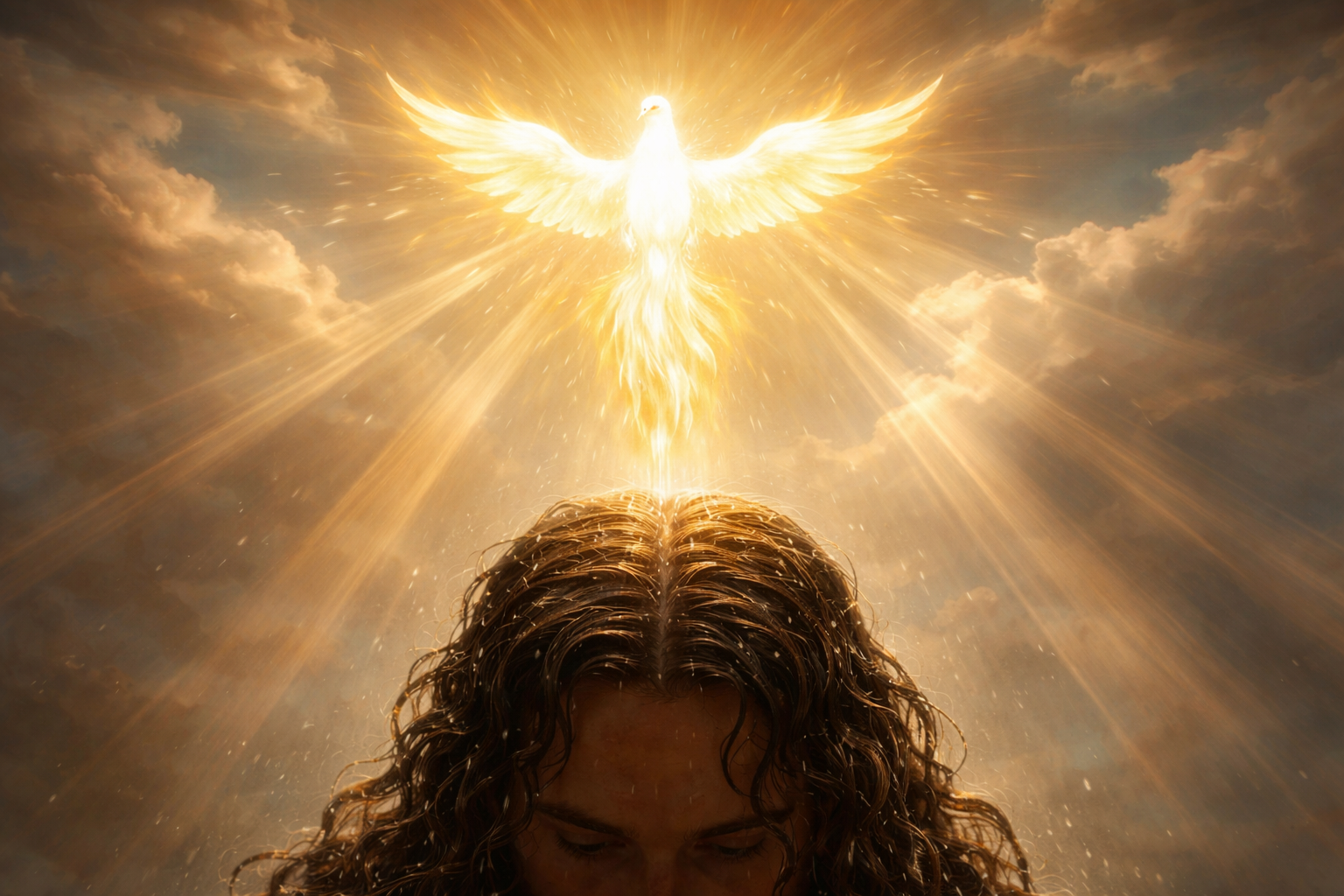
“…lo, the heavens were opened unto him, and he saw the Spirit of God descending like a dove, and lighting upon him…” (Matthew 3:16)

The second version of the Nicene Creed, that of 381 A.D., specified the person and role of the Holy Spirit this way: “And we believe in the Holy Spirit, the Lord, and Giver of Life, Who proceeds from the Father, Who with the Father and the Son together is worshipped and glorified, Who spoke by the Prophets” (source).

But fairly soon after that version was published, various branches of the Church edited “Who proceeds from the Father,” adding “and the Son”, like this: “Who proceeds from the Father and the Son“. The italicized phrase translates a single Latin word: filioque. Thus, the controversy was over whether the Holy Spirit “proceeds from the Father” alone, or whether he also “proceeds from the Son.” Thus, the Western doctrine is called the double procession of the Holy Spirit. This is the specific thing the eastern branch of the Church was concerned to deny.

The Eastern Church took issue with the addition of filioque. When the bishop of Rome, Pope Leo IX, sought to impose his will over the entire Church and finally insisted on this addition being accepted universally, this led to mutual excommunications, in 1054, of key church figures. It seems Cardinal Humbert walked into the Hagia Sophia insisting that Patriarch Michael Cerularius accept the filioque. When he refused, Humbert excommunicated Cerularius. In response, Cerularius and the Holy Synod of Constantinople excommunicated Humbert and his delegation, not excommunicating Leo IX since Leo had recently died. After that, positions further hardened, centers of authority separated, and traditions grew apart. This slow-moving ecclesiastical civil war and its resulting division later came to be called the Great Schism. Thus, from what was essentially a power play centered on a relatively minor point of doctrine, the original (decentralized) Church was dissolved, or transformed, while the Roman Catholic Church and the Eastern Orthodox Church were born. Rome and the Popes went on to centralize the Western church even further, while the Eastern church remained without a single, central authority.

There is nothing, as far as I can tell, about the controversy over the filioque itself that is conceptually wedded to either side of this ecclesiastical controversy; many other points of dispute could have sparked a schism, which is perhaps best regarded as an attempt by the Pope and the Roman bishopric to assert its supremacy over all. The filioque issue itself seems to me fairly minor in terms of its impact on the rest of doctrine and practice. So, despite its historical importance, this is an issue to which I (like many Protestants) have given little thought. This is not to say I do not want to study it more, though.

In cases where I approach theological questions seriously for the first time, what I do is go through some relevant texts, seeing what they say. I have assembled quite a few, in the hope that they are adequately representative. I add my commentary on each afterward.

Filioque: relevant texts

John 14:16
And I will pray the Father, and he shall give you another Comforter, that he may abide with you for ever;

This affirms that the Father will give the Comforter, but does not say anything regarding the Son; so it is consistent with the notion that the Holy Spirit proceeds (i.e., to us) from both.

John 14:26
But the Comforter, which is the Holy Ghost, whom the Father will send in my name, he shall teach you all things, and bring all things to your remembrance, whatsoever I have said unto you.

This contains two intriguing details. The first is that the Father sends the Holy Spirit in the name of the Son. This colors the issue in an interesting way, because while it affirms that the Spirit is sent by the Father, he arrives in the name of the Son. If the Spirit is sent “in the name of” Jesus, then surely there is a sense in which he proceeds from the Son. The second item here is that the task or function of the Spirit with respect to us (or, at least, to the Apostles to whom Jesus was speaking!) is to “bring all things to your remembrance, whatsoever I have said unto you.” This suggests that when the Spirit communicates to us, at least part of what he communicates is “whatsoever I have said unto you.” Thus the Spirit would seem to be an emissary, sent by the Father, but carrying the message of the Son.

John 15:26
But when the Comforter is come, whom I will send unto you from the Father, even the Spirit of truth, which proceedeth [ἐκπορεύεται] from the Father, he shall testify of me:

Here, as in 14:16 and 26, the Comforter is said to be from the Father, while testifying about Jesus. Yet is sent by Jesus. This provides a sense in which the Comforter might “proceed” from the Son; but it does not use the word ἐκπορεύεται (ekporeuetai) but instead the word πέμψω (pempso, “will send”). It does affirm again that the function of the Comforter is to speak for or about Jesus. The question is, does that entail another kind of “procession”? Perhaps. We will have to see.

John 16:7
Nevertheless I tell you the truth; It is expedient for you that I go away: for if I go not away, the Comforter will not come unto you; but if I depart, I will send him unto you.

This again says two interesting things. First, it clearly states that the outpouring of the Holy Spirit depended on Jesus being absent from earth and returning to heaven. We are not here told why this is the case. Second, Jesus again claims “will send [πέμψω again] him unto you.” The question, again, is whether this means the Spirit proceeds from Jesus? Perhaps, perhaps not. Perhaps there is a metaphysical or theological distinction to be drawn between the Spirit proceeding from the Father but being sent by the Son. What makes matters even more difficult is that, as I am inclined to think, many (not all) such recondite metaphysical or theological distinctions are unlikely to be found in or settled by what the Bible writers intended. I doubt John had such elaborate and detailed distinctions in mind; but perhaps he had some distinction he was marking out by using two different words.

John 16:13–15
Howbeit when he, the Spirit of truth, is come, he will guide you into all truth: for he shall not speak of himself; but whatsoever he shall hear, that shall he speak: and he will shew you things to come. He shall glorify me: for he shall receive of mine, and shall shew it unto you. All things that the Father hath are mine: therefore said I, that he shall take of mine, and shall shew it unto you.

This adds even more detail to the latter passage (16:7). The Spirit will guide the Apostles (and quite possibly us as well) into the truth, not of himself but what he is told to say. But we learned already in 14:26 and 15:26 that he will speak on behalf of and testifying about Jesus himself; here, Jesus adds the similar points that the Spirit will glorify Jesus and show that which he (the Spirit) has received from Jesus. Yet the last sentence here (v15) might be thought to be particularly relevant to the question of double procession: Jesus says, “All things that the Father hath are mine,” just after saying that the Spirit will show that which he receives from Jesus. In context, this suggests that, since whatever the Father has, the Son has as well, it follows that the Spirit might communicate things that, as it were, originated with the Father. That is basically what “he [the Spirit] shall take of mine [which includes things of the Father], and shall shew it unto you” means.

What these cryptic statements mean is not clear. On the narrow question of whether the Spirit “proceeds from” the Son, matters have really become no clearer. It certainly is the case that the Spirit gives us the messages and gifts of the Son, which are at least sometimes (perhaps always) messages and gifts of the Father. Whether these proceed from the Son is another question, and whether this means the Spirit itself proceeds from the Son is a still different question. Nevertheless, the fact that Jesus explicitly avows that “All things that the Father hath are mine,” in the context of communications from the Holy Spirit, seems particularly important.

John 20:22
And when he [Jesus] had said this, he breathed on them [the Apostles], and saith unto them, Receive ye the Holy Ghost.

This famous event, unique to John, has been described as “an earnest” of the outpouring of the Holy Spirit on all the rest of the disciples at Pentecost. What is important to the issue here is that the breath (pneuma, a word that also means “spirit”) of Christ is said to convey the Spirit himself. Thus, he proceeded to the Apostles out of the mouth of Jesus, so to speak; what remains to study is whether that is what is meant by “procession” in “double procession.”

Luke 24:49
And, behold, I send the promise of my Father upon you: but tarry ye in the city of Jerusalem, until ye be endued with power from on high.

“The promise” and “power” (of the Spirit: this is implied) are said to come from “my Father” and “on high.” Once again, this does not deny that the Spirit does not also proceed from Jesus; but neither does it affirm that it does.

Acts 2:33
Therefore being by the right hand of God exalted, and having received of the Father the promise of the Holy Ghost, he [Jesus] hath shed forth [ἐξέχεεν] this, which ye now see and hear.

This is surely a key text, because it provides another word describing the relationship between Jesus and the Spirit: ἐξέχεεν (execheen, “pour out” or “shed forth”). Peter is speaking at Pentecost, explaining that speaking in tongues, as shown by the gathered disciples to the Jewish visitors from many lands, has two heavenly explanations: (1) Jesus received the promise of the Holy Ghost from the Father; (2) Jesus “shed forth” this same Spirit to the assembled disciples, evidence of which was visible and audible. Similar remarks as before apply.

Romans 8:9
But ye are not in the flesh, but in the Spirit, if so be that the Spirit of God dwell in you. Now if any man have not the Spirit of Christ, he is none of his.

Much in line with what John said in 16:7 and 13–15, Paul here casually describes the Holy Ghost as “the Spirit of God” as well as “the Spirit of Christ.” This suggests that he is properly called the Spirit of both. Again, perhaps there are further fine metaphysical distinctions to draw here, with regard to “procession.”

Romans 8:11
But if the Spirit of him that raised up Jesus from the dead dwell in you, he that raised up Christ from the dead shall also quicken your mortal bodies by his Spirit that dwelleth in you.

Here Paul describes the Spirit as he who raised Jesus from the dead; this might well be used to argue that he does not “proceed” from Jesus, or not always. More of course can be said here, of course. But this is not a strong argument, considering that sometimes it is even said that Jesus raised himself from the dead (see, e.g., Jn 2:19 and 10:17–18).

Galatians 4:6
And because ye are sons, God hath sent forth the Spirit of his Son into your hearts, crying, Abba, Father.

Here, God is said to have sent the Spirit; but it is “the Spirit of his Son” which is said to have been sent! This is very much in line with John’s remarks in Jn 14–16.

Philippians 1:19
For I know that this shall turn to my salvation through your prayer, and the supply of the Spirit of Jesus Christ, …

Here is another instance of the Spirit being referred to as Jesus’ own.

Titus 3:5–6
Not by works of righteousness which we have done, but according to his mercy he saved us, by the washing of regeneration, and renewing of the Holy Ghost; Which he shed on [ἐξέχεεν again] us abundantly through Jesus Christ our Saviour; …

Similarly to Gal 4:6, Paul implies that it is the Father who “renewed” the Holy Ghost (in us) but who did it “through” Jesus Christ. Once again, this might or might not point to abstruse metaphysical distinctions. The simple reading is that, before, the Holy Ghost did not dwell in us; but he does after we are born again, by “renewing” the presence of the Holy Ghost in us.

Analysis

Now, having rehearsed these verses and made a few non-committal remarks about how they bear on the question, I think we can make a few more general, helpful, and I hope uncontroversial summary statements. The Holy Spirit is said most consistently to proceed or come from the Father; but added to this, we are told that Jesus would send the Spirit himself, and that the Spirit was of both the Father and the Son, and shed or poured from both. Moreover, we must not forget the intriguing details the Gospel of John supplied, such as that the Spirit communicated the message of Jesus and that the Father has given all things to the Son.

As a point of general exegesis, I would add here that the outpouring of the Holy Spirit was a notion introduced by prophecies that might well have been familiar to Jesus’ audience.1 When Jesus adverted to these prophecies, he might well, at that point, be expected to say that the Spirit would come from the Father; this, it stands to reason, would serve to dignify and lend credibility to the deliverances of the Spirit, in the mouths of the Apostles. It is particularly important that Jesus should say this, as an endorsement of the preaching of the Apostles, who, it was said, were inspired by this same Spirit, as Jesus said they would be (quoted above, particularly John 14–16). After all, they would be battling critical Jews who denied apostolic authority and even, in some cases, the authority of Jesus himself. So, they needed a “letter of recommendation” (to use Paul’s term), and that from the highest and least controversial source: the Father himself.

Yet Jesus also, quite clearly albeit less frequently, stated that this same Spirit carried his own messages. This was to underscore his own authority. And we should never forget Jesus’ clear, relevant pronouncement: “I and my Father are one.” (Jn 10:30)

So what bearing does all this have on the question of the double procession? To answer that, we must first ask: What is the doctrine of the double procession?

The simple formulation of the doctrine is that the Holy Spirit proceeds from the Father and the Son both, and not from the Father alone. But this language of “proceeding” or “procession” seems to be special jargon that both the Western church and Orthodoxy use. A key question in my mind is whether both traditions actually understand the term in the same way.

Whatever mysteries are involved, we may say that there are two things that the terms might mean, at least on first glance. In the first (“ontological”) sense, “procession” refers to an eternal relationship between two, or maybe three, persons in the Trinity: The Holy Spirit eternally proceeds from (or out of) the Father. Here, the arrival of the Spirit is metaphysical or ontological, which is to say that the Spirit “proceeds” into being from the Father. This suggests an ontological priority of some sort (not temporal, or in time, because this relationship is held to be eternal, or atemporal). The question, then, is whether the Spirit also eternally “proceeds” into being from the Son as well.

In the second (“economic”) sense, the Spirit proceeds from the Father (and, as the text says often, the Son) to us in the indwelling of the Holy Spirit. On this concept, procession is something that happens between the Father (and maybe the Son) and the Spirit with respect to us; such procession was not even occurring before human beings were created, obviously.

I am not now definitively claiming that the filioque in either of these senses is settled by Scripture. The reason I draw this distinction is to raise a question: How do the warring sides understand it? Could this, perhaps, be a semantic dispute?

I do not think so. I have not read widely about the Trinity yet, as much as I want to, so I will not pretend to have a well-informed or interesting opinion on this. I gather, however, that the Latin (so, Western Church) Fathers Hilary, Ambrose, and Augustine, whose writings are perhaps most responsible for the addition of the filioque, definitely understood the filioque to refer not just to the economic sense but also to the ontological sense. They each developed arguments that, yes, made use of the fact that Jesus sent his Spirit, but the conclusion of the argument was that the Spirit eternally proceeded from the Son.

The economic question is fairly obvious in light of many texts: the Spirit is of Christ; Christ sends him; he speaks for Christ; all things of the Father are also held by the Son, and this is stated in the context in which the Son sends the Spirit. Therefore, there is a double procession of the Spirit in the economic sense: he proceeds to us from both. But the ontological question lies shrouded in mystery.

My present view, for what little it is worth (I am no expert), is that the Trinity is already quite a mystery enough for us to be insisting on things about the internal relations of the persons of the Godhead about which neither the Bible nor a priori reasoning can offer anything definite. I have read enough of speculative theology, as opposed to biblically based systematic theology, to have developed a decided distaste for it. By “speculative” I mean reasoning that extends beyond both Scripture and things strictly, logically entailed by correct scriptural exegesis. This is particularly difficult considering that we have no (or woefully inadequate) immediate experience of God. Reasoning and philosophy I love; but this does not mean I think we can, or should, attempt to rule on questions about the things of God that lie well beyond our purview.2

So, on this question, for now, I remain agnostic. Perhaps when I finally read books on the Trinity like Augustine’s De Trinitate, which is definitely in the queue, I will change my mind. Maybe that will even change my attitude toward theological speculation. As to the dispute between the Western and Eastern Church, for now, my entirely amateur opinion is this: I suspect the dispute is neither clear nor important enough to justify a denominational division. But I don’t even know that, to be honest.

Footnotes

  1. Joel 2:28–29; Isa 32:15, 44:3; Ezek 36:26–27, 39:29.[]
  2. I can illustrate the methodological principle in play by pointing out that I also have no taste for speculation about orders of angels and demons, the nature of heaven and hell, etc., for similar reasons.[]

by

Posted

in

,

Comments

Please do dive in (politely). I want your reactions!

11 responses to “Is the Filioque legitimate, or a corruption?”

  1. Alain

    I find the filoque interesting because of the translation/liguistics issue that runs along side the theological one. While other commenters are talking about the Western church, I think Hispania that is modern Spain was where it was first used before spreading to there rest of the Latins, and this is iirc in the AD500s to deal with resurgent Ayrianism.
    The Eastern Greek churches were dealing with a different Trinitarian heresy (I forget which one – maybe Modalism?) that required a very strong form of along the idea of “there is only one God.”
    But back to the language. When a Greek Catholic, that is say a Byzantian Rite or other, says the creed in Greek, they omit the Filoque. Why? because back to translation, the Greek implies more the through the Son that the Filoque in Latin and the West needs to directly say.
    The most recent Popes when saying divine liturgy’s with Greeks be they Catholic or Orthodox have omitted the Filioque.
    I agree with the poster who said that this is a sort of Guardrail. And while Eastern churches members maybe more energetic on this point than some in the west they too are trying to have a guardrail to their belief. After all we all think our Souls require us to believe and worship God correctly and how could we do that if we don’t know this God?

    FWIW while I’m a Western Christian and have never doubted the Trinity, it was a Coptic online Catachism that gave the best explanation for why God has to be a trinity. I don’t remember all of it but it started by saying something like (quotes are to indicate the idea, not direct quotation)
    “If God is love, but a singular, from where and to who would the love flow? It wouldn’t and be come like Narcissus, a self love that only loves itself and has no space for others”

  2. Micah Smith

    I’m not a theologian, and I wouldn’t presume to settle the deep mysteries of God’s inner life. That said, your explanation of the Filioque made real sense to me in everyday terms—I truly appreciated how you laid it out clearly. Would it help if Christians looked first through the lens of Scripture, then next through rituals, creeds and traditions, rather than vice versa? Changing the order of the looking lens would certainly change perspectives. Thanks for helping me think deeper about an important issue.

    1. Thanks for the feedback. I make a practice of looking at what Scripture implies independently of any particular interpretive issues, before I take up the questions in any detail. This greatly constrains the available options (or, it should). That said, I have barely gotten started understanding the Filioque.

  3. Re-posting this specific piece is smart; the *Filioque* debate is consistently fascinating. I’m curious about the historical context you found most compelling when you first wrote this section.

    1. Glad you thought so. And looks like I was not wrong. I’ll be posting another extract next, for more feedback.

  4. Thomas Dill

    The clearest explanation I can give of the Trinity is this: Our whole understanding of oneness and twoness, etc. is rooted in the idea of separation in space and time. Two objects are two objects because they occupy two separate positions in space. If they occupied the same space, they would be a single object. Likewise, two events will be two events if they occur at separate times. It is therefore inevitable that the God who created space and time would transcend our concept of enumeration.

    Tritheism posits three separate gods in three separate places. Modalism, a god who is three different things at separate times. Both attempt to restrict God to the limits of human understanding. It’s the same impulse that drove men to fashion and worship idols that they could see and touch. Humanity rebels against the idea of a God it cannot understand, but it ought to be obvious that the Creator of heaven and earth could never be modeled in wood or stone, or even in the purest mathematics.

    1. Your theory is rooted in an interesting metaphysical claim, that individuation requires spatial and temporal separateness. But what if we’re talking about minds or mental contents? These are not (or at least, not obviously) individuated by spatial and temporal differences. Moreover, there is another kind of counterexample on the other side: according to the usual conception of demonic possession, a demon has an overlapping extent in terms of time and space (at least for some times) to a person, but this does not make the possessed person and the demon the same being.

  5. Scott

    I was raised Evangelical (and still am), so was not aware of the filioque until recently when I saw it discussed by Jonathan Pageau (Orthodox) and Rusland KD (Oriental Orthodox) on Youtube (https://youtu.be/P0Gx4HYpf44?t=986). I was introduced to Pageau through Jordan Peterson.

    Pageau shared a couple ideas on this that I found imporant:

    1. Filioque was added in reaction to the problem of Arianism.
    2. Islam’s rise disconnected the east and west and allowed for filioque to occur.
    3. Council of Florence resolved the filioque.
    4. Differences on church authority overshadowed Council of Florence maintaining the schism.

    1. Thanks for the video pointer. And your points regarding 3 & 4 are interesting.

  6. Thank you for this and for sharing some of your faith explorations and working out.

    I think your conclusion—that the filioque is likely a minor issue, perhaps semantic, and insufficient to justify division—rests on an assumption worth revisiting: namely, that the doctrine concerns a speculative curiosity about God’s inner life rather than a confession about how God is given to us and how salvation itself coheres.

    1. The Filioque Is Not Primarily About Power or Speculation

    You are surely right that the Great Schism involved politics, personalities, and ecclesial power. But it would be a mistake to conclude that the filioque itself was therefore theologically marginal. Historically, the Western Church did not add the filioque in order to speculate about divine metaphysics, but to protect the unity of Christ’s saving work against real doctrinal threats—especially Arian and semi-Arian accounts in which the Son becomes functionally subordinate, and the Spirit becomes detached from Christ’s redemptive mediation.

    In other words, the filioque was not introduced to explain how God works internally, but to confess who the Spirit is in relation to Christ and, therefore, how salvation is Christ-shaped all the way down.

    2. Scripture Already Pushes Beyond a Purely “Economic” Reading

    Your own exegesis actually presses further than your stated agnosticism allows.

    You rightly note that Scripture distinguishes ἐκπορεύεται (procession) from πέμπω (sending). Eastern theology has leaned heavily on this lexical distinction. But Scripture does more than describe functional sending:
    • The Spirit is “the Spirit of the Son” (Gal 4:6)
    • “The Spirit of Christ” (Rom 8:9; Phil 1:19)
    • Given through the Son (Titus 3:6)
    • Breathed from the risen Christ himself (John 20:22)

    These are not merely statements about mission; they are identity claims. The Spirit is not simply sent by the Son but is intrinsically related to the Son in his very being.

    This is why the Western tradition insists that economic revelation is not arbitrary. God does not act in history in ways that contradict who God eternally is. The missions (missio) reveal the processions (processio). If the Spirit is from the Son in salvation history, this is not accidental or merely instrumental.

    3. Why the Ontological Question Cannot Be Avoided

    You suggest that the ontological question lies beyond Scripture and therefore beyond responsible theology. But here is the difficulty: every denial of ontological claims is itself an ontological claim.

    To say “the Spirit proceeds from the Father alone” is no less metaphysical than to say “from the Father and the Son.” The Eastern position is no less speculative—it simply speculates differently.

    The Western concern, articulated classically in De Trinitate, is this:

    If the Spirit does not proceed from the Son, then the Son does not fully share in the Father’s act of self-giving.

    That would mean:
    • The Father gives himself fully to the Son
    • But the Son does not fully give himself with the Father

    At that point, the Son’s consubstantiality becomes formally affirmed but functionally thinned.

    4. The Filioque as a Confession of Love, Not Causality

    A common misunderstanding—understandable, given later polemics—is that the filioque makes the Spirit “dependent” or “derivative.” In classical Western theology, this is not the case.

    Augustine, followed by Aquinas, does not argue that the Spirit proceeds from the Father and the Son as two sources. Rather:
    • The Father is the single principle (principium)
    • The Son receives everything the Father is
    • Including the Father’s capacity to give the Spirit

    Thus, the Spirit proceeds:

    From the Father through the Son, as from one divine source.

    This is not metaphysical excess; it is a way of safeguarding that the Spirit is the personal communion of Father and Son, not an independent divine channel.

    5. Why This Matters for Faith, Not Just Doctrine

    You describe yourself as approaching this from a Protestant posture, wary of speculative theology. But here is where the filioque may matter more than expected for your own faith trajectory.

    Without the filioque:
    • The Spirit risks becoming a parallel authority alongside Christ
    • Or an immediate divine presence not intrinsically Christ-shaped

    With the filioque:
    • Every work of the Spirit is Christologically ordered
    • The Spirit never bypasses Christ, corrects Christ, or relativises Christ

    This matters pastorally, ecclesially, and spiritually. It guards against:
    • Charismatic detachment from Christ
    • Pneumatology drifting into experience without incarnation
    • “Spirit-led” claims that subtly eclipse the Son

    In short, the filioque is not about divine plumbing. It is about confessing that the Spirit who indwells us is the Spirit of the crucified and risen Jesus, eternally and inseparably.

    6. Is the Division Justified?

    On this point, your instinct is generous and right: the filioque alone should not justify mutual excommunication. Indeed, many contemporary Catholic theologians explicitly affirm that the Eastern formula—“from the Father through the Son”—is orthodox when properly understood.

    But the issue is not trivial either. It touches:
    • Christology
    • Soteriology
    • Ecclesial authority
    • The unity of divine action

    It is not a hill to die on lightly—but neither is it a footnote.

    7. A Final Word

    Your conclusion that the Trinity is already mysterious enough is well taken. But Christian doctrine does not exist to solve mysteries—it exists to prevent us from misunderstanding the mystery in ways that distort salvation.

    The filioque is best understood not as an attempt to peer behind the veil, but as a guardrail: ensuring that the God who saves us in Christ is the same God who eternally is Father, Son, and Spirit—without remainder, without rivalry, and without division.

    If you do go on to read Augustine, I suspect you may find not speculative excess, but a disciplined reverence for the way love itself names God.

    And that, perhaps, is where this doctrine may yet speak most powerfully into your own growing faith, that I give thanks for and have been praying for.

    1. Jason, thanks for the substantive feedback!

      Thank you for this and for sharing some of your faith explorations and working out.

      I learn a lot from readers.

      I think your conclusion—that the filioque is likely a minor issue, perhaps semantic, and insufficient to justify division—rests on an assumption worth revisiting: namely, that the doctrine concerns a speculative curiosity about God’s inner life rather than a confession about how God is given to us and how salvation itself coheres.

      To be sure, I intend to revisit this and many theological issues several more times, depending on how long the Lord gives me. My understanding is that the distinction you are drawing here is marked by “ontological” versus “economic” senses of procession. In the ontological sense, the Spirit proceeds in his being (whatever such eternal procession might entail) whereas in the economic sense (which doesn’t concern finances but rather the divine oikonomia or “stewardship of a household”), the Spirit proceeds to us. Thus it is possible, for all we know, that the Spirit proceeds ontologically only from the Father, while he proceeds economically (again, to us) from both the Father and the Son. So when you speak about “God’s inner life,” that would include the ontological sense of procession, whereas the kind of procession relevant to our salvation is the economic sort.

      So then what you’re saying is that I should revisit the assumption that the doctrine of the Filioque concerns the ontological sense rather than the economic sense. But the question in my mind is whether East and West actually differ on the economic sense. I don’t know. My Orthodox brothers and sisters agree that the Spirit proceeds to us from or sent through Father and Son. That much is found in the text itself, after all. So the ultimate and most important disagreement does seem to be about the ontological sense, even if there are more detailed points of disagreement regarding the economic sense.

      1. The Filioque Is Not Primarily About Power or Speculation

      You are surely right that the Great Schism involved politics, personalities, and ecclesial power. But it would be a mistake to conclude that the filioque itself was therefore theologically marginal. Historically, the Western Church did not add the filioque in order to speculate about divine metaphysics, but to protect the unity of Christ’s saving work against real doctrinal threats—especially Arian and semi-Arian accounts in which the Son becomes functionally subordinate, and the Spirit becomes detached from Christ’s redemptive mediation.

      In other words, the filioque was not introduced to explain how God works internally, but to confess who the Spirit is in relation to Christ and, therefore, how salvation is Christ-shaped all the way down.

      I think I follow that, and it makes sense as far as it goes. But is this really true? If that really was the main reason for adding the Filioque, then it would concern the economic sense, but my understanding is that in De Trinitate Augustine very clearly focuses on the ontological sense of procession, and that the Eastern Church (much later) took issue with his claims regarding the ontological sense. So, while the Filioque might indeed have been added to the (381) Nicene Creed as a “talking point” against Arianism, the doctrine might have been developed for other reasons in the context of deeply speculative metaphysical theology (especially in De Trinitate). And the reason it was controversial had nothing to do with the reason it was added to the Nicene Creed—because, after all, of course the Eastern Church was strongly opposed to Arianism as well!

      2. Scripture Already Pushes Beyond a Purely “Economic” Reading

      Your own exegesis actually presses further than your stated agnosticism allows.

      You rightly note that Scripture distinguishes ἐκπορεύεται (procession) from πέμπω (sending). Eastern theology has leaned heavily on this lexical distinction. But Scripture does more than describe functional sending:
      • The Spirit is “the Spirit of the Son” (Gal 4:6)
      • “The Spirit of Christ” (Rom 8:9; Phil 1:19)
      • Given through the Son (Titus 3:6)
      • Breathed from the risen Christ himself (John 20:22)

      This may be so. In my post, I did not consider this argument, and, yes, perhaps a scriptural case can be made for the ontological procession. I wouldn’t be surprised. But you have only gestured at the case, you haven’t made one.

      These are not merely statements about mission; they are identity claims. The Spirit is not simply sent by the Son but is intrinsically related to the Son in his very being.

      This is why the Western tradition insists that economic revelation is not arbitrary. God does not act in history in ways that contradict who God eternally is. The missions (missio) reveal the processions (processio). If the Spirit is from the Son in salvation history, this is not accidental or merely instrumental.

      You draw a distinction between “statements about mission” and “identity claims,” but it seems to me that the persons of the Trinity might well be distinguished in their identities by their mission, at least in part—though I know this is strange to say—which I say mostly because statements about mission, procession, and identity are subject to such indirect and metaphorical analysis. You assume (maybe correctly) that the missions are “accidental” or “merely instrumental,” while it seems to me that who the persons are, and how they are ontologically distinguished, depend to some extent on the fact that they had “missions.”

      But if we really are licensed to distinguish processions from missions—fine—then there is still the question whether every statement about procession has a corresponding missional statement.

      From my point of view this all involves extreme amounts of speculation about facts of which we have no experience and no clear (or uncontested) textual evidence.

      At some point I’m no longer confident that the technical jargon corresponds to anything in reality. The fact that speculative metaphysics done by distinguished old theologians introduced the jargon does not overcome the fact that it is, after all, speculative metaphysics, which runs largely on parsing metaphors such as “light emanating from a source of light,” metaphors left vague or not found at all in Scripture.

      3. Why the Ontological Question Cannot Be Avoided

      You suggest that the ontological question lies beyond Scripture and therefore beyond responsible theology. But here is the difficulty: every denial of ontological claims is itself an ontological claim.

      I don’t see this. A failure to draw a conclusion is not to issue a denial. You distinguish between agnosticism and atheism, right?

      To say “the Spirit proceeds from the Father alone” is no less metaphysical than to say “from the Father and the Son.” The Eastern position is no less speculative—it simply speculates differently.

      Oh, right. Well, what I’m saying is that I don’t see how Scripture supports a clear statement on the issue at all.

      The Western concern, articulated classically in De Trinitate, is this:

      If the Spirit does not proceed from the Son, then the Son does not fully share in the Father’s act of self-giving.

      But on this formulation, you’ve left it ambiguous whether you mean ontological or economic procession. But Augustine wasn’t arguing against the Eastern Church, which at the time was not fighting against the doctrine of double procession, right? Indeed Paul made clear that the indwelling of the Spirit of Christ is what makes us adopted children and holy in the sight of the Father (cf. Rom 8:9–10, 1 Cor 6:11, Gal 4:6). Surely the Eastern Church does not deny these things, but some other doctrines.

      A common misunderstanding—understandable, given later polemics—is that the filioque makes the Spirit “dependent” or “derivative.” In classical Western theology, this is not the case.

      Interesting. Eventually, I’ll learn more about such things.

      5. Why This Matters for Faith, Not Just Doctrine

      You describe yourself as approaching this from a Protestant posture, wary of speculative theology. But here is where the filioque may matter more than expected for your own faith trajectory.

      Without the filioque:
      • The Spirit risks becoming a parallel authority alongside Christ
      • Or an immediate divine presence not intrinsically Christ-shaped

      I’m confused. If they are distinct and equal persons, they are each authorities; if they have one essence and are entirely unified in will, any distinction between them qua authority is a distinction without a difference.

      What would a “Christ-shaped” presence even be? Do you see what I mean when I complain about the way in which the controversies seem to be about how to cash out metaphors, with no direct knowledge of what the metaphors stand for?

      With the filioque:
      • Every work of the Spirit is Christologically ordered
      • The Spirit never bypasses Christ, corrects Christ, or relativises Christ

      Well, maybe, for all I know. I suppose this would be clearer if I did more reading. Surely Orthodox believers would agree that “The Spirit never bypasses Christ, corrects Christ, or relativises Christ.” Are we sure this reflects a fair representation of the other side?

      This matters pastorally, ecclesially, and spiritually. It guards against:
      • Charismatic detachment from Christ
      • Pneumatology drifting into experience without incarnation
      • “Spirit-led” claims that subtly eclipse the Son

      In short, the filioque is not about divine plumbing. It is about confessing that the Spirit who indwells us is the Spirit of the crucified and risen Jesus, eternally and inseparably.

      You seem to be ascribing the Orthodox mystical tradition to the idea that the Spirit does not proceed from the Son. I don’t know that I see that. It makes sense to a certain extent, I suppose.

      6. Is the Division Justified?

      On this point, your instinct is generous and right: the filioque alone should not justify mutual excommunication. Indeed, many contemporary Catholic theologians explicitly affirm that the Eastern formula—“from the Father through the Son”—is orthodox when properly understood.

      But the issue is not trivial either. It touches:
      • Christology
      • Soteriology
      • Ecclesial authority
      • The unity of divine action

      It is not a hill to die on lightly—but neither is it a footnote.

      OK. For all I can tell, you might well be right. At least, in the discourse about the Filioque, different positions on those topics according to the disputants are associated by assertion or accusation as arguments in favor, or against, the competing sides. But if I am right that the data is lacking—that we have no basis on which to debate the metaphysics of ontological procession, though I know you think we do—then these are falsely claimed advantages and disadvantages.

      7. A Final Word

      Your conclusion that the Trinity is already mysterious enough is well taken.

      But, evidently, not when it comes to the details of ontological procession!

      But Christian doctrine does not exist to solve mysteries—it exists to prevent us from misunderstanding the mystery in ways that distort salvation.

      The filioque is best understood not as an attempt to peer behind the veil, but as a guardrail: ensuring that the God who saves us in Christ is the same God who eternally is Father, Son, and Spirit—without remainder, without rivalry, and without division.

      If you do go on to read Augustine, I suspect you may find not speculative excess, but a disciplined reverence for the way love itself names God.

      And that, perhaps, is where this doctrine may yet speak most powerfully into your own growing faith, that I give thanks for and have been praying for.

      Thank you. And you are very possibly right. My eyes might be opened by Augustine. (Or by some Orthodox theologian, for that matter.)

      This has been interesting, because it gives me a better taste of what the debated issues are, especially from a Western standpoint.

Leave a Reply to MELOCOOL Cancel reply

Your email address will not be published. Required fields are marked *