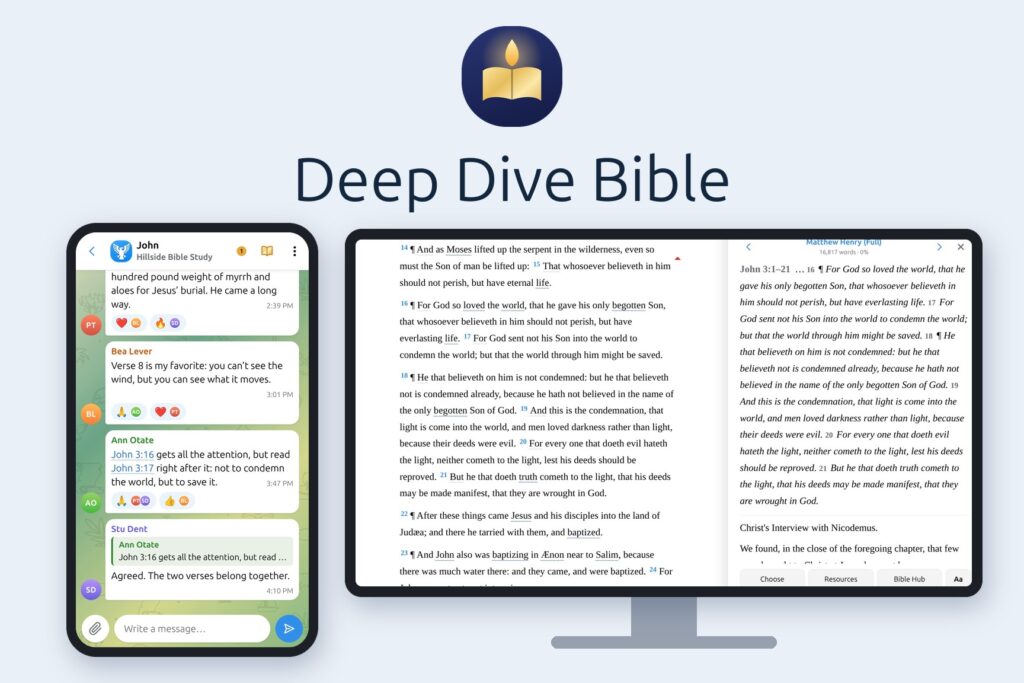
Today I’m launching a new, full-featured Bible study app—not a business enterprise, but a gift to the Church:
A full-featured app made in six weeks? While I’m working on other projects? I’m almost as surprised as (I imagine) you are. So, here’s the story of how this project basically popped into existence.
Well, maybe it shouldn’t be that surprising. AI has become enormously powerful (it develops good code really fast now), and I’ve written a few different times about Bible apps and study tech.
I should add that I got an enormous amount of mileage out of three apps, which I’ve used from the very first months of my own Bible study: YouVersion Bible, Tecarta (Life) Bible, and BibleHub. These are each excellent apps in their own right. In addition, I’ve been using Telegram with my Bible study group.
But each of these tools is limited in various ways, at least for my Bible study purposes. The straw that broke the camel’s back with Telegram is that Telegram kept spamming me disgusting solicitations, and they require users to pay them to be able to turn these off.
So I decided to try an experiment: Why not make my own Telegram? I knew that AI development tools were powerful—I had been using Claude Code—so I reflected that I could easily export the group data, accumulated from the previous three years, and Claude could easily copy the Telegram design (the Telegram codebase is open source).
But when that proved to be ridiculously easy—I (or rather, Claude and I) basically did it in a day or two—I reflected further. If it’s so easy to duplicate Telegram, why not finally make the sort of Bible app I’ve always wanted to have? I began, experimentally, by adding the KJV. But that was, again, ridiculously easy, and it looked great. So I decided to go all-in: I wanted to make commentaries and other study features (maps, encyclopedia articles, etc.) as easy to get to as possible.
As my study group members started using the app and giving me requests, I realized how powerful it could be to have links back and forth between the group study chat area (the Telegram clone) and the Bible features.
Now the app is my daily driver. I know it doesn’t sound very Christian, but I started by making it for myself, basically, and soon I felt compelled to make it usable for everyone—for the universal Church. I wanted to make my own process of Bible study (which, in my routine, takes me over an hour a day) as seamless as possible.
Here’s my study routine. There’s a Bible icon everywhere on the site, and when I click on it, I see a handy “Continue reading” link:
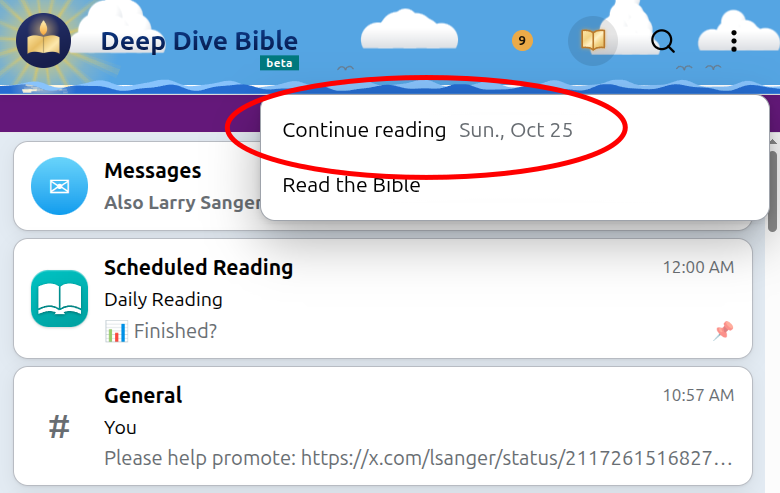
It plops me down right where I left off, and if I was listening, it starts playing immediately. (Yes, it has a full-featured audio Bible feature built in, at least for the KJV and NKJV, more coming soon.)
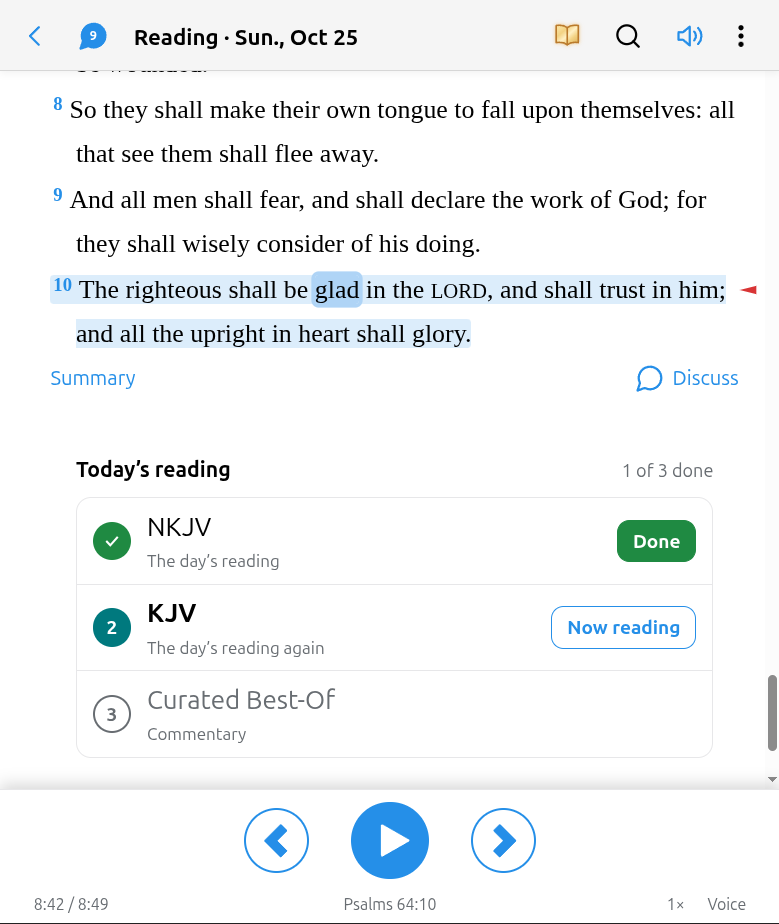
I can easily control how many times (maybe just once) I read the day’s assignment, and which commentary I read (or two, or none at all). When I mark a certain part done, I am automatically put in the next part of the assignment. So say I press that “Now reading” button for the KJV. Then I am plopped down at the beginning of the commentary I chose:
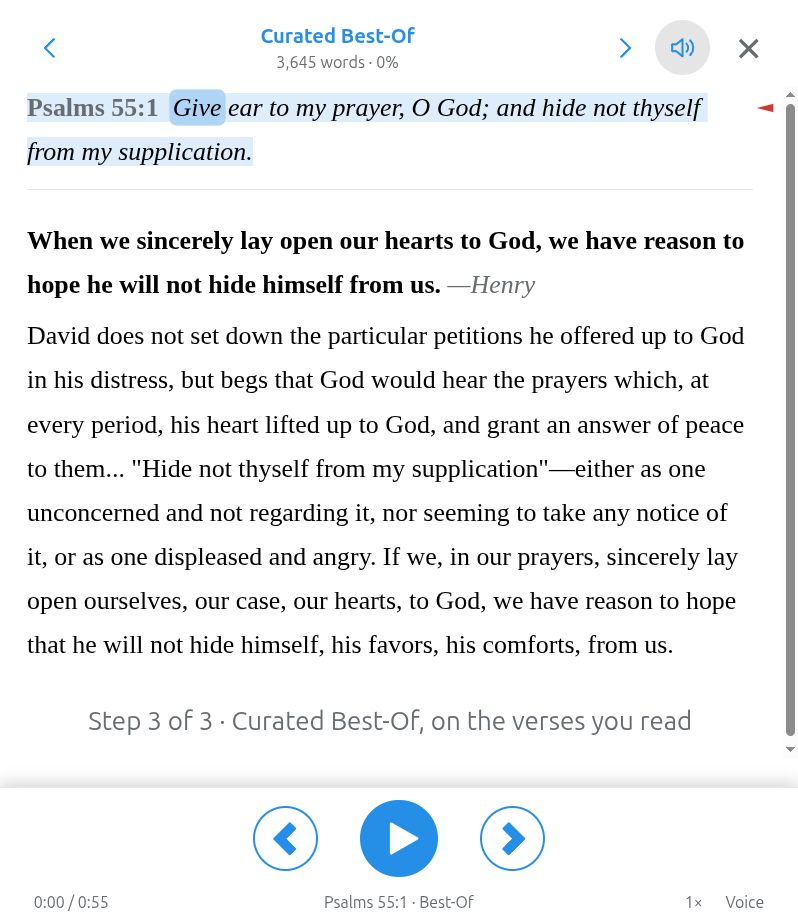
This “Curated Best-Of” commentary is another quick AI project I threw together. First, I downloaded (or had Claude download) 30+ commentaries. Then, an AI agent divided the chapter into verses or chunks of up to three related verses. Next, I had it find a bit more than one comment per verse; comments are typically not longer than a paragraph, but I make a special exception for Matthew Henry. The comments are judged “best” according to a certain prompt I wrote.{{Here is Claude’s own summary of my (rather long) prompt:
For each verse, the curator finds the verse’s central point and its two to four most important insights. For each insight, it takes the one commentator who states it best. A second voice gets in only if it teaches the reader something the first did not.
The test of “best” is insight over exposition: does the comment tell the reader something they would not see by reading the verse themselves? Restating a clear verse is excluded, even from a good commentator. Explanation counts only where the verse is genuinely obscure. When one commentator explains and another analyzes, the analyst wins.
What counts in a commentator’s favor is theological depth: the implications, difficulties, and significance of the text. So do Hebrew or Greek points that change the meaning, background that unlocks the text, and cross-references whose connection is explained. So do typology the New Testament warrants, the Fathers, application that is not obvious, and honesty about real difficulties.
What is passed over is word study that leads nowhere, and textual or literary points that change no meaning. So are liberal critical assumptions presented as fact, and condescension to Hebrew thought. So are doctrinal conclusions Protestants reject, though there the conclusion is excluded, not the writer.
Across the chapter, the aim is about 1.5 comments per verse [the actual rate, with this prompt, ends up around 1.1, which is how I want it], with no point made twice and no commentator in more than about a quarter of the chunks. The curator is told to look past Calvin and to favor Henry, Ellicott, Gill, the Pulpit Commentary, Bengel, and the Fathers. Where Henry is at his best, one longer passage of his may be kept whole.}}
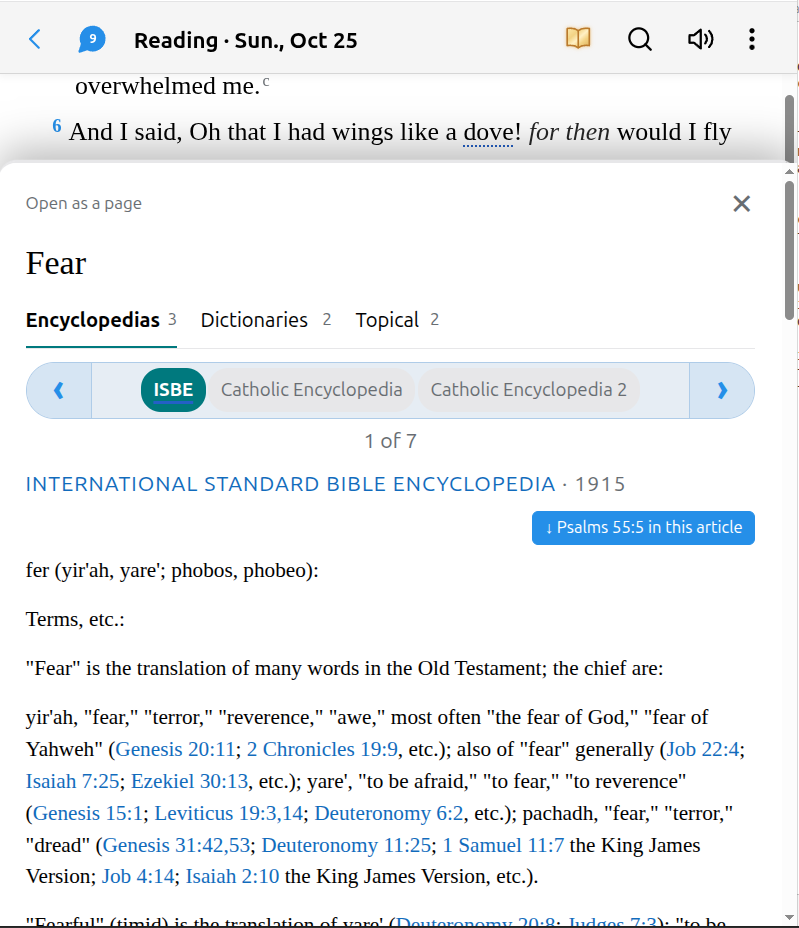
Occasionally, I want to consult encyclopedia, dictionary, or map references, or to look at cross-references; I also not infrequently want to look at the Hebrew or Greek. All these things are just a few taps or clicks away in the interface.
See the about page for more details on features.
Better yet, just try it out yourself, make a new account, and even (once you have an account) ask to start a group, or joine one (if you have an invite). You could also start a personal study (no invite needed).
I hope you like it—but my prayer in any case is that you do indeed study the Bible, which is the word of the holy, living God.
Reply to “Deep Dive Bible: a new Bible study app”