This is an essay on whether there are multiple gods, according to the Bible. Suffice it to say that there were strong opinions about the May 18 previous version of this; the following day, I revised it, removing the name of a certain Bible scholar. This is just a blog post, not my final word on the subject; it’s just some summary remarks.
In what follows, I argue that it is both heretical and philosophically confused to maintain that there are multiple gods. Some people who are, or at least seem to be, Christian, do in fact endorse such claims as “There are multiple gods” and “The Bible correctly refers to multiple gods.” Such statements—not any one person’s body of work—are my target.
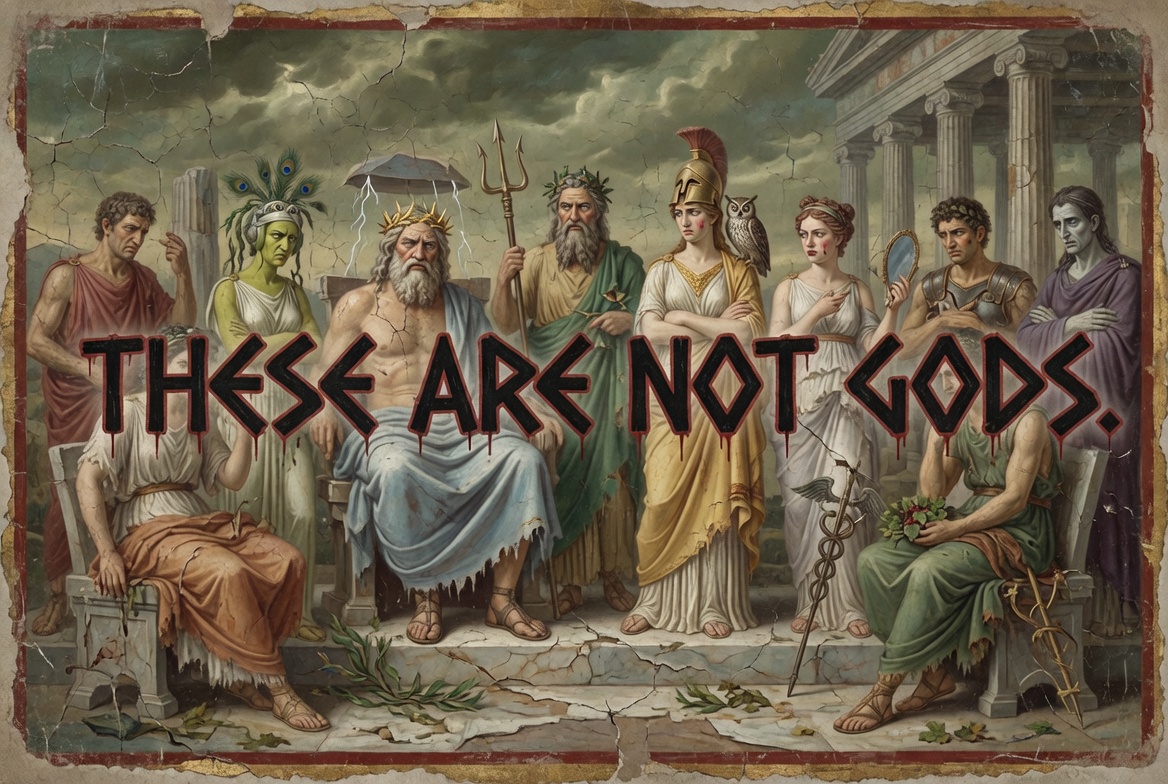
1. The general background of words for “God” and “gods” in Scripture
My view, and that of Christians (full stop), and that of the Bible (also full stop), is this: There is exactly one God, and no other gods exist; but I acknowledge that some pagans worship or worshipped demons, some of which may exist or have existed, and which they wrongly called “gods” (Hb. elohim, Gk. theoi, Lat. deī, etc.). This is the traditional view (full stop again). It is the view of the traditional, orthodox branches of Christianity, Protestant, Catholic, and Eastern Orthodox, going back to Scripture and the early Church Fathers.
Polytheism is an ontological position, not a position about your personal objects of worship. Monotheism means belief in one God (i.e., that one exists), period. If you think there are multiple gods but you only worship one of them, you are a nonstandard kind of polytheist (maybe a henotheist)—not a monotheist. Do you believe there are many entities that are properly called “gods”? Then you’re a polytheist. That’s the standard definition you’ll find discussed in any philosophy of religion, theology, or religious studies context. The issue obviously does not turn on the question whether certain spiritual entities exist. The issue turns on the question whether (in our doctrine) we should, or are permitted to, call them “gods.”
The key issue is whether our doctrine must acknowledge that other entities that we call “gods” exist. Answer: no. Others call them “gods”; we call the same beings “demons.” If Scripture does call them “gods,” and if we do so as well, then we and Scripture do so quotationally: They are “gods,” but not really. Or, in some other cases, we call them “gods” metaphorically (see below).
Nevertheless, there is a certain view, fashionable among some Christians, about what we are to make of scriptural usage of the words for “gods” (Hebrew elohim, Greek theoi). Christians have always believed in a robust spiritual realm; for over a century, modern secular Bible scholars sought to restrain such beliefs, but such people were heretical anyway. Now, some careless readers have observed that the Bible applies elohim to various kinds of entities and then immediately conclude, “The ancient Hebrews believed in many gods!” But it just doesn’t follow in any immediate, simple way from the data; you must construct a case. The OT is willing to call created beings that “the nations” worship, as well as carved idols, the spirits of the dead, and even human judges elohim. So elohim does not always mean literally “god.” Even when it does mean “god,” in some reasonable sense of this word, it is often used in a quotational way; that is, it is as if the prophets would write, if they had the modern English idiom, “the nations worship demons that they are pleased to call gods.” That is my view and, I think, that of Scripture and Church tradition. Just because the Bible speaks of these entities quotationally as elohim, that hardly means that the writers themselves held them properly to be what we Christians would call “gods.” Sometimes, by the way, you might translate elohim as “spiritual being” or perhaps “entity taken as an object of worship, rightly or wrongly.” (The latter is appropriate for when Scripture calls dumb carved idols elohim, as for example at Ex 34:17.) But the force of calling them the pagan deities “gods” is not to endorse them as being gods, but to say that that is what the pagans called them.
This complex linguistic situation might seem to permit us to make the edgy move renaming demons (and angels as well) “gods” (because indeed, angels and demons are sometimes called elohim) and to say that, for this reason at least, the ancient Hebrews believed in multiple gods. Such claims can be downplayed in terms of their doctrinal significance, treating them as purely about Bible exegesis. It is not just that. It is certainly a doctrinal claim, and if taken seriously, it would require massive rewrites of theological tomes. But it is true that, for many years, “critical” naturalistic Bible scholars, who do not concern themselves with confessions or systematic theology, have said that the Bible endorses many gods, on grounds that Hebrew monotheism emerged out of pre-existing polytheism. This sort of speculative theory has long been touted by liberal and skeptical Bible critics. It was in part due to the popularity of this view among Bible scholars in general that some Christian scholars introduced the idea that the angels and demons found in the Bible are, in fact, simply the gods of the polytheistic milieu of the ancient Near East (ANE). My view is that this doctrine smuggles in a theological framework for a kind of polytheism in a Christian context. If taken seriously in the Church, it would lay the foundation for the sort of pantheon of “spiritual beings” that esoteric, New Age, and other liberal “Christians” often discuss.
My view, then, is that a significant difficulty on this subject is rooted in the fact that the words elohim and theoi are applied to entities just because the Gentiles worshipped them. And, again on my view, this undisputed fact has resulted in a simplistic position (not to say all such positions are simplistic) that is both heretical and philosophically uninformed—particularly as regards the distinction between literal and quotational uses of a word or phrase.
Let us see if we can make better sense of what is going on here. Consider the quotational use of words; this is a universal feature of language. When we describe the beliefs of other people, the straightforward way is to use the words that they use, even if we do not share the same beliefs. If I condemn your belief and say, “Look at all of the wicked gods you believe in,” it simply does not follow from what I said that I believe in the gods that you believe in. We can accurately say the ancient Romans worshipped many gods—thousands of them. Are we thereby saying that those gods existed? Of course not. Or if I want to refer to my Hindu friend’s god Shiva, I might well use the word “god,” but that doesn’t commit me either to the existence of Shiva or to the idea that Shiva is properly called a “god.” I’m just using the word quotationally: my Hindu friend’s god Shiva. The basic idea of quotational use is itself not terribly complicated. But it causes all sorts of problems; it is just confusing enough that it is the reason people have introduced what are called scare quotes: my Hindu friend’s “god” Shiva. Yet the Bible writers did not have scare quotes.
Now, combine this complex and confusing linguistic situation with the fact that the prevailing ANE worldview was polytheistic. No one disputes this. Now, on the orthodox view, the one and only God, the creator of the universe, revealed himself to Abraham and said, essentially, “Only I am God.” Ever after, the orthodox Hebrew (and then Christian) view has been: There is one God, full stop. Sure, there are demons that rule the nations, and these might be called “gods” by their Gentile worshippers, and that description might be repeated quotationally by the Bible writers. Similarly, sure, God has angels—messengers—who, because they speak for the one true God, are called “gods.” But this is metaphorical, i.e., it is to say that it serves as a kind of symbol or representation of the real thing. Thus angels are metaphorically, not literally, elohim; they are called that because they are representatives of the one true elohim. Similarly, there were men called “gods” because they were tasked with the godly responsibility of judging other men; this use is metaphorical as well. But none of that stands in any tension with the fundamental truths that there is one God and that no other literal gods exist. So, in short, there are quotational and metaphorical uses of “gods” in the Bible, yes; but there are no literal, non-quotational and non-metaphorical uses of the plural, because Scripture is entirely consistent and it says, “there is one God,” period.
With this essential context and position statement in place, let us defend the claim that the Bible really is committed to one and only one God.
2. Why think the Bible is committed to one and only one God
As Moses said essentially and most emphatically, there is but one God: “The Lord he is God; there is none else beside him” (Deut 4:35). And this essential point is repeated in several places (see also Deut 6:4; Isa 45:5; 1 Cor 8:4; and Gal 4:8).
As I indicated earlier, when the Lord speaks of and Moses writes of “gods” (elohim), in the plural form, they are using the term either metaphorically or quotationally. Since Hebrew did not have quotation marks or other indicators of the quotational use of words, when they were forbidding and deploring worship of the pagan “gods,” how else were they supposed to make their points clear? Similarly, it was unusual to make the metaphorical use of words explicit. Men who judged the people of Israel were called “gods” because they were in God’s place (cf. Ex 18:19); thus, such a use was metaphorical (more on this below in connection to Psalm 82).
When we discuss such non-literal uses of the word “god,” I’m not even saying that we need to use another term. I’m simply saying that we need to understand that such uses might very well be quotational or metaphorical, and not literal. In other words, when the Bible writers and God himself speak of certain entities, they say not that they are gods, but that the Gentiles take them to be gods. Again, for modern precision and to understand the intent, we would use scare quotes: all the “gods” of Egypt. But we have increasingly seen the frankly heretical idea that there really were many pagan gods. There were and are demons that were and still are called “gods” by some. But so called by Christians? No. No pagan gods exist.
Now, let me make a challenge to those who say the Bible endorses the existence of entities really, properly called “gods.” Find me any place in the OT where the elohim of the nations are mentioned in way that must be understood non-quotationally—that is, where a biblical writer, speaking in his own voice, calls a pagan deity elohim. Also, find me any quotation from Jesus, the Apostles, or any NT writer speaking of the theoi of the Gentiles in their own voice rather than quotationally. Find me any quotation from the Church Fathers in which the “gods” (again theoi, or deī in Latin) of the Gentiles are so called in their own voice and not quotationally. I’m aware of no such place. Prove me wrong; I’ll be grateful.
Consider some verses that are presented as strong examples.
You might raise Exodus 20:3: “Thou shalt have no other gods before me.” The whole context—this is God, creator of heaven and earth, infinitely above all things—makes a reading of ontological peers of God impossible. Again, the difficulty is that ancient Hebrew had no scare quotes, no “so-called,” no italics. When the available word for “entity that pagans worship” is elohim, the word will appear in contexts where the speaker obviously does not endorse the ontological claim. The absence of quotational markers—since none were available—does not entail the absence of quotational intent.
Here, too, we must not ignore the context: The first two commandments are precisely the context in which God claims to be the one and only God. Again, see Deut 4:35 and the other verses cited above on this point.
You might point to Deuteronomy 32:17: “They sacrificed unto devils, not to God; to gods which they knew not.” But notice that Moses calls these same entities “devils” (shedim) in the very same verse. That is his own classification. The word elohim sits alongside it as a label for what their worshipers called them; “devils” is what Moses (and later inspired Bible writers) calls them.
You might point to 1 Corinthians 8:5: “For though there be that are called gods, whether in heaven or in earth, (as there be gods many, and lords many), but to us there is but one God.” But look at what Paul does here. He opens with “called” (legomenoi)—which is as close to an explicit quotational marker as you’ll find in the Bible—and closes with “but to us there is but one God.” Paul’s parenthetical words merely describe what pagans believe, and he is unambiguous about what he believes in: one God. Paul explicitly declared that he did not believe in other gods. He spoke of entities that might either be dumb idols or demons, and he acknowledged that the Gentiles called them “gods”; but he did not call them gods himself.
Let us consider an essential exegetical point that applies to confessional Christians. Let secular Bible scholars say what they will, but if you are committed to analogia fidei, then you must interpret the OT mentions (not uses!) of elohim consistently with what Paul says. If he calls them “wood and stone” and “demons,” and that the Gentiles call them “gods,” that is the stance we must find in the rest of Scripture. And that is why the Nicene Creed affirms clearly and unmistakably: “We believe in one God.”
In the Fathers you will find no pussyfooting around with the notion that the theoi of the Gentiles really were theoi. The word is used, but in no place are we required to believe that they really are gods. Much of later demonological theology goes back to Augustine in City of God, where he goes on for many pages discussing the common Roman belief in daimones that were sometimes good, sometimes bad. In Book VIII, Ch. 14, he introduces the topic and then argues that, while considered to be gods, they are no gods at all. Exegeting Psalm 96:5, Augustine writes, “He said, ‘above all gods,’
but added, ‘of the nations’;
that is to say, above all those whom the nations count gods, in other words, demons.”
The passage that precedes this is possibly clearer on the point:
If the Platonists prefer to call these angels gods rather than demons, and to reckon them with those whom Plato, their founder and master, maintains were created by the supreme God, they are welcome to do so, for I will not spend strength in fighting about words. For if they say that these beings are immortal, and yet created by the supreme God, blessed but by cleaving to their Creator and not by their own power, they say what we say, whatever name they call these beings by. And that this is the opinion either of all or the best of the Platonists can be ascertained by their writings. And regarding the name itself, if they see fit to call such blessed and immortal creatures gods, this need not give rise to any serious discussion between us…
Another often-cited passage is Psalm 82, where the psalmist says that God “judgeth among the gods” and “Ye are gods.” It is claimed—to my mind, with puzzling confidence—that these refer to spiritual beings, perhaps demons.
I take the absolutely, unquestionably traditional view (going back at least to Augustine again) that Psalm 82 was referring to human judges, just as Exodus 21–22 does in three places (21:6, 22:8–9, 22:28). The words of Jesus himself in John 10 may guide us. There, he affirmed that some men are dignified with the title theoi (gods). In John 10:34, Jesus quotes “ye are gods” from Psalm 82:6, clearly referring to the judges or rulers of Israel. You make nonsense of Jesus’ point if you take “ye are gods” to refer to “spiritual beings.” The Jews are accusing Jesus: “Thou, being a man, makest thyself God.” Jesus responds not by agreeing that he is God, but by quoting the text and then saying, “He called them gods, unto whom the word of God came.” That is, the persons called “gods,” i.e., representatives of God, were those who received the word of God, the judges who were judging in Moses’ stead, and this is why human judges were called elohim in Exodus 21:6 and 22:8–9, 28. Jesus’ response to his accusers would be much more on point—it would have much more rhetorical impact—if all understood the psalm to be speaking of human judges. Indeed, that’s the obvious reading. The “spiritual beings” reading is strained for these reasons.
Moreover, Jesus claimed rather to be the divinely appointed spokesman for God—a classic feature of human judges—who could be called Son of God because “the word of God came” to him. In Psalm 82, God says the elohim will “die like men,” which is an odd thing to say to angels. But it is not odd at all; it is the sobering and biting verbal irony to dignify human judges as “gods” and then to turn around and say they will die like the men they are. Again, this is, it should be noted, the traditional reading—the only reading of the Church Fathers and of orthodox commentators down through the centuries. Are we supposed to ignore that? The “spiritual beings” interpretation of Psalm 82 is the strained novelty, not the other way around.
To sum up: Since no demon is properly called a god, when Scripture refers to them as “gods,” the use of this word is quotational. The Bible writers sometimes did followed the ANE pagan usage of words, and indeed not their own preferred words in their own voice. Ironically, this was so they would be clearly understood by their audience. Scripture might call angels and men “gods” as well, but here the meaning is metaphorical: They are messengers and representatives of the one and only God. In short, in no place in Scripture and in no place in the Fathers does anyone ever speak of the “gods” of the Gentiles as gods in their own voice. The prophets, Jesus, the Apostles, and the Fathers are unanimous: There is exactly one God, and no other gods exist.
Let me leave you with some recommendations.
The view I urge here is ultimately quite simple. If your theology causes you to say there are many actual gods—entities that really should be called “gods”—you’re wrong, a polytheist (not just a henotheist), and taking a fundamentally heretical position. I’m not accusing anyone of taking this position, but if the shoe fits, wear it.
By contrast, if all you’re saying is that the pagans worshipped real entities that Scripture called “gods” to clarify that the Gentiles considered them such, then your position is not polytheism and you don’t really believe in multiple gods. Perhaps you’re just philosophically confused, but that’s common and resolved easily enough. (I hope this essay will help.)
If you are not sure what to think here, then let’s at least be clear about what decision you face: What should you put in your ontology, i.e., the set of things you believe actually do exist, in terms you use them to describe them literally? Among other things, you should consider whether you think you ought to embrace an orthodox ontology. We Christians believe in one and only one God and that no other gods exist (at all). I recommend you join us in this (orthodox) belief.
But please—don’t start calling demons gods. They’ll like that, you know.
Appendix: some of my arguments, reduced to logical form
The basic argument for Christian monotheism
- All the “gods” of the Gentiles (whether they exist or not and regardless of their powers and functions) are false.
- Thus, the “gods” of the Gentiles are not “gods” in any sense, other than a quotational sense (i.e., in the sense in which they are called that by their worshippers). (From 1.)
- If nothing is x in any but a quotational sense, then x does not really exist.
- So, the “gods” of the Gentiles do not really exist. (From 2 and 3.)
- God exists.
- The only (literal) “gods” we need consider are God and those of the Gentiles.
- Thus, only God exists; that is, there is only one God. Scripture is very clear about this. (From 4, 5, and 6.)
- That only God exists is stated very clearly in the classical formularies of the Church (i.e., accepted by all orthodox denominations).
- So, the proposition that there are many gods (of the Gentiles) is contrary to the classical formularies of the Church. (From 8.)
- Whatever is contrary to the classical formularies of the Church is certainly heretical.
- Thus, the proposition that there are many gods is certainly heretical. (From 9 and 10.)
- Therefore, there is only one God, and the proposition that there are many gods is certainly heretical. (From 7 and 11.)
What follows are three different arguments for premise (2), which I suppose is probably the most controversial one here. Of these, I think the third is the strongest, and is maybe clearer than what I wrote above on the same topic.
Argument from the false expert analogy
2a. A false god is to a god as a false expert is to an expert.
2b. A false expert is not really an expert at all (I am a “false Hegel expert,” and therefore not a Hegel expert).
2c. Thus, a false god is not really a god at all. (From 2a and 2b.)
2d. The “gods” of the Gentiles are false gods. (From 1.)
2e. Therefore, the “gods” of the Gentiles are not really gods at all—that is, not “gods” in any sense other than a quotational one. (From 2c and 2d.)
Argument from biblical usage
2f. When Moses refers to the entities worshipped by the Gentiles, he calls them shedim (“devils”) in his own voice (Deut 32:17).
2g. In the same verse, the word elohim appears alongside shedim as a label for what the worshippers called them.
2h. Thus, Moses’ own classification is “devils”; his use of elohim is quotational. (From 2f and 2g.)
2i. Paul, similarly, marks the Gentiles’ use of “gods” as explicitly quotational with legomenoi (“called”) and concludes “but to us there is but one God” (1 Cor 8:5).
2j. So, the biblical writers themselves treat “gods” as applied to pagan deities as quotational, not literal. (From 2h and 2i. These are only two examples. There is more and similar data.)
2k. Therefore, the “gods” of the Gentiles are not “gods” in any sense other than a quotational one. (From 2j.)
Argument from analogia fidei
2l. Scripture applies elohim and theoi to the gods of the Gentiles (e.g., Ex 20:3; Deut 32:17; 2 Chron 25:15; Acts 14:11, 17:18).
2m. Scripture also declares, repeatedly and emphatically, that there is only one God and that pagan deities are not gods (Deut 4:35; Deut 6:4; Isa 45:5; 1 Cor 8:4; Gal 4:8).
2n. The principle of analogia fidei requires that (2l) and (2m) be made consistent, i.e., a truth-preserving way to interpret Scripture so that the gods of the Gentiles may in some sense be called “gods” and also to deny that they are gods (since there is only one God).
2o. Specific verses indicate exactly how to make them consistent: Moses calls the Gentile gods “new gods that newly came up,” but names the same entities shedim (“devils”) in his own voice (Deut 32:17).
2p. Similarly, Paul explicitly marks “gods” with legomenoi (“that are called gods”) and concludes “but to us there is but one God” (1 Cor 8:5).
2q. Thus, the best application of analogia fidei is the one Scripture itself suggests: the uses in (2o) and (2p) are quotational. (From 2n, 2o, and 2p.)
2r. Therefore, the “gods” of the Gentiles are not “gods” in any sense other than a quotational one. (From 2q.)
Reply to “"There is none else beside him"”