The following is a new “synthetic” Harmony of the Gospels—covering the passion story through the end of all four gospels.
Following the harmony itself I will give notes on how I prepared this, defending various choices, etc. I aim to write an essay later explaining what can be learned from this sort of exercise. In short, it is remarkable just how well these four texts fit together in this way, with no dishonest fudging.
I hope you find it as illuminating as I found to compile.
Key
■ Matthew ■ Mark ■ Luke–Acts ■ John ■ connecting words
Mouse over the colored words to see their source.
The Preparation
The Conspiracy and the Anointing at Bethany
1Now the Feast of Unleavened Bread drew near, which is called Passover. 23Then the chief priests, [a]the scribes, and the elders of the people assembled at the palace of the high priest, who was called Caiaphas, and 2sought 4and plotted how they might 1take Him by [a]trickery and kill Him. 2But they said, “Not during the feast, lest there be an uproar of the people.” For they feared the people.
1Then, six days before the Passover, Jesus came to Bethany, to 3the house of Simon the leper, where Lazarus was [a]who had been dead, whom He had raised from the dead. 2There they made Him a supper; and Martha served, but Lazarus was one of those who sat at the table with Him. As He sat at the table, 3Mary took a pound of oil, an alabaster flask of very costly, 6fragrant [b]oil of spikenard. Then she broke the flask and poured it on His head and anointed the feet of Jesus, and wiped His feet with her hair. And the house was filled with the fragrance of the oil. 8But when His disciples saw it, 4there were some who were indignant among themselves and said, “Why was this fragrant oil wasted?” 4One of His disciples, Judas Iscariot, Simon’s son, who would betray Him, said, 5“Why was this fragrant oil not sold? 5For it might have been sold for 9much, more than three hundred denarii, and given to the poor.” 6This he said, not that he cared for the poor, but because he was a thief, and had the money box; and he used to take what was put in it. And they criticized[c] her sharply.
10But when Jesus was aware of it, He said to them, “Why do you trouble the woman? 6Let her alone. 7She has kept this for the day of My burial. She has done a good work for Me. 7For you have the poor with you always, and whenever you wish you may do them good; but Me you do not have always. 8She has done what she could. She has come beforehand to anoint My body: 12in pouring this fragrant oil on My body, she did it for My burial. 9Assuredly, I say to you, wherever this gospel is preached in the whole world, what this woman has done will also be told as a memorial to her.”
9Now a great many of the Jews knew that He was there; and they came, not for Jesus’ sake only, but that they might also see Lazarus, whom He had raised from the dead. 10But the chief priests plotted to put Lazarus to death also, 11because on account of him many of the Jews went away and believed in Jesus.
Preparation of the Passover
3Then Satan entered Judas surnamed Iscariot, who was numbered among the twelve. 4So he went his way and conferred with the chief priests and captains, how he might betray Him to them. He 15said, “What are you willing to give me if I deliver Him to you?” 5And 11when they heard it, they were glad, and agreed and promised to give him money; And they counted out to him thirty pieces of silver. 6So he promised and, from that time, sought opportunity to betray Him conveniently to them in the absence of the multitude.
1Now it came to pass, when Jesus had finished all these sayings, that He said to His disciples, 2“You know that after two days is the Passover, and the Son of Man will be delivered up to be crucified.”
7Then came the 12first Day of Unleavened Bread, when the Passover must be [a]killed. His disciples 17came to Jesus and said to Him, “Where do You want us to go and prepare for You, that You may eat the Passover?” 8And He sent 13two of His disciples, Peter and John, saying, “Go and prepare the Passover for us, that we may eat. 13Go into the city; and Behold, when you have entered the city, a 18certain man will meet you carrying a pitcher of water; follow him into the house which he enters. 4Wherever he goes in, 11you shall say to the master of the house, ‘The Teacher says to you, “My time is at hand; I will keep the Passover at your house. Where is the guest room where I may eat the Passover with My disciples?” ’ 12Then he will show you a large, furnished upper room; there make ready 15for us.”
19So the disciples did as Jesus had directed them; they 16 went out, and came into the city, 13and found it just as He had said to them; and they prepared the Passover.
The Last Supper
1Now before the Feast of the Passover, when Jesus knew that His hour had come that He should depart from this world to the Father, having loved His own who were in the world, He loved them to the end. 17In the evening, 14when the hour had come, He came and sat down, and the [b]twelve apostles with Him. 15Then He said to them, “With fervent desire I have desired to eat this Passover with you before I suffer; 16for I say to you, I will no longer eat of it until it is fulfilled in the kingdom of God.”
2During supper, the devil having already put it into the heart of Judas Iscariot, Simon’s son, to betray Him, 3Jesus, knowing that the Father had given all things into His hands, and that He had come from God and was going to God, 4rose from supper and laid aside His garments, took a towel and girded Himself. 5After that, He poured water into a basin and began to wash the disciples’ feet, and to wipe them with the towel with which He was girded. 6Then He came to Simon Peter. And Peter said to Him, “Lord, are You washing my feet?”
7Jesus answered and said to him, “What I am doing you do not understand now, but you will know after this.”
8Peter said to Him, “You shall never wash my feet!”
Jesus answered him, “If I do not wash you, you have no part with Me.”
9Simon Peter said to Him, “Lord, not my feet only, but also my hands and my head!”
10Jesus said to him, “He who is bathed needs only to wash his feet, but is completely clean; and you are clean, but not all of you.” 11For He knew who would betray Him; therefore He said, “You are not all clean.”
12So when He had washed their feet, taken His garments, and sat down again, He said to them, “Do you [b]know what I have done to you? 13You call Me Teacher and Lord, and you say well, for so I am. 14If I then, your Lord and Teacher, have washed your feet, you also ought to wash one another’s feet. 15For I have given you an example, that you should do as I have done to you. 16Most assuredly, I say to you, a servant is not greater than his master; nor is he who is sent greater than he who sent him. 17If you know these things, blessed are you if you do them.
18“I do not speak concerning all of you. I know whom I have chosen; but that the Scripture may be fulfilled, ‘He who eats [c]bread with Me has lifted up his heel against Me.’ 19Now I tell you before it comes, that when it does come to pass, you may believe that I am He. 20Most assuredly, I say to you, he who receives whomever I send receives Me; and he who receives Me receives Him who sent Me.”
18Now as they sat and ate, after 21Jesus had said these things, He was troubled in spirit, and testified and said, “Most assuredly, I say to you, one of you who eats with Me will betray Me.”
22Then the disciples looked at one another, perplexed about whom He spoke.
19And they began to be 22exceedingly sorrowful, and to say to Him one by one, “Lord, Is it I?” [e]And another said, “Is it I?”
20He answered and said to them, ”21Behold, the hand of My betrayer is with Me on the table. One of the twelve, who dips 23his hand with Me in the dish, will betray Me. 21The Son of Man indeed goes just as it is written of Him, 22as it has been determined, but woe to that man by whom the Son of Man is betrayed! It would have been good for that man if he had never been born.”
23Then they began to question among themselves, which of them it was who would do this thing.
23Now there was [d]leaning on Jesus’ bosom one of His disciples, whom Jesus loved. 24Simon Peter therefore motioned to him to ask who it was of whom He spoke.
25Then, leaning [e]back on Jesus’ breast, he said to Him, “Lord, who is it?”
26Jesus answered, “It is he to whom I shall give a piece of bread when I have dipped it.” And having dipped the bread, He gave it to Judas Iscariot, the son of Simon. 27Now after the piece of bread, Satan entered him. Then Jesus said to him, “What you do, do quickly.” 28But no one at the table knew for what reason He said this to him. 29For some thought, because Judas had the money box, that Jesus had said to him, “Buy those things we need for the feast,” or that he should give something to the poor.
25Then, 30having received the piece of bread, Judas, who was betraying Him, answered and said, “Rabbi, is it I?”
He said to him, “You have said it.” He then went out immediately. And it was night.
31So, when he had gone out, Jesus said, “Now the Son of Man is glorified, and God is glorified in Him. 32If God is glorified in Him, God will also glorify Him in Himself, and glorify Him immediately. 33Little children, I shall be with you a little while longer. You will seek Me; and as I said to the Jews, ‘Where I am going, you cannot come,’ so now I say to you. 34A new commandment I give to you, that you love one another; as I have loved you, that you also love one another. 35By this all will know that you are My disciples, if you have love for one another.”
36Simon Peter said to Him, “Lord, where are You going?”
Jesus answered him, “Where I am going you cannot follow Me now, but you shall follow Me afterward.”
22And as they were eating, Jesus took bread, blessed, 19gave thanks, and broke it, and gave it to 26the disciples and said, “Take, [f]eat; this is My body which is given for you; do this in remembrance of Me.”
20Likewise He also took the cup after supper, 23and when He had given thanks He gave it to them, and they all drank from it. And he said, “Drink from it, all of you. 28For this is My blood of the [d]new covenant, which is shed for you and for many for the [e]remission of sins. 25Assuredly, 18I say to you, [c]I will not drink of the fruit of the vine until the kingdom of God comes, on that day when I drink it new 29with you in My Father’s kingdom, the kingdom of God.”
24Now there was also a dispute among them, as to which of them should be considered the greatest. 25And He said to them, “The kings of the Gentiles exercise lordship over them, and those who exercise authority over them are called ‘benefactors.’ 26But not so among you; on the contrary, he who is greatest among you, let him be as the younger, and he who governs as he who serves. 27For who is greater, he who sits at the table, or he who serves? Is it not he who sits at the table? Yet I am among you as the One who serves.
28“But you are those who have continued with Me in My trials. 29And I bestow upon you a kingdom, just as My Father bestowed one upon Me, 30that you may eat and drink at My table in My kingdom, and sit on thrones judging the twelve tribes of Israel.”
31[d]And the Lord said, “Simon, Simon! Indeed, Satan has asked for you, that he may sift you as wheat. 32But I have prayed for you, that your faith should not fail; and when you have returned to Me, strengthen your brethren.”
33But 37Peter said to Him, “Lord, why can I not follow You now? Lord, I am ready to go with You, both to prison and to death. I will lay down my life for Your sake.”
38Jesus answered him, “Will you lay down your life for My sake? Most assuredly, 34I tell you, Peter, the rooster shall not crow this day before you will deny three times that you know Me.”
The Farewell Discourse
1“Let not your heart be troubled; you believe in God, believe also in Me. 2In My Father’s house are many [a]mansions; if it were not so, [b]I would have told you. I go to prepare a place for you. 3And if I go and prepare a place for you, I will come again and receive you to Myself; that where I am, there you may be also. 4And where I go you know, and the way you know.”
5Thomas said to Him, “Lord, we do not know where You are going, and how can we know the way?”
6Jesus said to him, “I am the way, the truth, and the life. No one comes to the Father except through Me.
7“If you had known Me, you would have known My Father also; and from now on you know Him and have seen Him.”
8Philip said to Him, “Lord, show us the Father, and it is sufficient for us.”
9Jesus said to him, “Have I been with you so long, and yet you have not known Me, Philip? He who has seen Me has seen the Father; so how can you say, ‘Show us the Father’? 10Do you not believe that I am in the Father, and the Father in Me? The words that I speak to you I do not speak on My own authority; but the Father who dwells in Me does the works. 11Believe Me that I am in the Father and the Father in Me, or else believe Me for the sake of the works themselves.
12“Most assuredly, I say to you, he who believes in Me, the works that I do he will do also; and greater works than these he will do, because I go to My Father. 13And whatever you ask in My name, that I will do, that the Father may be glorified in the Son. 14If you [c]ask anything in My name, I will do it.
15“If you love Me, [d]keep My commandments. 16And I will pray the Father, and He will give you another [e]Helper, that He may abide with you forever— 17the Spirit of truth, whom the world cannot receive, because it neither sees Him nor knows Him; but you know Him, for He dwells with you and will be in you. 18I will not leave you orphans; I will come to you.
19“A little while longer and the world will see Me no more, but you will see Me. Because I live, you will live also. 20At that day you will know that I am in My Father, and you in Me, and I in you. 21He who has My commandments and keeps them, it is he who loves Me. And he who loves Me will be loved by My Father, and I will love him and [f]manifest Myself to him.”
22Judas (not Iscariot) said to Him, “Lord, how is it that You will manifest Yourself to us, and not to the world?”
23Jesus answered and said to him, “If anyone loves Me, he will keep My word; and My Father will love him, and We will come to him and make Our home with him. 24He who does not love Me does not keep My words; and the word which you hear is not Mine but the Father’s who sent Me.
25“These things I have spoken to you while being present with you. 26But the [g]Helper, the Holy Spirit, whom the Father will send in My name, He will teach you all things, and bring to your remembrance all things that I said to you. 27Peace I leave with you, My peace I give to you; not as the world gives do I give to you. Let not your heart be troubled, neither let it be afraid. 28You have heard Me say to you, ‘I am going away and coming back to you.’ If you loved Me, you would rejoice because [h]I said, ‘I am going to the Father,’ for My Father is greater than I.
29“And now I have told you before it comes, that when it does come to pass, you may believe. 30I will no longer talk much with you, for the ruler of this world is coming, and he has nothing in Me. 31But that the world may know that I love the Father, and as the Father gave Me commandment, so I do. Arise, let us go from here.
1“I am the true vine, and My Father is the vinedresser. 2Every branch in Me that does not bear fruit He [a]takes away; and every branch that bears fruit He prunes, that it may bear more fruit. 3You are already clean because of the word which I have spoken to you. 4Abide in Me, and I in you. As the branch cannot bear fruit of itself, unless it abides in the vine, neither can you, unless you abide in Me.
5“I am the vine, you are the branches. He who abides in Me, and I in him, bears much fruit; for without Me you can do nothing. 6If anyone does not abide in Me, he is cast out as a branch and is withered; and they gather them and throw them into the fire, and they are burned. 7If you abide in Me, and My words abide in you, you[b] will ask what you desire, and it shall be done for you. 8By this My Father is glorified, that you bear much fruit; so you will be My disciples.
9“As the Father loved Me, I also have loved you; abide in My love. 10If you keep My commandments, you will abide in My love, just as I have kept My Father’s commandments and abide in His love.
11“These things I have spoken to you, that My joy may remain in you, and that your joy may be full. 12This is My commandment, that you love one another as I have loved you. 13Greater love has no one than this, than to lay down one’s life for his friends. 14You are My friends if you do whatever I command you. 15No longer do I call you servants, for a servant does not know what his master is doing; but I have called you friends, for all things that I heard from My Father I have made known to you. 16You did not choose Me, but I chose you and appointed you that you should go and bear fruit, and that your fruit should remain, that whatever you ask the Father in My name He may give you. 17These things I command you, that you love one another.
18“If the world hates you, you know that it hated Me before it hated you. 19If you were of the world, the world would love its own. Yet because you are not of the world, but I chose you out of the world, therefore the world hates you. 20Remember the word that I said to you, ‘A servant is not greater than his master.’ If they persecuted Me, they will also persecute you. If they kept My word, they will keep yours also. 21But all these things they will do to you for My name’s sake, because they do not know Him who sent Me. 22If I had not come and spoken to them, they would have no sin, but now they have no excuse for their sin. 23He who hates Me hates My Father also. 24If I had not done among them the works which no one else did, they would have no sin; but now they have seen and also hated both Me and My Father. 25But this happened that the word might be fulfilled which is written in their law, ‘They hated Me without a cause.’
26“But when the [c]Helper comes, whom I shall send to you from the Father, the Spirit of truth who proceeds from the Father, He will testify of Me. 27And you also will bear witness, because you have been with Me from the beginning.
1“These things I have spoken to you, that you should not be made to stumble. 2They will put you out of the synagogues; yes, the time is coming that whoever kills you will think that he offers God service. 3And these things they will do [a]to you because they have not known the Father nor Me. 4But these things I have told you, that when [b]the time comes, you may remember that I told you of them.
“And these things I did not say to you at the beginning, because I was with you.
5“But now I go away to Him who sent Me, and none of you asks Me, ‘Where are You going?’ 6But because I have said these things to you, sorrow has filled your heart. 7Nevertheless I tell you the truth. It is to your advantage that I go away; for if I do not go away, the Helper will not come to you; but if I depart, I will send Him to you. 8And when He has come, He will convict the world of sin, and of righteousness, and of judgment: 9of sin, because they do not believe in Me; 10of righteousness, because I go to My Father and you see Me no more; 11of judgment, because the ruler of this world is judged.
12“I still have many things to say to you, but you cannot bear them now. 13However, when He, the Spirit of truth, has come, He will guide you into all truth; for He will not speak on His own authority, but whatever He hears He will speak; and He will tell you things to come. 14He will glorify Me, for He will take of what is Mine and declare it to you. 15All things that the Father has are Mine. Therefore I said that He [c]will take of Mine and declare it to you.
16“A little while, and you will not see Me; and again a little while, and you will see Me, because I go to the Father.”
17Then some of His disciples said among themselves, “What is this that He says to us, ‘A little while, and you will not see Me; and again a little while, and you will see Me’; and, ‘because I go to the Father’?” 18They said therefore, “What is this that He says, ‘A little while’? We do not [d]know what He is saying.”
19Now Jesus knew that they desired to ask Him, and He said to them, “Are you inquiring among yourselves about what I said, ‘A little while, and you will not see Me; and again a little while, and you will see Me’? 20Most assuredly, I say to you that you will weep and lament, but the world will rejoice; and you will be sorrowful, but your sorrow will be turned into joy. 21A woman, when she is in labor, has sorrow because her hour has come; but as soon as she has given birth to the child, she no longer remembers the anguish, for joy that a human being has been born into the world. 22Therefore you now have sorrow; but I will see you again and your heart will rejoice, and your joy no one will take from you.
23“And in that day you will ask Me nothing. Most assuredly, I say to you, whatever you ask the Father in My name He will give you. 24Until now you have asked nothing in My name. Ask, and you will receive, that your joy may be full.
25“These things I have spoken to you in figurative language; but the time is coming when I will no longer speak to you in figurative language, but I will tell you plainly about the Father. 26In that day you will ask in My name, and I do not say to you that I shall pray the Father for you; 27for the Father Himself loves you, because you have loved Me, and have believed that I came forth from God. 28I came forth from the Father and have come into the world. Again, I leave the world and go to the Father.”
29His disciples said to Him, “See, now You are speaking plainly, and using no figure of speech! 30Now we are sure that You know all things, and have no need that anyone should question You. By this we believe that You came forth from God.”
31Jesus answered them, “Do you now believe? 32Indeed the hour is coming, yes, has now come, that you will be scattered, each to his [e]own, and will leave Me alone. And yet I am not alone, because the Father is with Me. 33These things I have spoken to you, that in Me you may have peace. In the world you [f]will have tribulation; but be of good cheer, I have overcome the world.”
The High Priestly Prayer and the Preparation for Departure
1Jesus spoke these words, lifted up His eyes to heaven, and said: “Father, the hour has come. Glorify Your Son, that Your Son also may glorify You, 2as You have given Him authority over all flesh, that He [a]should give eternal life to as many as You have given Him. 3And this is eternal life, that they may know You, the only true God, and Jesus Christ whom You have sent. 4I have glorified You on the earth. I have finished the work which You have given Me to do. 5And now, O Father, glorify Me together [b]with Yourself, with the glory which I had with You before the world was.
6“I have [c]manifested Your name to the men whom You have given Me out of the world. They were Yours, You gave them to Me, and they have kept Your word. 7Now they have known that all things which You have given Me are from You. 8For I have given to them the words which You have given Me; and they have received them, and have known surely that I came forth from You; and they have believed that You sent Me.
9“I pray for them. I do not pray for the world but for those whom You have given Me, for they are Yours. 10And all Mine are Yours, and Yours are Mine, and I am glorified in them. 11Now I am no longer in the world, but these are in the world, and I come to You. Holy Father, keep[d] through Your name those whom You have given Me, that they may be one as We are. 12While I was with them [e]in the world, I kept them in [f]Your name. Those whom You gave Me I have kept; and none of them is [g]lost except the son of [h]perdition, that the Scripture might be fulfilled. 13But now I come to You, and these things I speak in the world, that they may have My joy fulfilled in themselves. 14I have given them Your word; and the world has hated them because they are not of the world, just as I am not of the world. 15I do not pray that You should take them out of the world, but that You should keep them from the evil one. 16They are not of the world, just as I am not of the world. 17Sanctify[i] them by Your truth. Your word is truth. 18As You sent Me into the world, I also have sent them into the world. 19And for their sakes I sanctify Myself, that they also may be sanctified by the truth.
20“I do not pray for these alone, but also for those who [j]will believe in Me through their word; 21that they all may be one, as You, Father, are in Me, and I in You; that they also may be one in Us, that the world may believe that You sent Me. 22And the glory which You gave Me I have given them, that they may be one just as We are one: 23I in them, and You in Me; that they may be made perfect in one, and that the world may know that You have sent Me, and have loved them as You have loved Me.
24“Father, I desire that they also whom You gave Me may be with Me where I am, that they may behold My glory which You have given Me; for You loved Me before the foundation of the world. 25O righteous Father! The world has not known You, but I have known You; and these have known that You sent Me. 26And I have declared to them Your name, and will declare it, that the love with which You loved Me may be in them, and I in them.”
35And He said to them, “When I sent you without money bag, knapsack, and sandals, did you lack anything?”
So they said, “Nothing.”
36Then He said to them, “But now, he who has a money bag, let him take it, and likewise a knapsack; and he who has no sword, let him sell his garment and buy one. 37For I say to you that this which is written must still be [e]accomplished in Me: ‘And He was numbered with the transgressors.’ For the things concerning Me have an end.”
38So they said, “Lord, look, here are two swords.”
And He said to them, “It is enough.”
Gethsemane and the Arrest
1When Jesus had spoken these words, 26and when they had sung [h]a hymn, he went out over the Brook Kidron, to the Mount of Olives, 39as He was accustomed, where there was a garden; and His disciples also followed Him. 2And Judas, who betrayed Him, also knew the place; for Jesus often met there with His disciples.
27Then Jesus said to them, “All of you will be made to stumble [i]because of Me this night, for it is written:
‘I
will strike the Shepherd,
And
the sheep 31of
the flock will
be scattered.’
28“But after I have been raised, I will go before you to Galilee.”
33Peter answered and 29said to Him, “Even if all are made to [j]stumble because of You, I will never be made to stumble.”
30Jesus said to him, “Assuredly, I say to you that today, even this night, before the rooster crows twice, you will deny Me three times.”
35Peter said to Him, “Even if I have to die with You, I will not deny You!”
And so said all the disciples.
40When He came to the place, 32which was named Gethsemane and 1which He and His disciples entered, 32He said to His disciples, “Sit here while I 36go and pray over there. Pray that you may not enter into temptation.”
41And He was withdrawn from them about a stone’s throw; 33He took Peter 37and the two sons of Zebedee, James, and John, with Him. And He began to be sorrowful and troubled and deeply distressed. 34Then He said to them, “My soul is exceedingly sorrowful, even to death. Stay here and watch 38with Me.” 35He went a little farther, and fell on the ground 39on His face and knelt down; and he prayed that if it were possible, the hour might pass from Him, 42saying, “35Abba, O My Father, all things are possible for You. Father, if it is possible, let this cup pass from Me; if it is Your will, take this cup away from Me; nevertheless not My will, but Yours, be done.”
43[f]Then an angel appeared to Him from heaven, strengthening Him. 44And being in agony, He prayed more earnestly. Then His sweat became like great drops of blood falling down to the ground.
45When He rose up from prayer, and had come to His disciples, He found them sleeping from sorrow. 46Then He said 37to Peter and to them all, 40“What! Simon, are you sleeping? Why do you sleep? Could you not watch with Me one hour? Rise, 38watch and pray, lest you enter into temptation. The spirit indeed is willing, but the flesh is weak.”
42Again, a second time, He went away and prayed, saying 39the same words: “O My Father, [h]if this cup cannot pass away from Me unless I drink it, Your will be done.” 40And when He returned, He found them asleep again, for their eyes were heavy; and they did not know what to answer Him.
44So He left them, went away again, and prayed the third time, saying the same words. 41Then He came the third time 45to His disciples and said to them, “Are you still sleeping and resting? It is enough! Behold, the hour has come; behold, the Son of Man is being betrayed into the hands of sinners. 42Rise, let us be going. See, My betrayer is at hand.”
43And immediately, 47while He was still speaking, behold, a great multitude with 3lanterns, torches, swords and clubs. 47He who was called Judas, one of the twelve, having received a detachment of troops and officers, came from the chief priests, the scribes, the Pharisees, and the elders of the people. 44Now His betrayer had given them a signal, saying, “Whomever I kiss, He is the One; seize Him and lead Him away safely.”
45As soon as he had come, immediately 47Judas went before them and drew near to Jesus to kiss Him. He said to Him, ”49Greetings, Rabbi, Rabbi!” and kissed Him. 50But Jesus said to him, “Friend, why have you come? 48Judas, are you betraying the Son of Man with a kiss?”
4Jesus therefore, knowing all things that would come upon Him, went forward and said to them, “Whom are you seeking?”
5They answered Him, “Jesus [a]of Nazareth.”
Jesus said to them, “I am He.” And Judas, who betrayed Him, also stood with them. 6Now when He said to them, “I am He,” they drew back and fell to the ground.
7Then He asked them again, “Whom are you seeking?”
And they said, “Jesus of Nazareth.”
8Jesus answered, “I have told you that I am He. Therefore, if you seek Me, let these go their way,” 9that the saying might be fulfilled which He spoke, “Of those whom You gave Me I have lost none.”
49When those around Him saw what was going to happen, they said to Him, “Lord, shall we strike with the sword?” 50Then they came and laid hands on Jesus and took Him. 51And suddenly, 47one of those who stood by with Jesus, Simon Peter, stretched out his hand, drew his sword and struck the servant of the high priest, and cut off 10his right ear. The servant’s name was Malchus.
51But Jesus answered and said, “Permit even this.” And He touched his ear and healed him.
11So Jesus said to Peter, “Put your sword into the sheath, 52for all who take the sword will [j]perish by the sword. 53Or do you think that I cannot now pray to My Father, and He will provide Me with more than twelve legions of angels? 54How then could the Scriptures be fulfilled, that it must happen thus? Shall I not drink the cup which My Father has given Me?”
52Then Jesus said to the chief priests, captains of the temple, the elders, and 55to the multitudes who had come to Him,“Have you come out, as against a robber, with swords and clubs to take Me? I sat daily with you, teaching in the temple, and you did not 53try to seize Me. But this is your hour, and the power of darkness. 56All this was done that the Scriptures of the prophets might be fulfilled.”
Then all the disciples forsook Him and fled.
51Now a certain young man followed Him, having a linen cloth thrown around his naked body. And the young men laid hold of him, 52and he left the linen cloth and fled from them naked.
12Then the detachment of troops and the captain and the officers of the Jews arrested Jesus and bound Him.
The Trials and Death
Peter’s First Denial and the Arraignment before Annas
53And they led Jesus away 54and brought Him 57to Caiaphas the high priest, into the high priest’s house; and with him were assembled all the chief priests, the elders, and the scribes. 13And they led Him away to Annas first, for he was the father-in-law of Caiaphas that year. 14Now it was Caiaphas who advised the Jews that it was [b]expedient that one man should die for the people.
15And Simon Peter followed Jesus 55at a distance, and so did another[c] disciple. Now that disciple was known to the high priest, and went with Jesus into the courtyard of the high priest. 16But Peter stood at the door outside. 66Now Peter was below in the courtyard. Then the other disciple, who was known to the high priest, went out and spoke to her who kept the door, one of the servant girls of the high priest; and she came and brought Peter in. 58And he went in and sat with the servants to see the end. 55Now when they had kindled a fire in the midst of the courtyard and sat down together, Peter sat among them. 17Then the servant girl who kept the door 67saw Peter warming himself as he sat by the fire; she intently looked at him and said, “This man was also with Him. You also were with Jesus of Nazareth, 69of Galilee. You are not also one of this Man’s disciples, are you?”
68But he denied 57[g]Him 70before them all, saying, “I am not. Woman, I do not know Him. I neither know nor understand what you are saying.” And he went out on the porch, and a rooster crowed.
18Now the servants and officers who had made a fire of coals stood there, for it was cold, and they warmed themselves. And Peter stood with them and warmed himself.
19The high priest then asked Jesus about His disciples and His doctrine.
20Jesus answered him, “I spoke openly to the world. I always taught in synagogues and in the temple, where [d]the Jews always meet, and in secret I have said nothing. 21Why do you ask Me? Ask those who have heard Me what I said to them. Indeed they know what I said.”
22And when He had said these things, one of the officers who stood by struck[e] Jesus with the palm of his hand, saying, “Do You answer the high priest like that?”
23Jesus answered him, “If I have spoken evil, bear witness of the evil; but if well, why do you strike Me?”
24Then Annas sent Him bound to Caiaphas the high priest.
Peter’s Further Denials and the Trial before Caiaphas
25Now Simon Peter stood and warmed himself. Therefore they said to him, “You are not also one of His disciples, are you?” 58And after a little while, 71when he had gone out to the gateway, another saw Peter [or] another girl saw him [or] 69the servant girl saw him again, and began to say to those who stood by, “This fellow also was with Jesus of Nazareth. You also are of them.”
But Peter 70denied it again, 72with an oath: ”Man, I am not! I am not!71I do not know the Man!”
59Then, a little later, after about an hour had passed, those who stood by 73came up to Peter again. Another confidently affirmed, “Surely this fellow also was with Him; surely you are one of them; for your speech betrays you; you are a Galilean, [m]and your [n]speech shows it.” 26One of the servants of the high priest, a relative of him whose ear Peter cut off, said, “Did I not see you in the garden with Him?”
27Peter then denied again; 71he began to curse and swear, “I do not know this Man of whom you speak! 60Man, I do not know what you are saying!”
Immediately, while he was still speaking, 72a second time [h]the rooster crowed. 61And the Lord turned and looked at Peter. Then Peter remembered the word of the Lord, how Jesus had said to him, “Before the rooster [i]crows twice, you will deny Me three times.” And when he thought about it, 62Peter went out and wept bitterly.
55Now the chief priests, 59[k]the elders, and all the council sought false testimony against Jesus to put Him to death, but found none. 60Even though many false witnesses came forward, they found none. 56For many bore false witness against Him, but their testimonies [k]did not agree.
57Then at last some rose up; two [m]false witnesses came forward, and bore false witness against Him, saying, 58“This fellow said, ‘I am able to destroy the temple of God and to build it in three days.’ We heard Him say, ‘I will destroy this temple made with hands, and within three days I will build another made without hands.’ ” 59But not even then did their testimony agree.
60And the high priest stood up in the midst and asked Jesus, saying, “Do You answer nothing? What is it these men testify against You?” 61But 63Jesus kept silent and answered nothing.
Again the high priest asked Him, saying to Him, “Are You the Christ, the Son of the Blessed? I put You under oath by the living God: Tell us if You are the Christ, the Son of God!”
64Jesus said to him, “It is as you said. 62I am. Nevertheless, I say to you, hereafter you will see the Son of Man sitting at the right hand of the Power, and coming with the clouds of heaven.”
63Then the high priest tore his clothes and said, 65“He has spoken blasphemy! What further need do we have of witnesses? Look, now you have heard His blasphemy! 64What do you think?”
And they all condemned Him to be deserving of death. 66They answered and said, “He is deserving of death.”
The Mockery by the Guards and Condemnation by the Sanhedrin
63Now the men who held Jesus mocked Him and beat Him. 65Some began to spit on Him. 64[j]And having blindfolded Him, they struck Him on the face and asked Him, saying, “Prophesy! Who is the one who struck You?” 65And many other things they blasphemously spoke against Him.
1Immediately, 1when morning came, 66the elders of the people, both chief priests and scribes, came together and led Him into their council, saying, 67“If You are the Christ, tell us.” And they plotted against Jesus to put Him to death.
But He said to them, “If I tell you, you will by no means believe. 68And if I [k]also ask you, you will by no means answer [l]Me or let Me go. 69Hereafter the Son of Man will sit on the right hand of the power of God.”
70Then they all said, “Are You then the Son of God?”
So He said to them, “You rightly say that I am.”
71And they said, “What further testimony do we need? For we have heard it ourselves from His own mouth.”
2And when they had bound Him, 1the whole multitude of them arose and led Him away and delivered Him to [a]Pontius Pilate the governor.
The Death of Judas
3Then Judas, His betrayer, seeing that He had been condemned, was remorseful and brought back the thirty pieces of silver to the chief priests and elders, 4saying, “I have sinned by betraying innocent blood.”
And they said, “What is that to us? You see to it!”
5Then he threw down the pieces of silver in the temple and departed, and went and hanged himself; Acts 1:18and falling headlong, he burst open in the middle and all his [h]entrails gushed out. 19And it became known to all those dwelling in Jerusalem; so that field is called in their own language, Akel Dama, that is, Field of Blood.
6But the chief priests took the silver pieces and said, “It is not lawful to put them into the treasury, because they are the price of blood.” 7And they consulted together and bought with them the potter’s field, to bury strangers in. 8Therefore that field has been called the Field of Blood to this day.
9Then was fulfilled what was spoken by Jeremiah the prophet, saying, “And they took the thirty pieces of silver, the value of Him who was priced, whom they of the children of Israel priced, 10and gave them for the potter’s field, as the Lord directed me.”
Acts 1:18So Judas purchased a field with the [g]wages of iniquity.
Trials before Pilate and Herod
28Then they led Jesus from Caiaphas to the Praetorium, and it was early morning. But they themselves did not go into the [f]Praetorium, lest they should be defiled, but that they might eat the Passover. 29Pilate then went out to them and said, “What accusation do you bring against this Man?”
30They answered and 2began to accuse Him, saying, “If He were not [g]an evildoer, we would not have delivered Him up to you. We found this fellow perverting [a]the nation, and forbidding to pay taxes to Caesar, saying that He Himself is Christ, a King.”
31Then Pilate said to them, “You take Him and judge Him according to your law.”
Therefore the Jews said to him, “It is not lawful for us to put anyone to death,” 32that the saying of Jesus might be fulfilled which He spoke, signifying by what death He would die.
11Now Jesus stood before the governor.
33Pilate the governor entered the [h]Praetorium again, called Jesus, and 3asked Him, saying, “Are You the King of the Jews?”
34Jesus answered him, “Are you speaking for yourself about this, or did others tell you this concerning Me?”
35Pilate answered, “Am I a Jew? Your own nation and the chief priests have delivered You to me. What have You done?”
36Jesus answered, “My kingdom is not of this world. If My kingdom were of this world, My servants would fight, so that I should not be delivered to the Jews; but now My kingdom is not from here.”
37Pilate therefore said to Him, “Are You a king then?”
Jesus answered 2and said to him, “It is as you say. You say rightly that I am a king. For this cause I was born, and for this cause I have come into the world, that I should bear witness to the truth. Everyone who is of the truth hears My voice.”
38Pilate said to Him, “What is truth?” And when he had said this, he went out again to the Jews, and said to them, “I find no fault in Him at all.
3And the chief priests 12and elders accused Him of many things, but He answered nothing. 4Then Pilate asked Him again, saying, 13“Do You not hear how many things they testify against You? Do You answer nothing? See how many things [a]they testify against You!” 5But Jesus still answered 14him nothing, not one word, so that Pilate the governor marveled greatly.
4So Pilate said to the chief priests and the crowd, “I find no fault in this Man.”
5But they were the more fierce, saying, “He stirs up the people, teaching throughout all Judea, beginning from Galilee to this place.”
6When Pilate heard [b]of Galilee, he asked if the Man were a Galilean. 7And as soon as he knew that He belonged to Herod’s jurisdiction, he sent Him to Herod, who was also in Jerusalem at that time. 8Now when Herod saw Jesus, he was exceedingly glad; for he had desired for a long time to see Him, because he had heard many things about Him, and he hoped to see some miracle done by Him. 9Then he questioned Him with many words, but He answered him nothing. 10And the chief priests and scribes stood and vehemently accused Him. 11Then Herod, with his [c]men of war, treated Him with contempt and mocked Him, arrayed Him in a gorgeous robe, and sent Him back to Pilate. 12That very day Pilate and Herod became friends with each other, for previously they had been at enmity with each other.
The Final Sentencing
13Then Pilate, when he had called together the chief priests, the rulers, and the people, 14said to them, “You have brought this Man to me, as one who misleads the people. And indeed, having examined Him in your presence, I have found no fault in this Man concerning those things of which you accuse Him; 15no, neither did Herod, for [d]I sent you back to him; and indeed nothing deserving of death has been done by Him. 16I will therefore chastise Him and release Him.”
6Now at the feast 15the governor was accustomed to releasing one prisoner to the multitude, whomever they wished and requested; so 17it was necessary for him to release one to them at the feast. 16And at that time they had a notorious prisoner called [b]Barabbas, 7who was chained with his fellow rebels; they had committed murder in the rebellion. 17Therefore, when they had gathered together, 8the multitude, [b]crying aloud, began to ask him to do just as he had always done for them. 9But Pilate answered them, saying, 39“You have a custom that I should release someone to you at the Passover. Do you therefore want me to release to you the King of the Jews? Whom do you want me to release to you? Barabbas, or Jesus who is called Christ?” 10For he knew that the chief priests had handed Him over because of envy.
19While he was sitting on the judgment seat, his wife sent to him, saying, “Have nothing to do with that just Man, for I have suffered many things today in a dream because of Him.”
20But the chief priests and elders 11stirred up the crowd and persuaded the multitudes that they should ask for Barabbas, that he should rather release Barabbas to them and destroy Jesus. 12Pilate 21the governor answered and said to them again, “Which of the two do you want me to release to you?”
They said, “Barabbas!”
22Pilate said to them, ”What then do you want me to do with Jesus who is called Christ, whom you call the King of the Jews?”
18And 40again they all cried out at once, saying, ”Let Him be crucified! Away with this Man, and release to us Barabbas! Not this Man, but Barabbas!” Now Barabbas was a robber, 19who had been thrown into prison for a certain rebellion made in the city, and for murder.
20Pilate, therefore, wishing to release Jesus, again called out to them. 21But 13again they shouted, saying, “Crucify Him, crucify Him!”
22Then 23the governor said to them the third time, “Why, what evil has He done? I have found no reason for death in Him. I will therefore chastise Him and let Him go.”
23But they were insistent and 14cried out all the more, demanding with loud voices that He be crucified: “Crucify Him! Let Him be crucified!”
24When Pilate saw that he could not prevail at all, but rather that a [c]tumult was rising, he took water and washed his hands before the multitude, saying, “I am innocent of the blood of this [d]just Person. You see to it.”
25And all the people answered and said, “His blood be on us and on our children.” And the voices of these men [f]and of the chief priests prevailed.
24So Pilate, 15wanting to gratify the crowd, gave sentence that it should be as they requested. 26He released Barabbas to them, the one they requested, 25who for rebellion and murder had been thrown into prison; but he delivered Jesus to their will.
1So then Pilate took Jesus and scourged Him, and delivered Him to be crucified.
27Then the soldiers of the governor 16led Jesus away into the hall called the [f]Praetorium and they called and gathered together the whole [g]garrison around Him. 28And they stripped Him and put a 17purple or scarlet robe on Him. 2And the soldiers twisted a crown of thorns and put it on His head, 29and a reed in His right hand. And they 18began to salute Him, and bowed the knee before Him and worshiped and mocked Him, saying, “Hail, King of the Jews!” 30Then they spat on Him, and took the reed and struck Him on the head 3with their hands.
4Pilate then went out again, and said to them, “Behold, I am bringing Him out to you, that you may know that I find no fault in Him.”
5Then Jesus came out, wearing the crown of thorns and the purple robe. And Pilate said to them, “Behold the Man!”
6Therefore, when the chief priests and officers saw Him, they cried out, saying, “Crucify Him, crucify Him!”
Pilate said to them, “You take Him and crucify Him, for I find no fault in Him.”
7The Jews answered him, “We have a law, and according to [b]our law He ought to die, because He made Himself the Son of God.”
8Therefore, when Pilate heard that saying, he was the more afraid, 9and went again into the Praetorium, and said to Jesus, “Where are You from?” But Jesus gave him no answer.
10Then Pilate said to Him, “Are You not speaking to me? Do You not know that I have [c]power to crucify You, and power to release You?”
11Jesus answered, “You could have no power at all against Me unless it had been given you from above. Therefore the one who delivered Me to you has the greater sin.”
12From then on Pilate sought to release Him, but the Jews cried out, saying, “If you let this Man go, you are not Caesar’s friend. Whoever makes himself a king speaks against Caesar.”
13When Pilate therefore heard that saying, he brought Jesus out and sat down in the judgment seat in a place that is called The Pavement, but in Hebrew, Gabbatha. 14Now it was the Preparation Day of the Passover, and about the sixth hour. And he said to the Jews, “Behold your King!”
15But they cried out, “Away with Him, away with Him! Crucify Him!”
Pilate said to them, “Shall I crucify your King?”
The chief priests answered, “We have no king but Caesar!”
16Then he delivered Him to them to be crucified. Then they took Jesus [d]and led Him away.
31And they took the 20purple robe off Him, put His own clothes on Him, and led Him out to crucify Him.
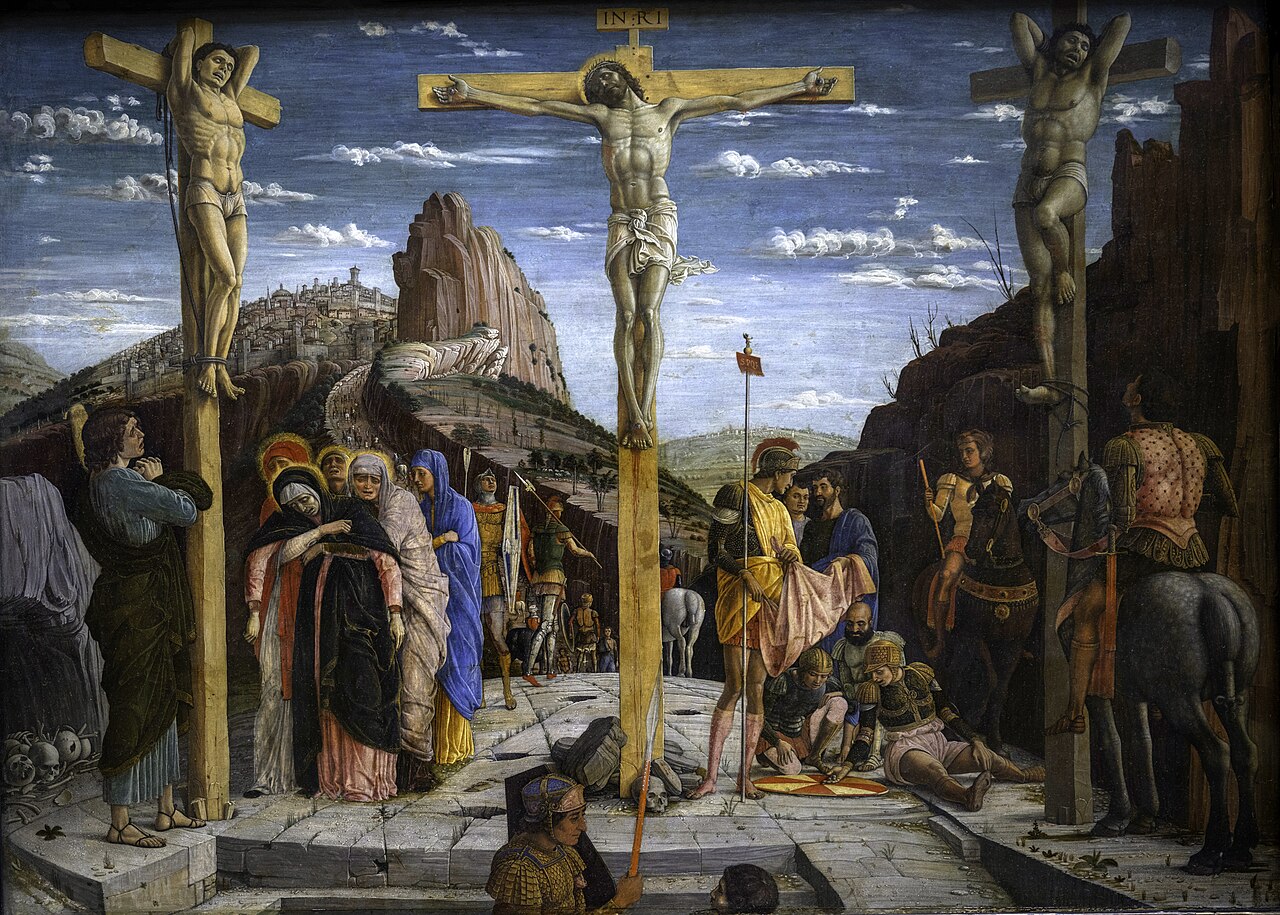
The Crucifixion
26Now as they 32came out and led Him away, 17and He, bearing His cross, went out to a place called the Place of a Skull, which is called in Hebrew, Golgotha. 21They laid hold of and compelled a certain man, Simon a Cyrenian, the father of Alexander and Rufus, as he was coming out of the country and passing by, to bear His cross; and on him they laid the cross that he might bear it after Jesus.
27And a great multitude of the people followed Him, and women who also mourned and lamented Him. 28But Jesus, turning to them, said, “Daughters of Jerusalem, do not weep for Me, but weep for yourselves and for your children. 29For indeed the days are coming in which they will say, ‘Blessed are the barren, wombs that never bore, and breasts which never nursed!’ 30Then they will begin ‘to say to the mountains, “Fall on us!” and to the hills, “Cover us!” ’ 31For if they do these things in the green wood, what will be done in the dry?”
32There were also two others, criminals, led with Him to be put to death. 22And they brought Him to the place Golgotha, which is translated, Place of a Skull, and the place was also called Calvary. 23Then they gave Him 34[i]sour wine mingled with myrrh, or gall, to drink. But when He had tasted it, He would not not take it and drink. 25Now it was the third hour, and they crucified Him, the 18two others with Him, 33one on the right hand and the other on the left, and Jesus in the center. 34[h]Then Jesus said, “Father, forgive them, for they do not know what they do.”
23Then the soldiers, when they had crucified Jesus, took His garments and made four parts, to each soldier a part, and also the tunic. Now the tunic was without seam, woven from the top in one piece. 24They said therefore among themselves, “Let us not tear it, but cast lots for it, whose it shall be.” Thus 24they divided His garments, casting lots for them to determine what every man should take, 35[j]that it might be fulfilled which was spoken by the prophet:
“They
divided My garments among them,
And for My clothing they cast
lots.”
Therefore the soldiers did these things.
36Sitting down, some of them kept watch over Him there, 35and some of the people stood looking on. But even the rulers with them sneered, saying, “He saved others; let Him save Himself if He is the Christ, the chosen of God.”
36The soldiers also mocked Him, coming and offering Him sour wine, 37and saying, “If You are the King of the Jews, save Yourself.”
19Now Pilate wrote a title and put it on the cross. 26And the inscription of His [d]accusation 38was [i]written 37over His head in letters of Greek, Latin, and Hebrew:
THIS IS JESUS OF NAZARETH
THE KING OF THE JEWS.
20Then many of the Jews read this title, for the place where Jesus was crucified was near the city; and it was written in Hebrew, Greek, and Latin.
21Therefore the chief priests of the Jews said to Pilate, “Do not write, ‘The King of the Jews,’ but, ‘He said, “I am the King of the Jews.” ’ ”
22Pilate answered, “What I have written, I have written.”
38Then two robbers were crucified with Him, 27one on His right and the other on His left. 28[e]So the Scripture was fulfilled which says, “And He was numbered with the transgressors.”
29And those who passed by blasphemed Him, wagging their heads and saying, “Aha! You who destroy the temple and build it in three days, 39save Yourself! If You are the Son of God, 30come down from the cross!”
31Likewise the chief priests also, mocking among themselves with the scribes 41and elders, said, “He saved others; Himself He cannot save. 42[l]If He is the King of Israel, let Him now come down from the cross, and we will believe [m]Him. 43He trusted in God; let Him deliver Him now if He will have Him; for He said, ‘I am the Son of God.’ 32Let the Christ, the King of Israel, descend now from the cross, that we may see and [f]believe.”
44Even the robbers who were crucified with Him reviled Him with the same thing. 39One of the criminals who were hanged blasphemed Him, saying, [j]“If You are the Christ, save Yourself and us.”
40But the other, answering, rebuked him, saying, “Do you not even fear God, seeing you are under the same condemnation? 41And we indeed justly, for we receive the due reward of our deeds; but this Man has done nothing wrong.” 42Then he said [k]to Jesus, “Lord, remember me when You come into Your kingdom.”
43And Jesus said to him, “Assuredly, I say to you, today you will be with Me in Paradise.”
25Now there stood by the cross of Jesus His mother, and His mother’s sister, Mary the wife of Clopas, and Mary Magdalene. 26When Jesus therefore saw His mother, and the disciple whom He loved standing by, He said to His mother, “Woman, behold your son!” 27Then He said to the disciple, “Behold your mother!” And from that hour that disciple took her to his own home.
33Now 28after this, when 44about the sixth hour had come, there was darkness over the whole land until the ninth hour. Jesus, [e]knowing that all things were now accomplished, that the Scripture might be fulfilled, said, “I thirst!” 34And at the ninth hour Jesus cried out with a loud voice, saying, “Eloi, Eloi, lama sabachthani?” which is translated, “My God, My God, why have You forsaken Me?”
35Some of those who stood by 47there, when they heard that, said, “Look, This Man is calling for Elijah!” 29Now a vessel full of sour wine was sitting there; 36then 48immediately one of them ran and took a sponge, filled it full with sour wine and put it on a hyssop reed, and put it to His mouth and offered it to Him to drink, and 49the rest said, “Let Him alone; let us see if Elijah will come to take Him down and save Him.” 30So when Jesus had received the sour wine, He said, “It is finished!”
46And when Jesus had cried out with a loud voice, he said, “Father, ‘into Your hands I commit My spirit.’ ” Having said this, bowing His head, He breathed His last and 50yielded up His spirit.
51Then, behold, the veil of the temple was torn in two from top to bottom; and the earth quaked, and the rocks were split, 52and the graves were opened; and many bodies of the saints who had fallen asleep were raised; 53and coming out of the graves after His resurrection, they went into the holy city and appeared to many.
39So when the centurion 54and those with him, who stood opposite and were guarding Jesus, saw the earthquake and the things that had happened, and that [g]He cried out like this and breathed His last, 7he glorified God and feared greatly, saying, “Certainly this was a righteous Man! Truly this Man was the Son of God!”
The Entombment
48And the whole crowd who came together to that sight, seeing what had been done, beat their breasts and returned. 49But all His acquaintances, and the women who followed Him from Galilee, stood at a distance and 55looking on from afar watching these things; 40among them were Mary Magdalene, Mary the mother of James the Less and of Joses, and Salome, 56the mother of Zebedee’s sons, 41who also followed Him and ministered to Him when He was in Galilee, and many other women who came up with Him to Jerusalem.
31Therefore, because it was the Preparation Day, that the bodies should not remain on the cross on the Sabbath (for that Sabbath was a high day), the Jews asked Pilate that their legs might be broken, and that they might be taken away. 32Then the soldiers came and broke the legs of the first and of the other who was crucified with Him. 33But when they came to Jesus and saw that He was already dead, they did not break His legs. 34But one of the soldiers pierced His side with a spear, and immediately blood and water came out. 35And he who has seen has testified, and his testimony is true; and he knows that he is telling the truth, so that you may believe. 36For these things were done that the Scripture should be fulfilled, “Not one of His bones shall be broken.” 37And again another Scripture says, “They shall look on Him whom they pierced.”
42Now 50behold, when evening had come, because it was the Preparation Day, that is, the day before the Sabbath, 43Joseph of Arimathea, 57a rich man, a prominent council member, and a good and just man, coming and taking courage, went in to Pilate and asked for the body of Jesus, 38that he might take away the body. 51He had not consented to their decision and deed and himself had also become a disciple of Jesus, 38but secretly, for fear of the Jews. He was from Arimathea, a city of the Jews, who[o] himself was also waiting for the kingdom of God. 44Pilate marveled that He was already dead; and summoning the centurion, he asked him if He had been dead for some time. 45So when he found out from the centurion, 38Pilate gave him permission: he granted the body to Joseph and 58commanded the body to be given to him. 46Then he bought fine linen, came and took Him down, and wrapped Him in the linen. 39And Nicodemus, who at first came to Jesus by night, also came, bringing a mixture of myrrh and aloes, about a hundred pounds. 40Then they took the body of Jesus, and bound it in strips of linen with the spices, as the custom of the Jews is to bury. 41Now in the place where He was crucified there was a garden, and in the garden he [Joseph] and they all laid Jesus 60in his new tomb which he had hewn out of the rock, 53where no one had ever lain before; and rolled a large stone against the door of the tomb, and departed. 42So there they laid Jesus, because it was the Jews’ Preparation Day and 54the Sabbath drew near, for the tomb was nearby.
55And the women who had come with Him from Galilee, 47Mary Magdalene and Mary the mother of Joses, followed after, and they observed the tomb and how His body was laid. 61And Mary Magdalene was there, and the other Mary, sitting [o]opposite the tomb. 56Then they returned and prepared spices and fragrant oils. And they rested on the Sabbath according to the commandment.
The Resurrection and Appearances
The Resurrection
1Now when the Sabbath was past, 1they—Mary Magdalene, Mary the mother of James, and Salome—[a]and certain other women with them bought spices. They 1came to see the tomb 1while it was still dark, that they might come and anoint Him, even as the first day of the week began to dawn. 2Very early in the morning, they came to the tomb when the sun had risen, bringing the spices which they had prepared. 3And they said among themselves, “Who will roll away the stone from the door of the tomb for us?” 4But when they looked up, 2they saw and found the stone had been taken away from the tomb, rolled away—for it was very large.
2And behold, a severe earthquake had occurred; for an angel of the Lord descended from heaven, and came and rolled back the stone [a]from the door, and sat on it. 3His countenance was like lightning, and his clothing as white as snow. 4And the guards shook for fear of him, and became like dead men.
5And presently, 3they went in and, entering the tomb, did not find the body of the Lord Jesus. 4And it happened, as they were [b]greatly perplexed about this, that behold, two young men stood by them in shining garments, with one clothed in a long white robe sitting on the right side; and they were alarmed.
5Then, as they were afraid and bowed their faces to the earth, 5the angel answered and said to the women, 6“Do not be alarmed or afraid, for I know that you seek Jesus of Nazareth, who was crucified. Why do you seek the living among the dead? 6He is not here; for He is risen, as He said. Come, see the place where the Lord lay, where they laid Him. 6Remember how He spoke to you when He was still in Galilee, 7saying, ‘The Son of Man must be delivered into the hands of sinful men, and be crucified, and the third day rise again.’ 7But go 7quickly and tell His disciples—and Peter—that He is risen from the dead, and indeed He is going [a]before you into Galilee; there you will see Him, as He said to you. Behold, I have told you.”8So they went out [b]quickly 8with fear and great joy, and fled from the tomb, for they trembled and were amazed. And they said nothing to anyone, for they were afraid.
9[c]Now when He rose early on the first day of the week, He appeared first to Mary Magdalene, out of whom He had cast seven demons.
8And they remembered His words. 9They returned from the tomb and ran to bring His disciples word. 9And [b]as they went to tell His disciples, behold, Jesus met them, saying, “Rejoice!” So they came and held Him by the feet and worshiped Him. 10Then Jesus said to them, “Do not be afraid. Go and tell My brethren to go to Galilee, and there they will see Me.”
10She—Mary Magdalene and the other women—went and told all these things to the eleven and to all the rest, those who had been with Him, as they mourned and wept. 2She ran and came to Simon Peter, and to the other disciple, whom Jesus loved, and said to them, “They have taken away the Lord out of the tomb, and we do not know where they have laid Him.” 10It was Mary Magdalene, Joanna, Mary the mother of James, and the other women with them, who told these things to the apostles. 11And when they heard that He was alive and had been seen by her, 11their words seemed to them like [c]idle tales, and they did not believe them. 12But Peter arose, 3went out, and the other disciple, and ran to the tomb. 4So they both ran together.
11Now while they were going, behold, some of the guard came into the city and reported to the chief priests all the things that had happened. 12When they had assembled with the elders and consulted together, they gave a large sum of money to the soldiers, 13saying, “Tell them, ‘His disciples came at night and stole Him away while we slept.’ 14And if this comes to the governor’s ears, we will appease him and make you secure.” 15So they took the money and did as they were instructed; and this saying is commonly reported among the Jews until this day.
The other disciple outran Peter and came to the tomb first. 5And he, stooping down and looking in, saw the linen cloths lying there; yet he did not go in.
6Then Simon Peter came, following him, and, stooping down, he went into the tomb; and he saw the linen cloths lying there by themselves, 7and the [a]handkerchief that had been around His head, not lying with the linen cloths, but folded together in a place by itself. 8Then the other disciple, who came to the tomb first, went in also; and he saw and believed. 9For as yet they did not [b]know the Scripture, that He must rise again from the dead. 10Then the disciples departed and went away again to their own homes. And Peter was marveling to himself at what had happened.
11But Mary stood outside by the tomb weeping, and as she wept she stooped down and looked into the tomb. 12And she saw two angels in white sitting, one at the head and the other at the feet, where the body of Jesus had lain. 13Then they said to her, “Woman, why are you weeping?”
She said to them, “Because they have taken away my Lord, and I do not know where they have laid Him.”
14Now when she had said this, she turned around and saw Jesus standing there, and did not know that it was Jesus. 15Jesus said to her, “Woman, why are you weeping? Whom are you seeking?”
She, supposing Him to be the gardener, said to Him, “Sir, if You have carried Him away, tell me where You have laid Him, and I will take Him away.”
16Jesus said to her, “Mary!”
She turned and said to [c]Him, “Rabboni!” (which is to say, Teacher).
17Jesus said to her, “Do not cling to Me, for I have not yet ascended to My Father; but go to My brethren and say to them, ‘I am ascending to My Father and your Father, and to My God and your God.’ ”
18Mary Magdalene came and told the [d]disciples that she had seen the Lord, and that He had spoken these things to her.
The Supper at Emmaus
12After that, He appeared in another form to two of them as they walked and went into the country.
13Now behold, two of them were traveling that same day to a village called Emmaus, which was [e]seven miles from Jerusalem. 14And they talked together of all these things which had happened. 15So it was, while they conversed and reasoned, that Jesus Himself drew near and went with them. 16But their eyes were restrained, so that they did not know Him.
17And He said to them, “What kind of conversation is this that you have with one another as you [f]walk and are sad?”
18Then the one whose name was Cleopas answered and said to Him, “Are You the only stranger in Jerusalem, and have You not known the things which happened there in these days?”
19And He said to them, “What things?”
So they said to Him, “The things concerning Jesus of Nazareth, who was a Prophet mighty in deed and word before God and all the people, 20and how the chief priests and our rulers delivered Him to be condemned to death, and crucified Him. 21But we were hoping that it was He who was going to redeem Israel. Indeed, besides all this, today is the third day since these things happened. 22Yes, and certain women of our company, who arrived at the tomb early, astonished us. 23When they did not find His body, they came saying that they had also seen a vision of angels who said He was alive. 24And certain of those who were with us went to the tomb and found it just as the women had said; but Him they did not see.”
25Then He said to them, “O foolish ones, and slow of heart to believe in all that the prophets have spoken! 26Ought not the Christ to have suffered these things and to enter into His glory?” 27And beginning at Moses and all the Prophets, He [g]expounded to them in all the Scriptures the things concerning Himself.
28Then they drew near to the village where they were going, and He [h]indicated that He would have gone farther. 29But they constrained Him, saying, “Abide with us, for it is toward evening, and the day is far spent.” And He went in to stay with them.
30Now it came to pass, as He sat at the table with them, that He took bread, blessed and broke it, and gave it to them. 31Then their eyes were opened and they knew Him; and He vanished from their sight.
32And they said to one another, “Did not our heart burn within us while He talked with us on the road, and while He opened the Scriptures to us?” 33So they rose up that very hour and returned to Jerusalem, and found the eleven and those who were with them gathered together, 34saying, “The Lord is risen indeed, and has appeared to Simon!” 35And they told about the things that had happened on the road, and how He was [i]known to them in the breaking of bread.
36Now as they said these things, Jesus Himself stood in the midst of them, and said to them, “Peace to you.” 37But they were terrified and frightened, and supposed they had seen a spirit. 38And He said to them, “Why are you troubled? And why do doubts arise in your hearts? 39Behold My hands and My feet, that it is I Myself. Handle Me and see, for a spirit does not have flesh and bones as you see I have.”
40[j]When He had said this, He showed them His hands and His feet. 41But while they still did not believe for joy, and marveled, He said to them, “Have you any food here?” 42So they gave Him a piece of a broiled fish [k]and some honeycomb. 43And He took it and ate in their presence.
44Then He said to them, “These are the words which I spoke to you while I was still with you, that all things must be fulfilled which were written in the Law of Moses and the Prophets and the Psalms concerning Me.” 45And He opened their understanding, that they might comprehend the Scriptures.
46Then He said to them, “Thus it is written, [l]and thus it was necessary for the Christ to suffer and to rise from the dead the third day, 47and that repentance and remission of sins should be preached in His name to all nations, beginning at Jerusalem. 48And you are witnesses of these things. 49Behold, I send the Promise of My Father upon you; but tarry in the city [m]of Jerusalem until you are endued with power from on high.”
50And He led them out as far as Bethany, and He lifted up His hands and blessed them. 51Now it came to pass, while He blessed them, that He was parted from them and carried up into heaven. 52And they worshiped Him, and returned to Jerusalem with great joy; 13and they went and told it to the rest, but they did not believe them either. 53And they were continually in the temple [n]praising and blessing God. [o]Amen.
The Supper Appearances to the Disciples
19Then, the same day at evening, being the first day of the week, when the doors were shut where the disciples were [e]assembled, for fear of the Jews, Jesus came and stood in the midst, and said to them, “Peace be with you.” 20When He had said this, He showed them His hands and His side. Then the disciples were glad when they saw the Lord.
21So Jesus said to them again, “Peace to you! As the Father has sent Me, I also send you.” 22And when He had said this, He breathed on them, and said to them, “Receive the Holy Spirit. 23If you forgive the sins of any, they are forgiven them; if you retain the sins of any, they are retained.”
24Now Thomas, called the Twin, one of the twelve, was not with them when Jesus came. 25The other disciples therefore said to him, “We have seen the Lord.”
So he said to them, “Unless I see in His hands the print of the nails, and put my finger into the print of the nails, and put my hand into His side, I will not believe.”
14Later, 26after eight days, He appeared to the eleven as they sat at the table; His disciples were again inside, and Thomas with them. Jesus came, the doors being shut, and stood in the midst, and said, “Peace to you!” He rebuked their unbelief and hardness of heart, because they did not believe those who had seen Him after He had risen. 27Then He said to Thomas, “Reach your finger here, and look at My hands; and reach your hand here, and put it into My side. Do not be unbelieving, but believing.”
28And Thomas answered and said to Him, “My Lord and my God!”
29Jesus said to him, [f]“Thomas, because you have seen Me, you have believed. Blessed are those who have not seen and yet have believed.”
30And truly Jesus did many other signs in the presence of His disciples, which are not written in this book; 31but these are written that you may believe that Jesus is the Christ, the Son of God, and that believing you may have life in His name.
The Appearances in Galilee
16Then the eleven disciples went away into Galilee, to the mountain which Jesus had appointed for them. 17When they saw Him, they worshiped Him; but some doubted.
1Jesus showed Himself again to the disciples at the Sea of Tiberias, and in this way He showed Himself: 2Simon Peter, Thomas called the Twin, Nathanael of Cana in Galilee, the sons of Zebedee, and two others of His disciples were together. 3Simon Peter said to them, “I am going fishing.”
They said to him, “We are going with you also.” They went out and [a]immediately got into the boat, and that night they caught nothing. 4But when the morning had now come, Jesus stood on the shore; yet the disciples did not know that it was Jesus. 5Then Jesus said to them, “Children, have you any food?”
They answered Him, “No.”
6And He said to them, “Cast the net on the right side of the boat, and you will find some.” So they cast, and now they were not able to draw it in because of the multitude of fish.
7Therefore that disciple whom Jesus loved said to Peter, “It is the Lord!” Now when Simon Peter heard that it was the Lord, he put on his outer garment (for he had removed it), and plunged into the sea. 8But the other disciples came in the little boat (for they were not far from land, but about two hundred cubits), dragging the net with fish. 9Then, as soon as they had come to land, they saw a fire of coals there, and fish laid on it, and bread. 10Jesus said to them, “Bring some of the fish which you have just caught.”
11Simon Peter went up and dragged the net to land, full of large fish, one hundred and fifty-three; and although there were so many, the net was not broken. 12Jesus said to them, “Come and eat breakfast.” Yet none of the disciples dared ask Him, “Who are You?”—knowing that it was the Lord. 13Jesus then came and took the bread and gave it to them, and likewise the fish.
14This is now the third time Jesus showed Himself to His disciples after He was raised from the dead.
15So when they had eaten breakfast, Jesus said to Simon Peter, “Simon, son of [b]Jonah, do you love Me more than these?”
He said to Him, “Yes, Lord; You know that I [c]love You.”
He said to him, “Feed My lambs.”
16He said to him again a second time, “Simon, son of [d]Jonah, do you love Me?”
He said to Him, “Yes, Lord; You know that I [e]love You.”
He said to him, “Tend My sheep.”
17He said to him the third time, “Simon, son of [f]Jonah, do you [g]love Me?” Peter was grieved because He said to him the third time, “Do you love Me?”
And he said to Him, “Lord, You know all things; You know that I love You.”
Jesus said to him, “Feed My sheep. 18Most assuredly, I say to you, when you were younger, you girded yourself and walked where you wished; but when you are old, you will stretch out your hands, and another will gird you and carry you where you do not wish.” 19This He spoke, signifying by what death he would glorify God. And when He had spoken this, He said to him, “Follow Me.”
20Then Peter, turning around, saw the disciple whom Jesus loved following, who also had leaned on His breast at the supper, and said, “Lord, who is the one who betrays You?” 21Peter, seeing him, said to Jesus, “But Lord, what about this man?”
22Jesus said to him, “If I [h]will that he remain till I come, what is that to you? You follow Me.”
23Then this saying went out among the brethren that this disciple would not die. Yet Jesus did not say to him that he would not die, but, “If I will that he remain till I come, what is that to you?”
24This is the disciple who testifies of these things, and wrote these things; and we know that his testimony is true.
The Great Commission
18And Jesus came and spoke to them, 4and being assembled together with them, He commanded them not to depart from Jerusalem, but to wait for the Promise of the Father, “which,” He said, “you have heard from Me; 5for John truly baptized with water, but you shall be baptized with the Holy Spirit not many days from now.” 6Therefore, when they had come together, they asked Him, saying, “Lord, will You at this time restore the kingdom to Israel?” 7And He said to them, “It is not for you to know times or seasons which the Father has put in His own authority. 8But you shall receive power when the Holy Spirit has come upon you; and you shall be [c]witnesses to Me in Jerusalem, and in all Judea and Samaria, and to the end of the earth.”
15And He said to them, “All authority has been given to Me in heaven and on earth. 19Go [c]therefore into all the world and preach the gospel to every creature; and make disciples of all the nations, baptizing them in the name of the Father and of the Son and of the Holy Spirit, 20teaching them to observe all things that I have commanded you. 16He who believes and is baptized will be saved; but he who does not believe will be condemned. 17And these signs will follow those who [d]believe: In My name they will cast out demons; they will speak with new tongues; 18they[e] will take up serpents; and if they drink anything deadly, it will by no means hurt them; they will lay hands on the sick, and they will recover. 19And lo, I am with you always, even to the end of the age.” [d]Amen.
19So then, after the Lord had spoken these things to them, 9while they watched, He was taken up, and a cloud received Him out of their sight. He was received up into heaven, and sat down at the right hand of God. 10And while they looked steadfastly toward heaven as He went up, behold, two men stood by them in white apparel, 11who also said, “Men of Galilee, why do you stand gazing up into heaven? This same Jesus, who was taken up from you into heaven, will so come in like manner as you saw Him go into heaven.”
25And there are also many other things that Jesus did, which if they were written one by one, I suppose that even the world itself could not contain the books that would be written. Amen.
20And they went out and preached everywhere, the Lord working with them and confirming the word through the accompanying signs. Amen.
Notes on Harmonization Method
General Method
The text used is the NKJV, except for John 13:2 where I substitute the NASB’s “During supper” for “Supper being ended”, and Matthew 28:2 where I substitute the NASB’s “a great earthquake had occurred” for the NKJV’s “there was a great earthquake.” These substitutions are consistent with the Greek and solve problems of order.
This was done quickly. I simply wanted to finish it in a timely fashion (although hopefully without being irresponsible). This is experimental. I wanted to finish it in a day or two (for Easter). Perhaps I will do a much more careful and fully-featured version in the future. But for what this is, I can say this is quite careful and reflects my in-depth experience with the texts and commentaries on them from the last six years. I worked in chunks of two to three pericopes at a time.
I first added Mark to Luke, then Matthew to the result, then John to the result of that. I started copying from John 12, because it has some passages corresponding to passages in the Synoptic Gospels, but the rest of John 12 I skipped because they were not part of the canonical “passion narrative,” which (as I suppose) began at Matthew 26, Mark 14, and Luke 22. That is, the part I developed began with the chief priests’ plot to kill Jesus and Jesus’ anointing by the woman. Thus it did not include any other events before Palm Sunday (the triumphal entry), or between that and the Last Supper (Maundy Thursday).
Colors were chosen before anything was copied. Verse numbers are retained and if, within a color, there is a number, that is the number of all words of that color after that, until the next higher number (except as noted, if necessary).
Obviously, sentences have been truncated when the precise same concepts were used in other forms in some previous (or more detailed, or more elegantly styled) version. Sometimes I changed the capitalization of words when a clause worked well as the beginning of a sentence, or when a word that began a sentence in one source would supply an otherwise missing detail in the middle of a harmonized sentence. Sometimes one version was virtually identical to another, but included a name where another used a pronoun; in such cases, if good style suggested that the name be used, I might substitute the name for the pronoun.
I have occasionally added “and,” commas, and semicolons, to make different words and phrases work together with good grammar and style. (This is OK, I believe, considering that there is no punctuation in the original, and all translations are forced to supply little words here and there for clarity and good grammar.) This, of course, introduces sentences that were never in the originals. But the fundamental Christian biblical principle of analogia fidei means that descriptions of the same events must be consistent; hence, if two sentences describe the same particular facts, clauses that accurately describe the same persons, things, and events should be able to be combined without introducing any falsehood.
I skip identical or extremely close wordings, ignoring semantically unimportant variations. (Semantically unimportant for the common reader, not for scholars, which would be a different question altogether.) I always choose the version that has more detail, and use individual words and phrases with details not otherwise found in the text I am adding to. I could, but have not bothered to (it would be a lot of work), ascertain how many versions used the precise same or extremely similar phrases, and used different colors. Suffice to say that the color that is indicated does have the words in question. Other versions might well have those words as well. Thus the goal is not so much to indicate how much attestation there is for a given word or phrase but simply to ensure that all the words and phrases from all Gospels are included. Or, briefly: while duplicate words and phrases are not indicated in the text, you can be sure that none are omitted (and none, except for a few little connecting words in black, are made up).
Occasionally—not often—I have let “doublets” stand, that is, when two similar words are different enough and cannot be easily combined, I simply put them one after another. I reckon this sounds natural enough, as people will indeed repeat themselves sometimes in slightly different words. The purpose here is not to assert that Jesus (or a Gospel writer) said both things, but to copy both formulations so the reader gets both. This is not to say that I do not, sometimes, excise quite redundant words and phrases, i.e., that are similar enough that it would be jarring style (and serve no clear purpose) to repeat them.
I was tempted to add explanatory footnotes, but have opted not to. There were some issues where it was unclear what happened first. There I simply used my best judgment and chose one based on preponderance of evidence and coherence. If you have any questions about any particular choice I have made, ask it in the comments and I’ll explain there; and see below.
Examples of How I Resolved “Hard Cases”
None of them are particularly hard, in my opinion, but there are some puzzles, to be sure.
I included both “that they might eat the Passover” (Jn 18:28) and “the Preparation Day of the Passover” (Jn 19:14), alongside the Synoptics, which present the Last Supper as a Passover meal. There is no call for editorializing, and the synthetic harmonization method requires that I not delete either. If it is a contradiction, it is not one that is immediately evident—nor is the solution of it immediately evident. This is not a task for the editor of a Gospel harmony to take on.
In the Last Supper, the main events are: (1) foot-washing, (2) warning of the betrayer, (3) revelation of the betrayer, (4) Judas’s departure, (5) the new commandment, (6) breaking bread and wine, (7) the dispute about greatness, (8) Satan’s demand to sift Peter / Jesus’ prayer for him, (9) first prediction of Peter’s thrice denial, (10) the upper room discourse, (11) the high priestly prayer, (12) the two swords, (13) the hymn and departure, (14) second prediction of Peter’s thrice denial. This is the order that I follow, which makes a few decisions; as usual I go with “majority rules.”
I decided to include Jesus’ prediction of Peter’s denial two times. It appears in at least two different places, in rather different contexts. John has it most clearly at an early point, as part of the discussion that follows the revelation of Judas as betrayer. Luke has it before the departure from the Upper Room, in a context that can rather elegantly (and without switching verse order) be placed with John’s. Matthew and Mark are very similar, in a different context, and have it on the way to Gethsemane.
I treat Annas and Caiaphas as sharing one compound, so that the Synoptic accounts of Jesus being led to “the high priest’s house” and John’s account of his being led “to Annas first” all refer to the same location, not to two separate journeys across Jerusalem. Within that compound, there are three distinct Jewish proceedings. First, John alone reports the arraignment before Annas (Jn 18:19–24), in which the high priest questions Jesus informally and an officer strikes him; this ends with Annas sending Jesus “bound to Caiaphas.” Second, Matthew and Mark report the formal night trial before Caiaphas, with false witnesses, the high priest’s direct question (“Are You the Christ, the Son of God?”), Jesus’ answer, and the verdict of blasphemy. Third, Luke reports a morning session of the full Sanhedrin (Lk 22:66–71), briefly corroborated by Matthew and Mark’s notices that “when morning came” the council “plotted against Jesus to put Him to death”; Luke gives this session its own exchange (“If You are the Christ, tell us”), after which they deliver him to Pilate. Peter’s first denial is placed with the Annas arraignment (following John’s chronological cues), and the remaining denials fall during and after the Caiaphas trial.
The Synoptics group Peter’s three denials together either before (Luke) or after (Matthew and Mark) the Caiaphas trial. When they all report the initial servant-girl accusation, we should consider that John (who implies he was personally there) places that first denial before the Arraignment before Annas, and the other denials after Jesus was sent to Caiaphas. So, we may conclude that lumping the denials together and placing them before or after the Caiaphas trial does not imply anything other than a common desire to tell the denial story in one complete narrative; only John seems to care about relative timing. So we follow him.
One particular narrative detail really does seem to be a narrative incompatibility: After identifying the servant girl as Peter’s first accuser, Luke then says another saw Peter. We can’t fudge the Greek here, which is ἕτερος, heteros, which definitely means “another” (someone else). Yet Mark says, “the servant girl saw him again.” Now, it is possible to say he denied four times; but that is not what Mark himself says: he (like all of the Gospel writers) says Peter denied Jesus three times. But such small details hardly matter when we are talking about fairly old memories and oral stories (even if carefully memorized, like folk songs, they will have legitimate variants). So I simply include both with “[or]”, especially since what the second accuser says is so similar across accounts; and I include the various versions of the denial without further comment. Similarly, there are various details in the third denial, which are best understood as minor variations in remembered or orally transmitted details.
Who bought Judas’ Field of Blood? The position expressed in this harmony is that while the chief priests purchased the field in which Judas had hanged himself, they (and Luke in Acts 1:18) attributed the purchase to Judas, since they used his money to purchase it; and, although he hanged himself there, a tree limb or the rope snapped, and his body burst open on sharp rocks below. The latter is interpretive and therefore not included in the harmony (of course). But it can be reasonably argued that Acts 1:18b–19 can be placed in a harmonizing way right after Matt 27:5, with Acts 1:18a following Matt. 27:9, so that is what I opted to do. This too is interpretive but it is really the only reasonable way to preserve the whole truth of Scripture, and it has the significant advantage of plausibility.
On the color of Jesus’ robe, I say simply “purple or scarlet,” these being different Greek words, and purple being attested twice (Mark, John) and scarlet once (Matthew; Luke has “gorgeous,” no color). A common scholarly observation is that the two different Greek words could refer to the same color.
There are some complex decisions to be made regarding the order of events in the final sentencing. A surface reading of John might suggest that the scourging (Jn 19:1) occurs mid-trial, as a failed attempt to satisfy the crowd, while the Synoptics place it after sentencing as routine pre-crucifixion punishment. But it is clear to me that John 19:4–16 is simply not reported in the Synoptic Gospels; it does not contradict them, of course, and indeed fits very well (as a read-through will show) as an elaboration of what happened after the sentencing. There is one scourging, and it is post-sentencing. It is following that, as John alone reports, that Pilate, having scourged and humiliated Jesus, paraded him before the people to show them that he was sufficiently punished. At that point, he is essentially begging them to back off from their bloodlust. The sequence that follows in John—”Behold the Man!” through “Behold your King!”—is Pilate’s public confrontation with the crowd, not a continuation of legal proceedings. The words and details of John 19:4–16 simply have no clear analogues in the Synoptics.
The Resurrection Scene
The resurrection scene presents some famous puzzles. Here is how I dealt with them.
Which women were at the tomb? Luke says simply “they” at Luke 24:1, but then clarifies himself at v. 10: “It was Mary Magdalene, Joanna, Mary the mother of James, and the other women with them.” No mystery there. Mark at 16:1 names women from the same group (I suppose “Salome” from Mk 15:40 is “the mother of Zebedee’s sons” from Mt 27:56 which seems likely). Moreover, similar phrases describing this group of women appear at Mark 15:40: “women looking on from afar, among whom were Mary Magdalene, Mary the mother of James the Less and of Joses, and Salome.” The phrasing at Luke 24:10, “and the other women with them,” makes it clear that the whole group (or a number greater than the three named) were there. John 20:1 names only Mary Magdalene and Matthew 28:1 has “Mary Magdalene and the other Mary.” This is sometimes said to represent some sort of contradiction, but Bible students know perfectly well that the leader or chief leaders of a group is often named as the main actor, and that name is made to stand in for the others. There are many examples of this.
One of the better-known “gotchas” of critics is the timing of the visit to the tomb. Was it “while it was still dark,” or “as the first day began to dawn,” or “when the sun had risen”? But this is shown to be the sophomoric quibbling that it is when one simply synthetically states all the details in their proper place: “Now when the Sabbath was past, they—Mary Magdalene, Mary the mother of James, and Salome—and certain other women with them bought spices and came to see the tomb while it was still dark, that they might come and anoint Him. Very early in the morning, as the first day of the week began to dawn, they came to the tomb when the sun had risen, bringing the spices which they had prepared.” As is often the case with these supposed puzzles, the text does not demand the reading I put on it here, but it does permit it. Anyone who has gotten up with the sun knows that it can be dark in many places just before dawn, and the sunrise itself occurs rather quickly. So it is perfectly acceptable that they would have set out from wherever they lived in the dark or very dim dawn light; by the time they approached the tomb, it was “dawn” (a vague period of time, naturally), and when they arrived, “the sun had risen.” Why not?
Another famous puzzle is whether the stone was already rolled away (as Mark, Luke, and John have it) or, instead, the visitors observed it being rolled away by an earthquake (Matthew). This is due to the ordinary translation of one word in Matthew, egeneto, which is an aorist middle as the BibleHub notes have it. The KJV/NKJV has it in the simple past, as if the women saw it happen: “And behold, there was a great earthquake; for an angel of the Lord descended from heaven” (Mt 28:2). Many other translations follow it. But the NASB notices what harmonization requires and that the aorist permits rendering with the pluperfect “had occurred.” This is possible because the aorist tense describes a completed action without specifying its temporal relationship to the surrounding narrative; it does not require the English pluperfect, but it is consistent with it. So this is a second example where I prefer the NASB to the NKJV.
Perhaps the most confusing aspect from the point of view of harmonization is the question of how many angels there were and when they appeared; was it one or two, and was he (or they) already there, or did he (or they) appear suddenly? Again, if we simply look and see whether there is a way to make the texts consistent, we will see that, indeed, there is one. Clearly, this is another case in which there were indeed two, but one is made to represent the pair, because he was the speaker. But one of our authors (Luke) has the pair of them speaking. But it is again clear from the customary way of describing things in the Bible that they were not speaking as a pair, in unison, but only one of them spoke for the pair.
Careful Bible students will note that I included Mark’s longer ending (16:9–20). This is because the text appears in the KJV/NKJV, and while I understand very well that many scholars insist it was not in the original, my view is the traditional one: All branches of the Church (until the 19th century) settled on this as the text, doubtless because there were many distinguished sources that did include it and because the claims it makes are entirely consistent with (indeed, contained in, or inferrable from) the rest of the NT.
You might notice that I placed the Mark 16:14 appearance “to the eleven” with the supper “after eight days” that included Thomas (Jn 20:26ff). Some commentators might find this to be a strange choice, but really it is not. There are two obvious reasons, either one of which would be quite adequate to put it there. First, if the appearance is “to the eleven,” then certainly it includes Thomas, because Judas was dead; a full eleven disciples required his presence. Second, Jesus specifically “rebuked their unbelief and hardness of heart” (Mk 16:14), and this was specifically the issue he addressed at the meal, by giving Thomas first-hand empirical evidence of his bodily resurrection.
Concluding Observations
I have succeeded, almost perfectly, in both including all significant details from all gospels and putting phrases in the precise order in which they appear, relative to each other; that is, I almost never put a phrase that appears in a given gospel earlier or later than it appears among other phrases from the original. There are only one or two minor exceptions. One is from John 19:38, where John’s recounting of details is in a slightly different order from the others. Sometimes I accept a doublet to avoid reordering.
I will have to write more about the following, but if there is one thing that has struck me most forcibly by this work, it is that the four gospels lend themselves to this surprisingly well, rather better than I was expecting, and far better than you might expect from many commentaries. In short, it is a strong argument for the historicity of the gospel accounts that it is possible to fit them together in this way—a way that reads naturally, leaves nothing significant out, and does not simply ignore purported “problems.” As confessional Christian scholars know very well, the vast bulk of purported problems regarding harmonization disappear upon adequate acquaintance with the text; many “problems” are artificial and depend on speculative assumptions that disappear if you simply assume that the texts can be read charitably (as being faithful, accurate accounts). Showing the consistency of the accounts is the original harmonizing challenge, after all. If you start saying, “Well, given this interpretation of A, then B looks inaccurate,” then you’re off to the races: All a scholar has to do to make a “plausible” point is give any creative interpretation of a particular text, which happens to render some other text from a corresponding pericope false, and lo and behold, he has “demonstrated” the inconsistency of the gospels! Obviously, we must judge whether this sort of synthetic harmony does justice to all four originals. So far, anyway, I am discovering that it does, in spades. It does not just “do justice” to all four originals; the combination of the four provides a richer account that fills in gaps and answers questions.
In the case of John, it is clear that he knew of the commonly-repeated stories (as he has many of the same phrases, especially in the passion stories). He wrote his gospel down after the others precisely in order to elaborate areas they had left out. Many times, John covers the same story but adds unique, precious details of his own of a sort that an elder might want to supply. The Upper Room Discourse is maybe the best example. To take another example, he is the only one who says, “And Nicodemus, who at first came to Jesus by night, also came, bringing a mixture of myrrh and aloes, about a hundred pounds. Then they took the body of Jesus, and bound it in strips of linen with the spices, as the custom of the Jews is to bury. Now in the place where He was crucified there was a garden, and in the garden a new tomb in which no one had yet been laid.” (19:39–41) There are plenty of other examples of unique additions in other gospels, but John is more constantly, as it were, playing around the edges.
Reply to “A Harmony of the Passion Story”