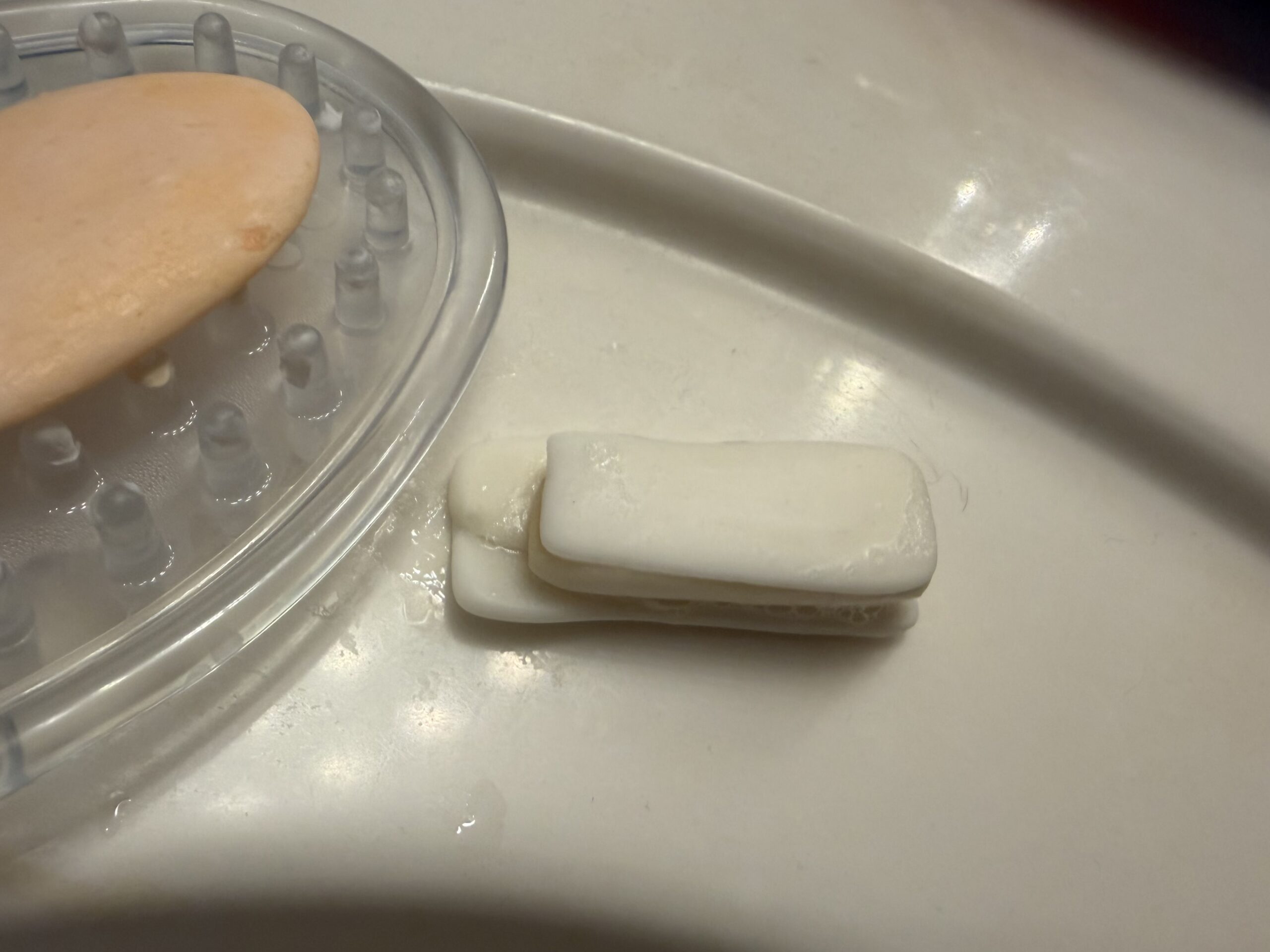
There is a kind of person—and mood, and outlook on life—for which slow-to-disappear bars of soap are a problem.
You know what I mean. You start a new bar of soap. A week later, it is half its original size. It takes just a couple more weeks to become positively small. After that, it takes longer and longer to disappear. As a result, for most of its life, your bar of soap is frustratingly tiny. For some, this seems to be part of the injustice of the universe. Are the soap manufacturers to blame?
But there is a reason for this that is related to simple physics and geometry. Essentially, when full-sized, the soap has a large surface area. The warm water and the rubbing action of your hands erode a layer of soap from the entire, large surface area. When the bar is smaller, the surface area is smaller, so the total volume of soap removed by erosion is smaller. Moreover, if you are typical, you use the larger bar more generously, since it gives up its soapiness generously. And you use smaller bars more stingily, since they give up its soapiness more stingily. Is that not a good thing?
The thing is, your hands get just as clean, and you do use less soap when the bar is small. Perhaps you have to handle the soap slightly longer to work up a lather, but it really does not take long, even when the bar is small.
The fact is, ordinary new bars of soap—unlike, say, those little bars they give out at hotels—are much bigger than they need to be, to get the job done.
I invite you to do a thought experiment: Imagine you simply cut each bar of soap you have in two. Would the same soap last longer? Of course it would. While cutting into two exposes two new surfaces, it also doubles the number of bars of soap. You need only one at a time, and the smaller size of each changes how you use each; each bar is definitely smaller than the original bar of soap. Taken together, then, the total amount of soap from the original bar will disappear more slowly. And while the initially exposed surface area increases after cutting, you never handle the larger bar as a whole; so, due to typical usage patterns of larger bars, the rate of disappearance is never so high. It’s rational to buy soap in large quantities of small bars.1
I say that, for economy, we should cut our bars of soap. Or buy hotel sized bars in bulk. I’m trying to persuade my wife to let me do this. (She takes ownership of this sort of thing, so I have to ask her permission.) And in any case, I always rejoice in my small bars of soap, which I now join together when they become unwieldily small. The smaller and more pliable they are, the more easily they stick together, so that two or three tiny bars of soap become one small bar. That almost sounds profound. I leave it as an exercise to the reader to tell me where the profundity lies.
But slightly more seriously: There is something right about appreciating the ordinary course of things. We often evaluate our circumstances according to false ideals. A large new bar of soap is not better than a small old one. We ought to think of what is good about the ordinary. Is young love more impressive than very old love? Is there not something quite nice about hearing local bands live in person, even if you can listen to something world-class recorded?
Next, let me tell you about the small bits of potato chips at the bottom of the bags, state parks, cloudy days, listening to audiobooks on long car rides, and Ohio…
Footnotes
- I leave it to the mathematicians to analyze the phenomenon more rigorously. All I know is that I’m right, dammit.[↩]
Reply to “In Praise of Small Bars of Soap”