In Part I, I discussed those questions that distinguished Catholicism and Orthodoxy, on the one hand, from all of Protestantism, on the other. In Part II, I began to discuss questions that distinguish “High Church” traditions (Catholicism and Orthodoxy again, but also including Lutheranism, much of Anglicanism, and some of other traditions) from “Low Church” traditions. As it happens, I have already spent much more time on Part II than on Part I. This was not because the questions were less important, but because my mind was already more firmly made up about them, so that I did not feel it necessary to go into detail about some of the questions. But the first three questions about the High Church distinctives took much more time to decide, partly because many of the issues were fairly new to me, and partly because they were evidently very important to get right, if I am to distinguish between some of the remaining “leading contenders.”
I have not yet revealed what I take these contenders to be, nor will I, until I am farther along in the process. But, especially after the following, third part, you or your LLM can probably guess.
- I. To be properly baptized in the Church, is infant baptism sufficient, or must one be a believer?
- II. Should church governance be episcopal, presbyterian, or congregational?
- III. Must worship be liturgical, or is liturgy optional or unnecessary?
- IV. Should we be awed by Catholic and Orthodox tradition?
- Concluding discussion
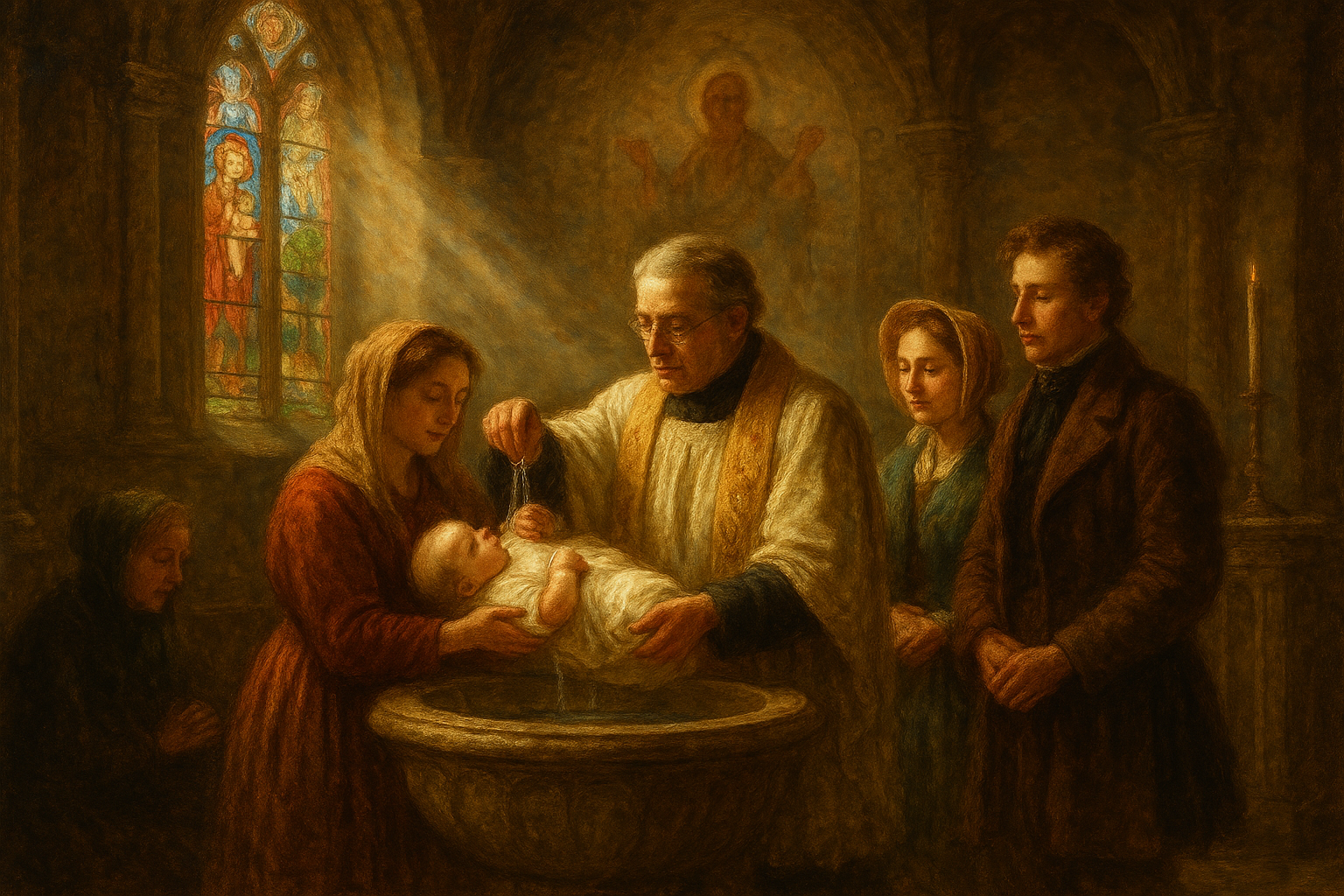
I. To be properly baptized in the Church, is infant baptism sufficient, or must one be a believer?
The practice of baptizing babies is called paedobaptism; if sufficiently mature believers are baptized, then the practice is credobaptism and believer’s baptism. The question, then, is simply: Is paedobaptism permissible or recommended, or not? (No one disputes credobaptism for those who have never been baptized before; but, in the Reformation, there was a strong objection against the so-called rebaptism of adults who had been baptized as infants.)
Compared with the other questions we have taken up, this one is remarkable both for its narrowness and its heat. Precisely given this narrowness, the heat is puzzling to new Christians: Why does it matter whether or not we baptize infants? Why get so excited about it all?
First, unlike many theological questions, the question presents a clear binary: Either you are for infant baptism or you are not. Second, the debate is ancient; Tertullian disagreed with the other Church Fathers over it. Significant parts of the Church seem to have settled on the infant baptism side by the 200s A.D., with the practice well entrenched by the time of Augustine (c. 430 A.D.). The controversy did not disappear, however. While the High Church Protestants continued to baptize their infants, the Anabaptists (the etymology means baptism again) did not. This was the primary denominational dividing issue for the Anabaptists and their descendants, including the Mennonites. More significantly for the modern United States, it is also the dividing issue for Baptists,1 who began as a Separatist offshoot of Anglicanism in the early 1600s. They later took some inspiration from the Anabaptist view on “believer’s baptism.”
It may be easier to see the reason for the controversy if we examine the questions on which it turns:
- What does Scripture say about paedobaptism? Some commentators say it is found nowhere in the Bible; others say that baptizing whole families implies baptism of children.
- Is there Original Sin, and if so, what is its nature? Are infants in some sense sullied with the sin of Adam?
- If indeed infants are subject to Original Sin, does the rite of Baptism cleanse them of it? So say the paedobaptists.
- Does the Bible not make baptism an expression of the believer’s repentance, as with “the baptism of John”? Is the rite of Baptism, then, necessarily an act of a believer?
- Or should we not say, rather, that the purpose of Baptism is, first and foremost, a divine act administered by the Church, and therefore something done to initiate a new member of the Church?
This is the order in which we will take up these questions.
1. What does Scripture say about paedobaptism?
Evidence for an early practice of paedobaptism has been inferred from the following:
Acts 10:1–2, 44–48
There was a certain man in Caesarea called Cornelius, a centurion of the band called the Italian band, A devout man, and one that feared God with all his house, which gave much alms to the people, and prayed to God alway. …While Peter yet spake these words, the Holy Ghost fell on all them which heard the word. And they of the circumcision which believed were astonished, as many as came with Peter, because that on the Gentiles also was poured out the gift of the Holy Ghost. For they heard them speak with tongues, and magnify God. Then answered Peter, Can any man forbid water, that these should not be baptized, which have received the Holy Ghost as well as we? And he commanded them to be baptized in the name of the Lord. Then prayed they him to tarry certain days.
Acts 16:14–15
And a certain woman named Lydia, a seller of purple, of the city of Thyatira, which worshipped God, heard us: whose heart the Lord opened, that she attended unto the things which were spoken of Paul. And when she was baptized, and her household, she besought us, saying, If ye have judged me to be faithful to the Lord, come into my house, and abide there. And she constrained us.
Acts 16:30–34
And brought them out, and said, Sirs, what must I do to be saved? And they said, Believe on the Lord Jesus Christ, and thou shalt be saved, and thy house. And they spake unto him the word of the Lord, and to all that were in his house. And he took them the same hour of the night, and washed their stripes; and was baptized, he and all his, straightway. And when he had brought them into his house, he set meat before them, and rejoiced, believing in God with all his house.
Acts 18:8
And Crispus, the chief ruler of the synagogue, believed on the Lord with all his house; and many of the Corinthians hearing believed, and were baptized.
1 Corinthians 1:16
And I [Paul] baptized also the household of Stephanas: besides, I know not whether I baptized any other.
These texts are significant for a couple reasons. They are found among the canonical examples of the first converts to Christianity. They use the phrases (indicated by the bolding above), “Cornelius … one that feared God with all his house … [Peter] commanded them to be baptized”; “she [Lydia] was baptized, and her household”; “all that were in his [the Philippian jailer’s] house … baptized, he and all his”; “Crispus … with all his house … were baptized”; and “I [Paul] baptized also the household of Stephanas”. Thus we have multiple instances of ‘houses’ or ‘households’ being baptized by Peter and Paul; the Greek word is the same in all cases: οἶκος, oikos, “house, household, home, family.”
It is very clear that the use of oikos implies that other members of the families were baptized. What is less clear is that it extends to infants. Scripture, as a matter of style, sometimes exaggerates or glosses over small differences: “all Judaea” was said to go out to John the Baptist (Mt 3:5), and certainly it is not required, for this to be true, that every individual from Judaea paid John a visit. Expecting more precision would be mere pedantry. Thus, it is entirely possible that all above a certain age in a household were baptized, while small children were not deemed worthy of a mention. Perhaps the prescribed practice was that their older siblings were baptized, while the very young were baptized only after they had grown to maturity. Or perhaps even babes in arms were baptized: We are simply not told.
Scripture leaves much to inference here. In general, careful exegetical study of Scripture makes it very clear that Bible writers routinely crafted their narratives in such a telegraphic way that we are expected to ask questions and to infer general principles, which would shed light on the meaning of what transpired. Thus, the failure of explicit mention of children certainly does not mean children were not baptized. Perhaps, for all we can tell from a plain reading of the text, they were. Insisting that they were not, because none were explicitly mentioned, may be fairly counted as a kind of hyperliteralism that, by policy, would sap Scripture of much of its rich subtextual detail.
Nevertheless, there is one recurring detail found in the context of the above passages that might be thought to bear directly on the question. Cornelius is described as “a devout man, and one that feared God with all his house” (Ac 10:2); this seems to imply that those of his house were God-fearers. Similarly, Peter asks, “Can any man forbid water, that these should not be baptized, which have received the Holy Ghost as well as we?” (Ac 10:47) This implies that those baptized had received the Holy Ghost. Here we may ask the paedobaptists: Are we to say the infants were God-fearers who received the Holy Ghost and thus were baptized? Perhaps, but such an inference seems to be a stretch. You might point out that John “leaped in her [Elisabeth’s] womb” (Lk 1:41) when Mary came near, bearing Jesus in hers: Were not the pair of them inspired by the Holy Spirit? But then, these were the greatest of all prophets, ordained from on high, and God himself, so perhaps we should not draw inferences from their special case. In any event, it looks as though those in Cornelius’ house who were baptized were God-fearers who had received the Holy Spirit; and this likely did not include the infants, who did not understand such things. To be sure, any infants were blessed by the Holy Spirit, who certainly would not neglect them on account of their age.
This is not the only instance in which a household is described as believing before baptism. The Philippian jailer’s household heard the word of God before their baptism, and believed afterward: “And they [Paul and Silas] spake unto him [the jailer] the word of the Lord, and to all that were in his house. … And when he had brought them into his house, he set meat before them, and rejoiced, believing in God with all his house.” (Ac 16:32, 34) This suggests that hearing and believing the word of God was closely associated with their baptism. Crispus is perhaps the simplest example: “And Crispus, the chief ruler of the synagogue, believed on the Lord with all his house; and many of the Corinthians hearing believed, and were baptized.” (Ac 18:8) If he “believed … with all his house,” does this not imply that only those of his house who were capable of believing were baptized?
In fact, in all of Scripture, there are only two examples, that I found, of households that were baptized, where the text did not also imply that they believed: those of Lydia (Ac 16:14) and of Stephanas (1 Cor 1:16). Besides, these are both comparatively brief mentions and prove little.
On the whole, it must be said that if there were no other considerations, then a plain reading of the text would lead us to doubt that infants were baptized. It appears that those of a household who were believers were baptized. What is very clear, in any case, is that we cannot construct a case for paedobaptism just on the above-cited texts alone and on what immediately follows from them. But, of course, this is not the entire case. In fact, the case more essentially depends on the doctrine of Original Sin—which we will discuss next.
2. What is Original Sin?
a. The concept versus the doctrine of Original Sin
Original Sin may be provisionally defined as the notion that we are all sinful because of the Fall of Man, in which Adam and Eve ate the forbidden fruit in the Garden of Eden, thus freely choosing to rebel against God; ever after that, all of humanity has been mired in sin. We would not be able to escape it, but for the grace of God.
We ought to distinguish between Original Sin itself—a condition of which we are guilty, as the Bible itself asserts—and the doctrine of Original Sin, which is a difficult and controversial set of theological claims, as we will explain. While the concept has its scriptural origin in the writings of Paul, theories of what it ultimately is have been developed and promulgated as competing doctrines by theologians.
Now, one of the more surprising facts about the history of theology is that the doctrine of Original Sin—especially as developed by Augustine—arose neither as a name for explicit Bible teaching nor from casual development of theology. Rather, it began this way. When theologians began to look for justifications of what had become (at least as early as the 200s A.D.) the practice of infant baptism, they adverted to the idea that Adam’s sin was somehow passed on to his progeny, an idea found in the writings of Paul. To be clear, the Latin phrase peccatum originale, translated “Original Sin,” was coined by Augustine, but earlier theologians had introduced the concept. Even before Augustine most famously developed his version of the doctrine, it had taken on a life of its own, as we will see.
First, let us understand the relationship between the practice of infant baptism and a certain doctrine of Original Sin: If we have inherited our sinfulness from Adam, through all our ancestors and our parents, then, as theologians often infer, we were “born in sin.” If so, then the idea is that by baptism, infants are washed of this Original Sin. That is the traditional theological justification of paedobaptism, which we will explore.
This argument, however, makes an important assumption, and we should ask the question: Does Original Sin entail that infants are guilty from birth? Perhaps. But not necessarily. Infant guilt, as I will call it, is a doctrine we should distinguish from the concept of Original Sin as such. It is conceptually possible that only those who have reached the age of accountability are actually guilty of Adam’s sin, while younger children, being innocent, are not. Infant guilt is, at least, a point that needs to be argued—and, indeed, it is one of the points at issue in the debate over paedobaptism.
b. Excursus: Origen and Tertullian on Original Sin and infant guilt
The doctrine of infant guilt was present as early as Origen. In c. 238 A.D., he wrote,
Every soul that is born into flesh is soiled by the filth of wickedness and sin. … In the Church, baptism is given for the remission of sins, and, according to the usage of the Church, baptism is given even to infants. If there were nothing in infants which required the remission of sins and nothing in them pertinent to forgiveness, the grace of baptism would seem superfluous … (Homilies on Leviticus 8.3.5.).
The Church received from the apostles the tradition of giving baptism even to infants. The apostles, to whom were committed the secrets of the divine sacraments, knew there are in everyone innate strains of sin, which must be washed away through water and the Spirit … (Commentaries on Romans 5.9.11).2
This is remarkable not only for its definite assertion of the doctrine, but also for its attribution to the Apostles, who are also said to have initiated the practice of infant baptism. Now, I take this to be a substantive piece of evidence: Origen, writing some 200 years after the Apostles wrote the New Testament books, and perhaps 100 years after any living memory of the Apostles, claims that the practice of paedobaptism was instituted by the Apostles. My personal policy is to take such statements about tradition seriously, but not to assume that they are definitely true. If we could make that assumption, then we could consider them as on a par with Scripture. This I refuse to do, since these men were not inspired prophets of God.
The problem with simply taking Origen’s word for it is that, if it were true, then we would surely see some piece of direct evidence for infant baptism in Scripture or the Apostolic Fathers. But we do not: as we said above, the baptism of an oikos (house, household) need not entail the baptism of every soul in the house. This does not mean that Origen was wrong—again, for all we have said so far, Scripture seems to leave the matter open—but, pending other evidence, we cannot simply take his word for it. It is plausible that some localities might have practiced infant baptism while others did not. It is also relevant that no Father of similarly early date makes a similar claim about the Apostles. The most we can say, based on other third century texts, is that infant baptism had become a common practice. This does not settle the questions of when it had become as common as it was, and how common it was.
Moreover, Origen wrote the above-quoted remarks on paedobaptism around 240 A.D. Meanwhile, scholars date Tertullian’s On Baptism to 40 years earlier—around 200 A.D.—and Tertullian wrote firmly against paedobaptism:
…according to the circumstances and disposition, and even age, of each individual, the delay of baptism is preferable; principally, however, in the case of little children. For why is it necessary—if (baptism itself) is not so necessary—that the sponsors [of the baptized children, i.e., typically parents] likewise should be thrust into danger? Who both themselves, by reason of mortality, may fail to fulfil their promises [to ensure the children will become faithful followers of the Lord], and may be disappointed by the development of an evil disposition, in those for whom they stood [as representatives, in the baptismal rite]? The Lord does indeed say, Forbid them not to come unto me. Let them come, then, while they are growing up; let them come while they are learning, while they are learning whither to come; let them become Christians when they have become able to know Christ. Why does the innocent period of life hasten to the remission of sins? More caution will be exercised in worldly matters: so that one who is not trusted with earthly substance is trusted with divine! Let them know how to ask for salvation, that you may seem (at least) to have given to him that asks. (On Baptism, ch. 18)
Tertullian, one of the giants among Church Fathers, opposed infant baptism. Now, his reason for doing so regards the spiritual dangers to the sponsors. Yet he does call early childhood “the innocent period of life,” declaring that such innocence means baptism is not necessary. In the context of infant baptism, this suggests skepticism, at least, of the doctrine of infant guilt. Still less is Tertullian bound to a doctrine of infant guilt that would necessitate Origen’s stance. The fact that he opposed the practice, spending only part of one chapter to do so, strongly suggests that the practice was known but far from universal as of 200 A.D.
This, then, further casts into doubt Origen’s claim regarding the apostolic origins of paedobaptism. If the Apostles uniformly practiced it, then one would expect it to have been universal in 200 A.D. Clearly, it was not. Ergo, the Apostles did not uniformly practice it. We may do justice to Origen’s claim simply by observing that some Apostles may have practiced or permitted it, while others did not. That strikes me as most likely, but of course we cannot know.
So, we cannot use the Origen texts as reliable evidence for an apostolic origin of the doctrine of infant guilt (and thus of paedobaptism). But the question is still open: Are infants guilty of Adam’s sin? And we cannot really answer that, unless we have made good sense of the doctrine of Original Sin more generally.
c. Two theories of the doctrine of Original Sin
With that historical excursus serving as a useful foundation, let us turn to the debate over the doctrine of Original Sin.3
Philosopher and Church Father Augustine is perhaps most responsible for developing and popularizing the doctrine that Original Sin is passed along from Adam and Eve to Cain and Abel, and from parents to children ever after, as a sort of inherited curse. On Augustine’s account, we do not merely imitate our first parents by our own sinning. Rather, we inherit Adam’s (as it were) legal status as sinner and his curse, or condemnation, for it. Augustine, who elaborated clearly in his treatise On Merit and the Forgiveness of Sins, and the Baptism of Infants, may speak for himself:
… Adam is the only one in whom all have sinned, on the ground that it is not the mere following of his evil example that makes men sinners, but the penalty which generates [i.e., is transmitted] through the flesh. … (ch. 19)
Now, inasmuch as infants are not held bound by any sins of their own actual life, it is the guilt of original sin which is healed in them by the grace of Him who saves them by the laver of regeneration [i.e., their infant baptism]. (ch. 24)
On Augustine’s telling, we are all culpable for Adam’s sin, which is as it were an existential or juridical status into which we are all born. An infant does not “contract” Original Sin after birth (as if it were a virus), or upon his first sin, but simply because he inherits it. It is the unfortunate state of humanity to have Adam’s sin imputed to us. Thus, Augustine’s theory of Original Sin includes the very idea of infant guilt. By way of clarifying the doctrine, a justification for paedobaptism is even suggested in its very explication: The “laver of regeneration” is a specific reference to the rite of Baptism and its key purpose of regenerating, or making us new in Christ. In short, Baptism washes away the inherited curse.
There is, as we said, a difference between the mere concept and the doctrine of Original Sin. Now, the particular form of the doctrine that treats sin as somehow an inherited juridical status is not to be found in the Bible. Nor does the Bible anywhere say that Baptism washes away an inherited curse. But the concept of Original Sin is certainly present in Scripture.
To be sure, it is understandable that Augustine put it the way he did. The concept is expressed this way in Paul’s letter to the Romans: “by one man sin entered into the world, and death by sin; and so death passed upon all men, for that all have sinned.” (Rom 5:12) But this is a very broad formulation, and I would have you note carefully several things that it does not explicitly state. It does not state that we inherited Adam’s sin from our parents; nor that his very sin is what constitutes us as sinful; nor that infants are guilty of that sin simply because it is juridically imputed to them. Very well, you might say, but some relationship is being claimed between Adam’s sin and our present (rather evident) sinfulness. What is that relationship? It is in answering that question that various doctrines of Original Sin are generated.
A bit further down, Paul adds, “by one man’s disobedience many were made sinners” (Rom 5:19). The language is unmistakable: by Adam’s disobedience, we were “made” sinners. That suggests causality. Yet the bare notion of causality is still broad, and many diverse doctrines can be draped on such bare bones. The Augustinian notion of inherited guilt is an option, but not the only one; another is that we are innocent at birth but inevitably, being apart from God, do sin. I would seek to clarify the matter by asking this: What did Adam do that could even possibly (and plausibly) make us sinners? Did Adam’s sin somehow change human nature, which was once morally perfect? That would require that Adam’s nature itself changed. And then we would have to answer another hard question: What caused his nature to change? For, God is the fashioner of our nature, surely, and his workmanship was “very good”; and if Adam changed his own nature, how was he permitted to do so? God certainly did not make him sinful by nature, and surely Satan would not be permitted to do so. But I do not think we are at all committed to the notion that Adam’s nature was changed.
Let us return to the puzzle. The Bible’s claims and its uncontroversial implications about Adam are easy enough to express, but their deeper consequences are very difficult. Adam was originally sinless, indeed, meaning that he was at first without sin; then he was tested, and he failed the test. This, we might well say, provided an adequate demonstration that the free will of man is wicked by nature. But we might say that the reason it is thus is not because of an inherited curse, but only and precisely because it is undisciplined and unsanctified. Perhaps a simple explanation will be most useful: God’s aim is moral perfection, and moral perfection is difficult. And what was the result of Adam’s failure? He was excluded from the presence of God. He was expelled from the Garden and its Tree of Life and, thus, from eternal life. That exclusion applied to his wife and his progeny. The consequences of this were, of course, profound.
Here we may take a clue from another letter of Paul’s: “For since by man [namely, Adam] came death, by man [namely, Jesus] came also the resurrection of the dead. For as in Adam all die, even so in Christ shall all be made alive.” (1 Cor 15:21–22) In other words, the original sin—that is, a single historical event, the first sin committed by human beings—occasioned a broken relationship between God and man, that is, humanity. The suggestion is that, had we human beings been able to stay in God’s presence, we all (any who were born later) would have had God’s gloriously righteous example and influence directly over our behavior. Perhaps then we would have had eternal life with him.
Instead, following Adam’s exile from the presence of God, all of the rest of humanity, from its infancy, was separated from God and doomed to die. It is obvious that this state of affairs—separation from God—is part of our “inheritance.” What clinches the argument is that this same separation from God is what sets up the central conflict of the biblical narrative: How can we restore our original relationship with God? That is what the Bible is ultimately about. Casual readers might not understand this, especially not on a first reading of Genesis alone. Yet it is central to the doctrine of salvation (how we are saved) in Christian theology of all types. Not surprisingly, it is also one of Paul’s central themes, as we will explain further down. This general set of claims about what Original Sin is and how it works was originally called mediate imputation by Reformed controversialists.4 We must also blame, I think, the inevitable and universal consequences of corporate sin. There is no family and no society that is wholly free of sins. In various corporate bodies, we all, like it or not, pass on various sins to our children by example and even by precept.
That then is another notion of how we were “made sinners” by Adam’s sin. What we inherit from Adam is not culpability for his specific sin, but rather (1) a sinful, prideful, self-willed nature, (2) separation from God, and (3) various traditions of corruption. Therefore, we all inevitably, though freely, do sin. Adam’s Fall determined the plight of all his descendants, but not by inherited culpability for his sin. This notion of mediate imputation—that we inherit a sinful nature from our parents and that we are separated from God—can be found in several ancient theologians, such as Irenaeus,5 John Chrysostom,6 and Gregory of Nyssa.7 But we have barely introduced these themes, so let us explain them further. After all, it is strange to say that Adam’s sin “made” us “sinners,” and we are right to wonder what it means. Bear in mind that this is not just an idiosyncratic Pauline doctrine we can (somehow) safely ignore. The sinfulness of man from the womb, or by nature, is frankly admitted throughout scripture. Centuries before Paul, the Lord told the prophet Jeremiah, “The heart is deceitful above all things, and desperately wicked: who can know it?” (Jer 17:9) and David sang, repenting for his great sin with Bathsheba, “Behold, I was shapen in iniquity; and in sin did my mother conceive me.” (Ps 51:5) And long before that, after the great flood, God said, “the imagination of man’s heart is evil from his youth”. (Gen 8:21)
My view is that we were not created generally perfect, or even morally perfect in the sense that Adam had every virtue. He did not. Adam lacked sin at first, indeed, but he also lacked some virtues for the very simple reason that some virtues can exist only in response to a fallen world. For example, wisdom in dealing with fools, forgiveness of sinners, legal justice, and physical bravery are possible only in a world beset with fools, sins, injustices, and violence. Perhaps most importantly, Adam and his wife lacked experience with the likes of the serpent: they were innocents, as children are. They were misled, as children are. But our first parents, being adults and created capable of reasoning and sophisticated rationalization such as both of them show in Genesis 3, were responsible for their choice. Theirs was a true sin. Thus they required moral training to develop better judgment, as we all do; according to the Bible, we also require a certain sort of guidance, regardless of our age. We have the original brand of sinfulness they had. So we may say that, if they committed the original sin due to an untrained and unguided sinfulness, we partake in that same sin insofar as we share in the same type of sinfulness. To make matters worse, we also learn from the sins of our elders in our family and society.
Here then is a way to make good sense of Paul’s statement that we were “made sinners” by Adam. If righteousness requires training and guidance, it is highly relevant that we do not have in our midst the great Teacher and Guide that Adam and Eve had. Adam was indeed sinless and morally pure, standing in God’s presence. Still, God was absent for a time, letting Adam and Eve be tested by the serpent. Adam’s first sin and its consequences betokened all the rest, which resemble it, or are mediately imputed to it; but, more importantly, we go on sinning because of our separation from God. Adam’s sin estranged all of us from the enlivening and purifying influence of God. Thus we have his same tendency to sin, and we tend to pass on our bad habits to the following generations.
In sum, then, many unbelievers (and not a few believers, notwithstanding) find the concept of Original Sin offensive and hard to swallow. But various doctrines may be urged that do make sense of it; we are not stuck with Augustine’s notions of inherited culpability for Adam’s specific sin and of infant guilt. On mediate imputation views, it is key to observe that in Adam’s place, any of us would eventually have sinned. This is why some suggest that the story of Adam and Eve is an allegory for the situation of man in general. The idea is that we may assign key elements of the narrative of the Fall to observable aspects of man’s existential situation. Our first parents’ sin may be understood as a type of our general rebellion against God, of choosing our own judgment over his. Similarly, if their rebellion goes proxy for ours, then their punishment is a symbol of the mortality we face. While we need not read the story of Adam and Eve in this way, doing so can make it easier to understand. In other words, an allegorical or metaphorical reading provides an account of why, if there is an immortal God, we are nevertheless mortal and not constantly in his presence. But, as I was saying earlier, the explanation goes just as well in the other direction: because we live apart from him, we lack the guidance and sanctification needed to transcend our sinful nature.
One important result falls out of this discussion: We may affirm the concept of Original Sin without positing the idea of infant guilt, i.e., that helpless little babies are, by imputation, guilty of Adam’s sin. That always struck me and many others as a rather ugly sort of theory, to be quite honest.
I want to acknowledge, here, that I have had rather little by way of scriptural evidence for mediate imputation. But this is because our theories of Original Sin are underdetermined by the scriptural evidence, and unfortunately, what we choose here can have implications for dependent doctrine—such as, indeed, the doctrine of infant baptism. If I have done my work, in any event, I have shown not only that there is a coherent doctrine of Original Sin that does not require infant guilt, but also that the theory is quite in line with Church Fathers other than Augustine. Yet, in fact, we can offer positive support for the contrary doctrine, namely, infant innocence, from the Bible, as we will see next.
3. Does the rite of Baptism cleanse infants of Original Sin?
Are babies innocent? If they are, they need no baptismal cleansing. If they are guilty of Original Sin, however, then they might—possibly, anyway—be cleansed of that through the rite of Baptism.
The previous section explained the Augustinian doctrine of Original Sin, then provided a mediate imputation alternative to it. As we said, the Augustinian doctrine entails, or includes, the doctrine of infant guilt. Now it is time to discuss the latter doctrine both from a general theological standpoint and regarding its scriptural support.
I suspect many people respond in knee-jerk fashion to the suggestion that babies are guilty of anything. So, the paedobaptists often hasten to clarify: Infants bear no guilt for actions of their own. Rather, through no fault of their own, they are born into a fallen world, inheriting the guilt common to humanity as such. To understand why theologians find themselves committed to this, study again: “by one man sin entered into the world, and death by sin; and so death passed upon all men, for that all have sinned.” (Rom 5:12) It is the last clause— “for that all have sinned”—that refers to the universal imputation of Adam’s sin. To borrow Tertullian’s phrase, the “filth of wickedness and sin” is, according to paedobaptists, a juridical or existential condition; it is imputed to us. As such, age is no barrier. It was this inherited filth that is called Original Sin, and which entails infant guilt. That, then, is the argument for infant guilt.
Here I am afraid we must get briefly into a technical point of grammar. What led Augustine to make the argument may be laid down, in part, to a mistaken Latin translation of Romans 5:12. The problem came down to the little words ἐφ’ ᾧ, in the longer phrase ἐφ’ ᾧ πάντες ἥμαρτον (“for that all have sinned”). In the Old Latin translation, ἐφ’ ᾧ was translated in quo, “in which.” So, Augustine took the passage to mean “in which all have sinned.” In other words, according to him, the Latin implied that all sinned in Adam, and this in turn implied that all are responsible for Adam’s sin. If that interpretation were correct, it would make Romans 5:12 a direct assertion of universal imputation and, therefore, by implication, of infant guilt. But the Latin was badly rendered. The Greek means essentially “because all sinned.” The Greek is ambiguous—it is not as clear as the Latin had it or as Augustine apparently thought it was.
But enough tripping over the weeds of dogmatic argument and strained grammar. Let us clarify what this crucial verse means. The first part simply recounts the story of the Fall: “by one man [Adam] sin entered the world, and death by sin.” The second part draws the sad consequence (καὶ οὕτως, and so): “death passed upon all men.” Why? Because all sinned, to use our simpler and more correct translation. This then raises the question: Why does the consequent follow? There are two explanations on the table. The first is the Augustinian one already given: Adam’s sin is the sin referred to in the second part of the sentence; we die because Adam’s sin is imputed to us. But there is a second possible explanation of the consequence. This would make the verse into a brief argument by analogy, which we might construct this way: “In the same way that Adam’s sin led to his death, so also for each of us, our sin will lead to our death as well.”
On this second view, the “filthy condition” that Origen identified is only a tendency to sin. This is crucial to understand. We each, when we come to the age of accountability, will inevitably sin. None of us is morally perfect, no matter how wonderfully kind and honest some of us can be. The mediate imputation model does not eliminate the concept of Original Sin; it would say, rather, that the Original Sin of which we are actually guilty is our tendency to sin. Now, I submit that, whatever you think of it, this is an interesting observation. We may say—with perfect accuracy—that Adam did have a tendency to sin when he was made. Yet he was, in his first moments in the Garden, morally unsullied, not having sinned at all. My view8 is that his tendency to sin was due to his being wholly untrained yet equipped with the freedom to act according to his own judgment. He had not yet gone through the refiner’s fire, as we all must. This, then, is our universal condition as infants. We are born in Adam’s condition; we are born sinless, being untrained. In our training we develop the ability to answer for our actions—and, like Adam, we then do inevitably sin. That then is the Original Sin with which we are born. But if we are born sinless, as Adam was, then we have nothing like infant guilt. Rather, our babies are wholly innocent, just as they appear to be.
Augustinians are hard put to explain why this doctrine is not open to us. They press into service a verse found further down in Romans 5: “as by the offence of one [i.e., by Adam’s sin] judgment came upon all men to condemnation [katakrima]” (v18). But this only states that our condemnation has followed after Adam’s sin. Again, Augustinians insist that this implies that Adam’s sin is juridically imputed to us. Yet the verse does not say so explicitly, nor does it imply it in any clear way; imputation is something the Augustinians read into the text. They can insist that katakrima carries a juridical weight, and perhaps it does, but they cannot simply help themselves to the contested point that our (juridical) condemnation is for Adam’s particular sin. Again, they might insist that the fact that our judgment follows upon Adam’s sin entails that we are judged for Adam’s sin, but we may just as well deny the inference: Adam’s sin led to the separation of God and man that made our sin inevitable. Neither Romans 5:18 nor its context demand the interpretation the Augustinians put upon it. All that is required is that our sin and our death followed Adam’s; that, again, is the concept of mediate imputation.
Augustinians also argue that Adam serves as the corporate head of the entire human race (that is, before Christ, who serves as a “second Adam” and our new head). Thus, our death sentence is included in Adam’s. The problem with this argument is that there are many places later in Scripture that make it quite clear that the children should not be made to suffer for the sins of the father;9 this specifically undermines the notion of Adam’s sin as saddling us all with corporate guilt. Besides, it is not necessary to read the Romans 5:12–21 passage as implying corporate guilt for one particular sin. Indeed, I believe it comports much better with both the text and common sense to say that Adam is taken as a type of sinful, fallen man, while Christ is a type or example for us in our new life in Christ. In fact, there is a strong disanalogy between Adam and Christ.10) As Christ is God himself, it makes sense to say that the sacrifice of the righteous Christ is the gift of grace by which we are saved, through faith. But, since there is another more plausible interpretation open to us, we cannot infer by analogy that Adam’s sin was so powerful as to be (i.e., constitute) the unearned guilt by which billions of human beings are damned. No: we are damned for our own sins, not Adam’s. We are damned as he was, for our own sins, not for his sins.
A third Augustinian argument is that infant death itself is evidence that Adam’s death sentence is imposed upon us; to support this, they point out that “the wages of sin is death” (Rom 6:23). Against this all we really need to say is that the context of Romans 6:23 is individual, not Adamic or corporate sin. Look at two verses prior: “What fruit had ye then in those things whereof ye are now ashamed? [italics added] for the end of those things is death.” (v21) But let us dismantle the argument further. This would be a rather obvious example of post hoc ergo propter hoc (“after the fact, therefore because of the fact”): just because it is a general rule that sin results in death, and because infants do die, it does not follow that they die because of Adam’s sin in particular. You might well say, “But without Adam’s sin, death would not have entered the world, and no infants would die.” That is true enough, but the Augustinian position requires that we say infants die because of their own sin, which—according to them—is their own Original Sin, even if it is also Adam’s sin juridically imputed to them. Yet we may just as well say that, as far as Romans 6:23 goes, if an infant’s death is the wages of sin, it need not be their own sin, but that of others. It might even have been Adam’s, but then, the infant need not be smeared with the guilt of Adam’s particular sin, but only with its consequences. Children are often caught up in the punishment of fathers, in Scripture. In other words, infants may die as the consequence of someone else’s sin, but that does not mean the infants are being punished for that sin.11
I hope it is clear that I do not simply assert that these arguments lack merit. I acknowledge that they have a distinguished history and line of defenders. My position is that they are not required by the text, that in each case there are better explanations of the function of the verses employed in the arguments. I find the idea that God condemns infants for Adam’s sin, as our corporate head, to be needless and strange. It is far more persuasive to me to point out that we are born rough clay and will inevitably sin, as Adam himself did. He was a representative man—”Adam” meant simply “man” in Hebrew—and his original sin was a type of ours.
But this is not all that we, who defend infant innocence, can say on the matter. We can point to some key texts on our side, and these are difficult indeed for the Augustinians to deal with.
It will be good to begin with another text often cited by Augustinians, which we have already cited once before: “Behold, I was shapen in iniquity; and in sin did my mother conceive me.” (Ps 51:5) This, it is said, directly supports the idea of infant guilt. In this famous psalm, the great king of Israel was lamenting his (very adult) sin of stealing another man’s wife, Bathsheba, and essentially sending her husband, Uriah the Hittite, to his death. The verse does not, however, necessarily mean that the newly-conceived David was iniquitous in his mother’s womb. In part, he is reflecting on the fact that all of us are sinful—even his mother. But in part, too, with “I was shapen in iniquity,” he is saying that his very nature is imperfect, untutored, and as such, naturally inclined to sin. This need not mean that he was guilty of some iniquity even in his mother’s womb. Finally, even if David did happen to mean that his guilt extended back to his very conception—a position not required by the text—we should not hang an important doctrine on one line from metaphor-laden poetry written in the anguish of very adult guilt. As poetry, it is subject to hyperbole, and a passing flourish of this sort should not be made the basis of any conclusion that David draws.
Philosophers frequently distinguish between what is innate from what is learned. This distinction may be usefully pressed into service here. On another conception of Original Sin, sin is indeed innate, in the sense that it comes to us as soon as we can take responsibility for our actions (whenever that is). There are many other features that are innate to us, even at conception, that do not emerge until later in life—in some cases, much later indeed. Many children have, innately, a different hair color when they are very young, and this color changes throughout childhood; new hair grows, naturally, on the body at puberty; baldness and white hair are innate to the elderly. Similarly, sin emerges at the age of responsibility.
“Sin emerges at the age of responsibility? There is nothing like this in the Bible,” an Augustinian may reply to me. Perhaps not. Perhaps this is just a matter of common sense. What we can find, however, are texts affirming the perfect innocence of children. Suppose Adam and Eve had remained as sinless and innocent as little children; would they not have remained welcome in God’s presence? Presumably so. Here I refer to the words of Jesus, who
called a little child unto him, and set him in the midst of them [his disciples], And said, Verily I say unto you, Except ye be converted, and become as little children, ye shall not enter into the kingdom of heaven. Whosoever therefore shall humble himself as this little child, the same is greatest in the kingdom of heaven. … (Mt 18:2–4)
Take heed that ye despise not one of these little ones; for I say unto you, That in heaven their angels do always behold the face of my Father which is in heaven. (v10)
This beautiful discourse has our Lord declaring that innocent children are pictures of those who, like Adam and Eve at first, may view the face of God. Reflection on such passages helps us to understand one of the Beatitudes in the Sermon on the Mount: “Blessed are the pure in heart: for they shall see God.” (Mt 5:8) The truly innocent, or pure in heart, are acceptable to God. Therefore, like Adam at first, they may see his face.
Children are not the only ones who were unusual in their being acceptable to God. The Bible portrayed precisely three men who, unlike Adam, did not commit any recorded sin and who arose directly to continued life with God in Heaven. Among all of us, only they are not now dead and buried, according to the Bible.12 The first instance is in Genesis 5, which lists the pre-Noachian patriarchs (i.e., the ancestors of Noah). This was the chapter with the seemingly needless and obvious refrain, “and he died.” What was the point of that? The author was emphasizing that the mortality even of these long-lived men followed upon Adam’s sin and separation.
Though there were nine pre-Noachian patriarchs, the refrain is repeated only eight times. The case of Enoch is the noteworthy exception. We read that “Enoch walked with God: and he was not; for God took him.” The phrase “walked with God,” repeated twice apparently for emphasis (Gen 5:21–24), suggests unusual righteousness. Thus he became the first man who did not see death.
The second example is the prophet Elijah, the spiritual opponent of wicked king Ahab and his queen Jezebel. Elijah is the Old Testament prophet par excellence, one who with his successor Elisha prefigured Christ richly. He is not recorded as having sinned and is held up as an unusual example of faithfulness: his good works include raising the dead, an efficacious prayer for rain, and the defeat of the wicked priests of Baal by calling down fire from Heaven. Upon his retirement, a “chariot of fire” appeared and “Elijah went up by a whirlwind into heaven.” (2 Kgs 2:1–14, esp. 2:11) Later he appeared alive alongside Moses on a mountainside, conversing with Jesus, in the event called the Transfiguration (Mt 17:1–13).
The third example is, of course, Jesus himself.
Enoch and Elijah were, thus, two ordinary men who “walked with God” and who were taken directly up to see God face-to-face, as Adam and Eve had done at first. They are startling and interesting examples of men who were not made to suffer the consequences of Adam’s sin, suggesting that righteousness and innocence were still possible in a fallen world. It was just such innocence that Adam and Eve freely rejected. I have dwelt on these figures because it helps greatly for us to understand what was so valuable about their righteousness, and why it exempted them from death and brought them close to God.13 Our sinfulness led God to cut himself off from us. God loves life—living beings—and especially innocent life, which by its very nature advances and does not undermine his own project of emergent order. Such life is always peaceful, always loving, and always compassionate, as God is himself.
This, then, is why Jesus invited the disciples to allow little children to approach him. In their innocence they are, like Enoch, Elijah, and Jesus himself, models of persons acceptable to God, who may see the face of God. This, I maintain, is deeply important doctrine, rooted in Scripture. Moreover, the idea that little children are actually guilty of any sin is obviously incompatible with Jesus’ praise of children: “of such is the kingdom of God.” (Mk 10:14) By contrast, as we have seen, Augustinians may cite a few ambiguous verses of Paul’s and Psalm 51, unnecessarily (as I think) reading into them a claim that Adam’s sin is imputed to children. But against such, we have Jesus Christ proclaiming that he who “shall humble himself as this little child, the same is greatest in the kingdom of heaven.” That little child was clearly not burdened with Adam’s particular sin, not if he was welcome before the face of God. After he grew up, he would be burdened with his own sin, from a tendency to sin he did inherit from Adam.
I simply put the question to you: How fair would it be for Adam’s sin to be immediately imputed to innocent children if, as we have seen, they are models of persons acceptable to God? After all, that is the claim before us. We have already clarified that the claim is not that infants are guilty of any sin of their own. It is that they are juridically burdened by the sin of their first father, and may be punished for it, if they are not cleansed. But perhaps we should not presume to critique God’s fairness. If so, we may put a similar question: How coherent is it for theologians to say, needlessly, that little babies are guilty of somebody else’s sin, when Jesus says that they are full of the innocence that would make them the greatest in the kingdom of heaven? The imputation of Adam’s sin is not demanded by the text; by contrast, the exemplary innocence of childhood is directly demanded by several texts. This not only violates our sense of fairness, it needlessly introduces a scriptural inconsistency. And that inconsistency simply disappears, if we drop the doctrine of infant guilt.
For all these reasons, I find the mediate imputation view of Original Sin—which does not require infant guilt—to be well supported scripturally. Therefore, there being no infant guilt in the Bible, we cannot really justify the practice of infant Baptism in order to wash away such guilt. We might still, however, justify paedobaptism as a rite of induction into the Church, or as the recognition of a new Christian child by the Church. We will discuss such possibilities in Section 5 below.
4. Does Scripture show Baptism to be an expression of belief?
Now we come to a different but equally central problem in the debate over paedobaptism. Does the Bible make baptism an expression of the believer’s repentance, beginning with “the baptism of John” in Matthew 3? Is, therefore, the rite of Baptism an act of a believer? Let us see.
The list of verses that imply that the rite of Baptism is expected to be done by believers is quite long:
John did baptize in the wilderness, and preach the baptism of repentance for the remission of sins. (Mk 1:4)
He that believeth and is baptized shall be saved; but he that believeth not shall be damned. (Mk 16:16)
Repent, and be baptized every one of you in the name of Jesus Christ for the remission of sins… Then they that gladly received his word were baptized. (Ac 2:38, 41)
But when they believed Philip preaching the things concerning the kingdom of God, and the name of Jesus Christ, they were baptized, both men and women. (Ac 8:12)
Then Simon himself believed also: and when he was baptized, he continued with Philip… (Ac 8:13)
…See, here is water; what doth hinder me to be baptized? And Philip said, If thou believest with all thine heart, thou mayest. And he answered… I believe that Jesus Christ is the Son of God. And he commanded the chariot to stand still… and he baptized him. (Ac 8:36–38)
[Paul] arose, and was baptized. (Ac 9:18)
Can any man forbid water, that these should not be baptized, which have received the Holy Ghost as well as we? And he commanded them to be baptized in the name of the Lord. (Ac 10:47–48)
Believe on the Lord Jesus Christ, and thou shalt be saved… And he… was baptized, he and all his, straightway. (Ac 16:31–33)
And Crispus, the chief ruler of the synagogue, believed on the Lord with all his house; and many of the Corinthians hearing believed, and were baptized. (Ac 18:8)
For ye are all the children of God by faith in Christ Jesus. For as many of you as have been baptized into Christ have put on Christ. (Gal 3:26–27)
Buried with him in baptism, wherein also ye are risen with him through the faith of the operation of God. (Col 2:12)
The like figure whereunto even baptism doth also now save us… by the resurrection of Jesus Christ. (1 Pe 3:21)
This list is too long to discuss in detail here. I want here to discuss two features, however.
The first is that some of the verses make it fairly explicit that a person’s declaration of belief is expected as a condition of his baptism. Perhaps the best example is that of the Ethiopian eunuch (Ac 8:26–40), who specifically asked, “What doth hinder me to be baptized?” (v36) In other words, do I fail to meet any qualifications for baptism? Philip did not say, “There are none.” He said, and I add italics here: “If thou believest with all thine heart, thou mayest.” (v37) This is an explicit condition; the condition is made emphatic by the addition of “with all thine heart”; and finally we have “mayest,” ἔξεστι or exesti, glossed “it is lawful, permitted, or possible.” Even though Philip said if, and not only if, the clear implication is that baptism would not be permitted if the eunuch did not believe with all his heart. Then, as if to drive the point home, the eunuch is shown declaring explicitly, “I believe that Jesus Christ is the Son of God.” Only then was he baptized.14
While the Acts 8 text is perhaps most explicitly in favor of credobaptism, another deserves special treatment: “He that believeth and is baptized shall be saved; but he that believeth not shall be damned.” (Mk 16:16) This is a centerpiece of Mark’s version of the Great Commission. While the text is sometimes used to argue that Baptism is required for salvation, it can also, I think more forcefully, be used to argue that belief must accompany the rite of Baptism. The warning is explicitly given that those who “believeth not shall be damned.” All the more, then, how can it be denied that belief must accompany Baptism?
The second feature of the above, long list of verses is that the pairing of belief and Baptism is so consistent, and occurs when persons are added to the Church, that the rite does appear to serve the purpose of an induction ceremony. In other words, when a person declares that he believes that Christ is the Son of God (or perhaps uses some other similarly foundational formula), the baptizer and any witnesses may use this as a way to determine the person’s agreement to be added to the (invisible) Church, insofar as that Church just is the “assembly of believers” who will stand justified before God. As an induction ceremony, Baptism might be regarded simply as a consequence of regeneration; those who are regenerate are, ipso facto, added to the Church.
But here, if you have read everything above, you might ask, “Did you not already speak about the purposes of Baptism? I do not recall ‘induction ceremony’ among those purposes.” This thought gives me pause. The purposes I listed were these three: to cleanse our sins, to regenerate us (or give us new life) in Christ, and to fill us with the Holy Spirit. I did not mention inducting the baptized into the Church—because, I suppose, that is a different kind of purpose. Nevertheless, we may conclude, from the above texts, that it is treated as such a purpose in Scripture. That it was treated as an induction ceremony in the early Church is given further support by a remark in the Didache (~70–110 A.D.): “let no one eat or drink of your Eucharist, but they who have been baptized into the name of the Lord.” (Didache 9:5)
Such points serve as the foundation of the argument for credobaptism, or believers’ baptism. The argument goes like this: from the earliest Church, belief is invariably shown preceding baptism. There are no unambiguous examples of infant baptism or of adults being (properly) baptized without being believers. Moreover, one of the main reasons it was expected that there would be a declaration of belief was that the whole rite was taken to be an induction ceremony into the Church. As we have seen, infant baptism was not documented in the first century and was still controversial in 200 A.D., i.e., the time of Tertullian, regardless of what Origen might have said forty years later. We may reject it, therefore, as an unjustified later accretion. So argues the credobaptist.
I propose to reconstruct the paedobaptist reply as follows:
Belief is obviously required for adults. We have no trouble admitting that there are many texts that suggest belief is a required condition of Baptism, but that is because, in the early Church, there were so many adults who stood in need of Baptism and to be added to the Church. The case of infants was not addressed because, particularly at the time, the focus was naturally on adults. But induction into the church can certainly be done for infants without the requirement of belief. Thereafter, there needs only to be a process of confirmation, in which a previously-baptized youth, who is old enough, accepts the faith for himself.
This, I think, is straightforward and plausible. Again, it is not surprising that it should be possible to develop a coherent defense of paedobaptism, considering how common the practice is across many Christian traditions. So I cannot point to any obvious blunders in the above reasoning. I might quibble on some points. How likely is it that the Apostles would intend for small children to be baptized and yet say nothing at all about their case? Not even the Apostolic Fathers mentioned the case of small children; they continue, as the Apostles themselves did, to speak of Baptism as a rite performed upon believing converts. Does the doctrine in Scripture and in the Apostolic Fathers not make it clear that Baptism was closely associated with repentance? John called it “the baptism of repentance for the remission of sins” (e.g., Mk 1:4). Its cleansing purpose was achieved through repentance. Later theologians speculatively added a doctrine to the effect that Baptism was capable of washing infants of Original Sin, which was imputed to them; but this requires several inferences that, as we have seen, are not required by the text.
I will not, however, develop these points in any greater depth, partly because I have already said enough along these lines, and partly because they do not greatly undermine the force of the reply just given. The reply is internally consistent. Belief is obviously required before the Baptism of adults. To affirm that Baptism requires belief on the basis only of the texts listed at the beginning of this section, is to make an unnecessarily weak inference. On such a basis, it would beg the question whether children may be baptized. The proper case, however, involves more than just these texts, and the cumulative case makes it quite plausible that, in point of fact, the reason that belief is consistently treated as a condition of the rite of Baptism is that only those sufficiently mature enough were indeed baptized. I do not claim that this was the fact, since no one knows for sure; but it seems likely to me.
A possibility remains that we introduced above, which we should discuss in the last section: Is there not something very much like Baptism that can be performed by the Church upon infants, even if it does not do all that the Baptism of adults does?
5. Is Baptism a divine act, administered by the Church?
There remain, I suppose, a whole cluster of closely related questions, which I will address together:
- Does God inevitably respond, in some way, to a properly constituted Baptism?
- Is Baptism an act performed by an individual, with the assistance of a baptizer?
- Can the Church baptize infants in some sense other than that which is clearly laid out in Scripture?
What these questions all have in common is that they concern whether the rite of Baptism is to be understood as a sacrament performed by the Church, in which the Holy Spirit crucially acts. If the answer is yes, then it certainly does make more sense to baptize infants; if no, then it makes less sense to do so.
I have already studied the underlying question at some length in Part II, Question II. I will not be duplicating the work done there, so I will summarize the relevant points now.
First, both Baptism and Communion are commanded ordinances, instituted by Christ, but they are not efficient causes of saving grace in themselves. They are visible signs and public seals of God’s work, but they are not its necessary instruments or, to use the sacramentalist jargon, means of grace.
Second, Baptism symbolizes and publicly confirms, or seals, cleansing and regeneration, all of which can occur before or apart from the rite itself. The rite is ordinarily expected—indeed, commanded by Christ—but not, as far as we can ascertain from Scripture, strictly required for salvation.
These points allow us to make light work of the above sub-questions.
a. Does God inevitably respond, in some way, to a properly constituted Baptism?
Does God bless every correct baptism? On the ordinance view, God does not inevitably respond. It can be performed—even by the likes of John the Baptist—yet, if a person is unrepentant and his life is unchanged, then, as John warned, you may well end up like useless chaff, and God “will burn up the chaff with unquenchable fire.” (Mt 3:8, 12) Yet God can and typically does respond, most obviously and paradigmatically in the case of Jesus himself: “And Jesus, when he was baptized, went up straightway out of the water: and, lo, the heavens were opened unto him, and he saw the Spirit of God descending like a dove, and lighting upon him” (Mt 3:16). As we said in Part II, Question II, Spirit-Filling might be regarded as a function of Baptism, but it is not inevitable. As we said, what is easier to support is that Baptism washes us of our sins and is the occasion—or seal—of our regeneration in Christ. These are things done by God, on the occasion of Baptism.
Once we have taken the conditions or qualifiers into account, then we are left with the view that if a sincere convert really does repent, then we might say the waters of Baptism wash away his sins, either at the moment or as a seal of this having been done at some point previously. Similarly, we might say that in that case, Baptism is the moment of regeneration or is the seal of a prior regeneration. To that extent, then, the Lord does inevitably respond to properly constituted Baptism, so long as we mean a baptism of a sincere believer.
This, however, is not enough to support paedobaptism, because faith is precisely the needed condition of the Lord’s action. Moreover, as we have argued, mere infants do not have any sins of their own of which they need be washed. To be quite clear, perhaps God does inevitably respond in some way to a properly-performed baptism of an infant; surely he blesses such children, I would like to say; but there is nothing in Scripture to support such a view directly, nor can we learn there what the Lord might do for the infant.
b. Is Baptism an act performed by an individual, with the assistance of a baptizer?
This would be a puzzling question but for the practice of infant baptism. The question needs no lengthy answer: Yes, to be sure, Baptism is an act willingly undertaken by an individual with the help of a baptizer. There is no Scriptural evidence, as far as I can tell, of a baptism in which a person is merely a passive recipient. This is what paedobaptism requires, but we have seen little evidence of it, and there really is nothing more we might add to support the idea at this point. It is possible that Baptism can properly be done upon passive infants, but the Lord has not given us a clear indication of that in his Word.
Now, in response to the present question, paedobaptists declare quite the opposite, namely that, in the typical case (i.e., of infants, as that was historically typical and still is, in their denominations), Baptism is an act done by the Church upon an individual. Yet we should be careful. It is a perfectly respectable view that the Holy Spirit does perform an action upon us, at least to seal our regeneration, when we undergo the rite. This much is indeed supportable by Scripture and not terribly speculative. But to make this further claim about the typical case of Baptism is only to make a claim about what the Church does in the case of infant Baptism, and to repeat what theologians say about that. It is not to elaborate, in any way at all, about how the rite of Baptism is demonstrated in the Bible; it is theological speculation, however ancient and respectable.
c. Can the Church baptize infants in some sense other than that which is clearly laid out in Scripture?
Here I think the answer must be Yes. Of all the doctrines and rites of great antiquity that are not found clearly in Scripture, this is the oldest and most widespread.15 I admit that there is something both winning and profound about the baptism of infants, in my opinion, when taken as an official announcement by parents and pastor to the congregation that a new child has arrived and is considered to be, as it were, a junior member of the Church. Why not encourage that?
As to the notion that the sins of infants are washed by the rite of Baptism performed upon them, it seems to me that this is a fairly harmless doctrine, particularly when—as is generally the case with paedobaptists—it is combined with the practice of confirmation of young people, after which time they are considered full members of the Church, as if they had been baptized as adults. If a person is confirmed in the faith, then his obligation to be baptized might be considered to be discharged by his infant baptism, even if done many years prior. Nevertheless, I am enough of an anabaptist myself to see the sense in adults being “rebaptized,” if they were once baptized as children, precisely because the baptism of adults manifestly performs functions that were not possible in infancy.
I myself might well want to be baptized again. I was baptized as an infant and also later confirmed. But a few years after that, I was, so to speak, unconfirmed, and an unbeliever for over 35 years. Therefore, a new baptism does seem to be in order in my case.
II. Should church governance be episcopal, presbyterian, or congregational?
1. The main arguments for congregationalism.
There are three main systems of Church governance. First, the High Church traditions generally make use of an episcopal system, under which there is a group of bishops appointed by existing bishops, each of whom has some degree of authority over the priests in a certain geographical region. This has been compared to an aristocratic system or, in the case of Catholicism, a monarchical or imperial system. Second, various denominations follow a presbyterian system, including Presbyterianism (of course), some Reformed, and some other Protestant denominations. In such a system, elders are elected by local church members to represent their congregation before a council. The council, in turn, is empowered to determine denominational policy and local church affairs, to a certain extent, by vote. Third, Baptist, Congregational, some Brethren, and other “free,” or independent, denominations and churches follow a congregational system, in which each congregation determines local church matters for itself, although they also elect representatives to the denominational body, which is a sort of loose confederation.16 This is glosses over many other governance issues, but they are not the ones over which denominations have, classically, divided.17
Some Protestants argue that only a congregational system is scriptural. As it turns out, a good way to review what the Bible says about Church governance is to review the congregationalist18 argument.
First, Jesus was careful not to elevate any of his Apostles over the others. When John and James,19 or their mother,20 requested that they be selected for a leadership role—“Grant that these my two sons may sit, the one on thy right hand, and the other on the left, in thy kingdom” (Matthew 20:21)—Jesus rebuffed the request. We might observe that in his answer, however, he did not deny that any one of them would lead, but rather, he said that whoever was a leader would be what was later called a “servant leader”: “And whosoever will be chief among you, let him be your servant” (Matthew 20:27). This makes room for clergy per se, which I suppose is a good thing; but see below.
Along similar lines, we ought to pay close attention to what Christ said about those who would elevate themselves as absolute authorities over others:
But be not ye called Rabbi: for one is your Master, even Christ; and all ye are brethren. And call no man your father upon the earth: for one is your Father, which is in heaven. Neither be ye called masters: for one is your Master, even Christ. But he that is greatest among you shall be your servant. And whosoever shall exalt himself shall be abased; and he that shall humble himself shall be exalted. (Matthew 23:8–12)
This passage is touted especially by congregationalists. But it is also the chief proof text of a radical subset thereof, which really has no set name but resembles, in a modern context, something like libertarianism or anarchism; I mean what used to be called radical egalitarianism and anti-clericalism. In such a system, all believers are treated as equal, with no or strictly limited authority of any Church office; services are generally unstructured and determined by whoever feels moved by the Spirit to speak. This is maintained by the Quakers (or Friends) most famously, but it was also followed by radical Puritans and early (English) Baptists. I will not be discussing this view much here.
In any event, congregationalists in general may point to this text as a powerful argument against those who would set themselves up as having exclusive authority over local clergy. The argument would go like this: Jesus had to mean something by the above text. Yet, since he placed the Apostles over the larger body of original Disciples, and since he evidently had no objections to the system of elders (presbuteroi) and deacons described by Paul, if this text is to have any application at all to the Church, no one is to be elevated above the elders as a class. This interpretation is given heft by the fact that Jesus said it in criticism of the “scribes and Pharisees” who “sit in Moses’ seat” (Mt 23:2), who sought out the “uppermost rooms at feasts” and the “chief seats in the synagogues.” (Mt 23:6) These might be analogized to episcopal roles; the point is not that the passage is about such positions, which is obviously not the case, but rather that if the passage has any application in the Christian era, it would be to powerful spiritual roles such as episcopal ones.
My take about this argument is that it has some persuasiveness, but it does not immediately demand assent, because it is an argument by analogy. Jesus’ point, while clear enough contra the scribes and Pharisees, can be applied to other contexts by an analogy; but such arguments inherently fall short of certainty. Still, having admitted this, I am inclined to think the congregationalist interpretation is stronger than otherwise. (We will return to this analogy later.)
I have been thinking about a case of Church governance (a somewhat random one, I admit) that I have been following recently. Pastor Jeff Kliewer, formerly of the Evangelical Free Church of America (EFCA), wrote a book, Woke-Free Church, in which he took his colleagues in the EFCA to task for buckling under to governors who closed churches in 2020 due to COVID, as well as platforming a left-wing activist, whom Kliewer had the temerity to confront for his liberal—arguably theologically incorrect—views. Kliewer came under official formal discipline in 2022, and then he was defrocked in 2023; i.e., his EFCA ministerial credentials were revoked. (He and his congregation have since joined the Regular Baptists.) On his telling, he was not given an opportunity to learn more about the charges against himself, nor was he given an opportunity to explain himself in any detail. The irony is that the EFCA is a classic example of a congregational body, yet, as near as I can tell, Kliewer’s unjust judges overstepped their bounds in just the way that congregational polity is supposed to prevent: they behaved, at least on Kliewer’s account, like a presbytery. We will be drawing a few lessons from this case further down; but the first lesson is that no system is perfect.
The other and perhaps more significant scriptural argument for congregationalism lies in the simple fact that episkopoi (bishop, overseer) and presbuteroi (elder, pastor, priest21) are used interchangeably in letters by Paul and Peter. This may be seen by simple inspection:
Acts 20:17
And from Miletus he sent to Ephesus, and called the elders (πρεσβυτέρους, presbuterous) of the church.Acts 20:28
Take heed therefore unto yourselves, and to all the flock, over the which the Holy Ghost hath made you overseers (ἐπισκόπους, episkopous), to feed the church of God, which he hath purchased with his own blood.
Titus 1:5, 7
For this cause left I thee in Crete, that thou shouldest set in order the things that are wanting, and ordain elders (πρεσβυτέρους) in every city, as I had appointed thee … For a bishop (ἐπίσκοπον) must be blameless, as the steward of God …
1 Peter 5:1–2
The elders (πρεσβυτέρους) which are among you I exhort, who am also an elder (συμπρεσβύτερος), and a witness of the sufferings of Christ … Feed the flock of God which is among you, taking the oversight (ἐπισκοποῦντες) thereof, not by constraint, but willingly; not for filthy lucre, but of a ready mind.
There is no need to dwell on the point. It is conceded even by Catholics that there was no distinction made between bishops and elders in the earliest Church. Indeed, the earliest instance of a distinction being observed occurs in Ignatius of Antioch, written in perhaps 107 A.D.
If this point is conceded by advocates of episcopal governance, then how do congregationalists make use of it? By adding the premise that the Church should not be governed by any broad principles other than those employed by the earliest Church, as revealed in Scripture.
While this form of argument is used repeatedly by sola scriptura Protestants, there is a rather obvious problem with it with regard to this particular issue, namely, the earliest Church was very small. The Church grew from dozens, to hundreds, to thousands of congregations, and from a handful of provinces, to the entire Empire, to the whole world. Thus, it is plausible to suppose that what was adequate for the earliest Church, as reflected in the book of Acts and in the letters of Paul and Peter, might not have been adequate for the later Church.
Congregationalists, however, have an unusually strong rebuttal to this, in the form of the first-cited texts above. Jesus discouraged placing even one Apostle over another. He was not just emphatic but positively strident in his criticism of those who deliberately sought to exalt themselves. Besides, it is not as if a congregational system of Church governance would be impossible to implement on a very large scale. So, while we may concede the point that the earliest Church was much smaller than the later Church, this does not in any way nullify the force of Christ’s repeated teachings about servant leadership.
Consider not just whatever concepts that phrase brings to mind, but read Mark:
Mark 10:42–45
But Jesus called them to him, and saith unto them, Ye know that they which are accounted to rule over the Gentiles exercise lordship over them; and their great ones exercise authority upon them. But so shall it not be among you: but whosoever will [θέλει, thelei, wishes to, desires to] be great among you, shall be your minister [διάκονος, diakonos, servant]: And whosoever of you will be the chiefest, shall be servant of all. For even the Son of man came not to be ministered unto, but to minister, and to give his life a ransom for many.
Gentiles that rule over others “exercise lordship over them,” which I suppose means that the Roman authorities disposed of cases however they saw fit. Jesus insists, however, “so shall it not be among you” because whoever desires to be great will not “exercise lordship” as the Gentiles do, but instead “shall be your minister”—your servant, a lowly position, generally filled by slaves in a Gentile context.
There are two ways to understand this. What we might call the episcopal way is to say that Jesus was making stern and important assertions about how leaders shall behave: humbly. And the higher the leader, the more humble his demeanor should be. By contrast, what we might call the radical-congregational way is to say that Jesus was rebuffing the very idea of spiritual authority. On their view, when Jesus said that those who desire to be “great” must not be so, he meant they must not be leaders at all—rather, they must accept a role as a mere servant.
But Luke’s account of the same sort of speech, which occurs at the Last Supper, makes it clear that the first interpretation is the correct one. Pay attention to the relevant differences:
Luke 22:25–27
And he said unto them, The kings of the Gentiles exercise lordship over them; and they that exercise authority upon them are called benefactors. But ye shall not be so: but he that is greatest among you, let him be as the younger; and he that is chief, as he that doth serve. For whether is greater, he that sitteth at meat, or he that serveth? is not he that sitteth at meat? but I am among you as he that serveth.
This passage leaves no room for the second interpretation. It refers unmistakably to “he that is greatest among you,” implying that some will indeed be regarded as greatest, and similarly, “he that is chief.” So, I am afraid the radical cannot simply point to the servant leadership passages and conclude, “no one will be chief.” That is simply not the case.
Nevertheless, a strong scriptural case can be made against an episcopal system, on the basis of these same passages. In such systems, as constituted by fallen mortals, the bishops and archbishops often draw a salary above that of a typical clergyman (if the denomination can afford it); they often have a paid residence and paid staff; they typically determine the careers and disposition of priests and congregations; and, as a result, they are often treated with deference, sometimes to an extreme degree. Whatever the practical advantages of this system—as well as its antiquity, dignity, and rootedness in what they call Sacred Tradition—I submit that it manifestly violates the notion of servant leadership. How is a well-paid bishop, comfortably ensconced, a servant in any way at all? It is said that they “serve” indeed, but is it really best called service if it involves leading dozens of priests and thousands of parishoners? Presidents and kings serve in a similar way.
What this indicates is that the analogy to the “scribes and Pharisees,” referred to skeptically above, might apply very well in the case of many episcopal systems. How can one become a leader in such worldly hierarchies without, in effect, seeking out the “uppermost rooms at feasts” and the “chief seats in the synagogues”? Can we really say that those who have risen high in such systems consider themselves “brothers” to the people in the pews? They often do consider (and sometimes call) themselves “fathers.” In what way are they “servants,” who are “abased” and “humbled” rather than exalted?
It is easy to be impressed by the gorgeous splendor of the more ancient traditions, thinking that it does justice to the beauty and dignity of the Lord. Consider the fine cathedrals, stained glass windows, painted ceilings; the gravity of priestly vestments and procession; the mystery of the host and incense; the antiquity of the traditions. An episcopal system does not require these, but fits well with them. Splendor abets hierarchy.
Yet I am drawn back constantly to the words of our Lord, which are indeed beautiful and dignified—but they appeared in the mouth of a poor carpenter. He had no palace. He was humiliated in his crucifixion. His hand-picked successors did not rule empires but were also brutally martyred like common criminals. He could have declared himself a worldly king, with a ready army of followers who expected him to do just that. But he did not. Where the ambitious might have curried favor, he harshly criticized; where others would laughingly slap backs and wink at personal foibles, he spoke in veiled, parabolic warnings, describing the hypocrites among his followers. He did not throw lavish parties or hand out special distinctions, but constantly ran away from his followers to pray to God and with his closest friends. He set up no Temple and named no successor,22 but declared that the Holy Spirit would reside within each of us. His Apostles were like him. Paul established no elaborate hierarchy, but reliable, godly local leaders. Peter ate with Gentiles, and declared all Christians to be priests.23
Was Christ himself Low Church, or High Church? And must not Church polity be constrained by Christ’s words about servant leadership and, indeed, his own example?
2. Can episcopalianism appeal to High Church elements in Scripture?
There are many issues in theology where people on one side, whatever positive case they rest upon, must simply swallow the problems that the other side raises uncomfortably, satisfying themselves with difficult doctrines. For example, I think this is how the eucharistic realists must ultimately respond to the problems such as those described in Part II, Question III above: They must simply accept that some difficult problems will remain and be satisfied with a “Holy Mystery.”
That is not quite how the defenders of episcopal24 governance must meet the problem just raised. They may (indeed, must) admit that Jesus was quite “Low Church” in his earthly ministry—outside of the Temple. But inside? We are told he did all that the complex Mosaic law required of him, and that was quite a lot. So it appears that Jesus was comfortable with the idea of a priesthood25 elevated over a second tier, i.e., the Levites,26 who were themselves set apart from the rest of the Israelite tribes.27 Indeed, that was the system that the Lord handed down to Moses on the Mount. And Jesus is one with the Lord:28 hence it is his system. Was Jesus not, to that extent “High Church”?
This is an interesting and potentially very persuasive response. The difficulty with it, as we have seen, is that Jesus harshly criticized the priesthood of the day precisely for their pretensions to greatness.29 Thereafter, he dismantled the Jewish priesthood (whether they accepted this fact or not), first when his Spirit left the Temple30 and later when the Temple itself was utterly destroyed.31 Thus the system of sacrifice and the priesthood came to an end. Against this, a defender of episcopacy with his wits about him will ask: “But did the Lord reject the idea of a higher priesthood as such? Or did he, instead, only reject its particular instantiation by the corrupt Second Temple priesthood?”
It was not just the Second Temple priesthood that fell into corruption; the First Temple did as well,32 and it too was destroyed.33 And we must bear in mind that Moses warned the entering Israelites that their nation would eventually sin and be exiled.34 This was an indictment, in advance, of the priesthood as much as the nation at large. Then, just before and during the exile, later prophets held out the offer of a revised and purified people and priesthood.35 But the Second Temple was never filled with the glory of God36 as the first had been,37 and its destruction was more complete38 than that of the first. One might be tempted to conclude that the whole point all along was to show to man what a mess he will make of a high priesthood, apart from the Lord. If he set up rules for the priesthood in the Mosaic code, that was part of divine pedagogy that would, in time, be done away with and superseded. Some readers may not understand the jargon, ‘divine pedagogy’, which is very relevant here. The idea is that God introduced his revelation by degrees, not all at once, taking into account what man, at any given stage of his development, was capable of taking on board. If the Mosaic priestly system was set up explicitly by the mouth of God, but no explicit Church hierarchy was established in the same way, perhaps the purposes of such a system were, to some degree, for the temporary training of the predecessors of Christianity. So congregationalists might say, and with some plausibility.
But defenders of episcopacy are unlikely to be impressed by the suggestion that the Mosaic priestly system was merely a temporary stage in divine pedagogy. They have a strong response: The problem cannot be with a priestly or ecclesial hierarchy as such, because Jesus is called our High Priest;39 all of the saints are promised crowns, not just the twelve Apostles;40 they too will be made judges;41 both the heavenly throne room42 and the New Jerusalem43 are described in ways that are very grand indeed; and there seems to be some manner of sacrifice even in Heaven.44 All of this suggests that, in himself, in Heaven, and in the New Jerusalem, God is very “High Church” indeed.
This does not settle the matter, the congregationalists will respond. Yes, Jesus is our High Priest; yes, we will be crowned with glory; yes, the New Earth will be very glorious. But we do not now have crowns. Such things depend on our future glorification. For now, the visible Church must resemble Christ humbled, not Christ glorified.
The defenders of episcopacy have a response to this as well: Our glorification may be future, but does not mean that what is depicted is not a model for us today. The point is that the saints will be in authority and part of a hierarchy. God will be over the “four and twenty elders” in his Throne Room; they will be set over the saints; and the saints will be set over angels and others.45 We cannot tell what other holy echelons there might be in Heaven and in the New Creation, but there might well be many. In like manner, in the visible Church, there are some whose faithfulness and ability to lead the Church make it appropriate for them to be set above others. Another useful analogy is Timothy and Titus: they were hand-picked by Paul to select, in turn, leaders for local churches in Asia Minor and Crete. Paul did not err in setting them above those men.
This argument looks hard to undermine: It does indeed appear that there will be echelons of authority in the New Creation. Why not imitate them in this life? But, as congregationalists will maintain, this is no rhetorical question. In fact, there are excellent, deeply scriptural reasons to think we should not imitate them in this life. The reasons have already been given. Jesus elevated none among his Apostles.46 He warned against titles and authority, criticizing religious leaders who sought such. Suppose that Jesus, or Paul or Peter, had thought there should be some distinction between higher and lower levels of ecclesial authority. Then there was plenty of occasion for this distinction to be articulated. Why was the time not taken? Yet we find no higher and lower ecclesial tiers in the New Testament. In fact, terminology was ready to hand; yet the Greek (descriptive) titles episkopoi (later, “bishops”) and presbuteroi (later, “priests”) were treated as interchangeable, not as higher and lower levels of a hierarchy.
As to Timothy and Titus, who, it is claimed, acted with a kind of episcopal authority, this is not really so. Rather, they were church planters, not bishops in an episcopal system. Of course there should be pastors who recommend, or appoint, other pastors for their planted churches. This alone would not make them episcopal bishops. Even Christ himself, who was King of the Jews and Lord of creation, refused the trappings of worldly power when he visited us. After he comforted his Apostles and the original Disciples by showing himself resurrected, he sent his Comforter, who spread the faith in a profoundly decentralized way. Think of how many were filled with the Holy Spirit at Pentecost and in the months and years following. It is not as if the new converts took orders, like troops, from captains and generals; the religion spread organically, led bythe Spirit and joy. Indeed, the man who is most often spoken of as the greatest early “general” of the Church, Peter, declared all the saints to be priests (1 Pet 2:9).
But there is one point that, perhaps, outweighs all the others, namely, that Jesus told us that those who were set on high would be brought low, and those who were most humbled would be set on high: “whosoever shall exalt himself shall be abased; and he that shall humble himself shall be exalted.” (Mt 23:12) We must not, in our Church organizations, presume that we possess the ability to make such judgments as those Jesus reserves to himself. As James, another great leader of the earliest Church, wrote, “Humble yourselves in the sight of the Lord, and he shall lift you up.” (Jas 4:10) He did not say that he or the Church would lift up the humble, but that God would do so.47 The Church is the assembly of all those who worship God; it is not his substitute, nor does it act in his stead. Beyond all this, we must not forget the fundamental point, on which Jesus was unequivocal—a point that we ought to dwell on—that we must seek truly to be, and remain, humble. We cannot seek to be set up over God’s shepherds and remain humble. A fortiori the Church cannot, in this life, be constituted in such a way as to encourage such ambitions.
I do not mean to condemn all the bishops in all the episcopal systems of the world as being self-seeking and proud; that does not follow from my premises. There must be many Orthodox and Catholic bishops who are deeply humble and not ambitious in a worldly sense. They might agree with me on much that I have said here but maintain that the grandeur of the High Church traditions does not reflect worldly pride but only the glory of God. Why should I deny that? Obviously, the greatest cathedrals do not celebrate the greatness of their bishops but of God. Still, that is not my point: I do not object to grand cathedrals but to the narrow issue of whether Church authority ought to be found in a top-down hierarchy. The fact of the matter is that in most large episcopal systems,48 the presence of such a hierarchy is often accompanied by trappings that stoke ambition. In large part, my argument reduces to this: We do not want the visible Church to be led by men ambitious for worldly power.
3. Is a presbyterian system preferable to a congregational one?
Most of this discussion has been conducted as if the only two contenders were episcopal polity and congregational polity. But there is a third contender. Where episcopalianism is aristocratic and congregationalism is democratic, presbyterianism is republican: this is Church governance by representatives, with authority flowing both up to various central bodies,49 and then from those bodies down to the individual congregations, which are answerable to them.50 We have tentatively set aside episcopal polity. But this means presbyterian and congregational systems remain to consider. While actual denominations are rarely pure instances of one or another of these systems, we are speaking about general principles in this essay.
To be clear, local churches elect people to represent them in both congregational and presbyterian systems. The difference is that congregational systems only ordain pastors and accept congregations as members. As in the case of Pastor Kliewer and the Evangelical Free Church (EFCA), the pastor was “defrocked” or had his credentials with the EFCA removed, but they could do nothing beyond that.51 Similarly, Pastor Kliewer’s church could not be ordered to accept a new pastor; they were simply told that they could no longer call themselves an “Evangelical Free Church” if they continued with Pastor Kliewer. The congregation remained in control.
While pastor ordination and local church membership have requirements, the requirements for them are less difficult to meet, generally speaking. By contrast, in presbyterian systems, the pastors are not only ordained by the presbytery, they are more actively answerable to it, and the congregations must respect their judgments. The presbytery (and higher levels of ecclesial authority) can not only depose a pastor; they may, in addition, force him out of church leadership, according to the church law (not necessarily, however, according to civil law; this depends on the local church’s articles of incorporation). Similarly, if the presbytery for some reason requires that the local church replace a pastor, they must comply, and if they do not, the presbytery may appoint an interim, and, if discipline breaks down, the congregation might have no (or limited) say in the matter.
So a central question on which presbyterian and congregational systems differ is: Who has final, controlling say about who the leaders of a local church are, and whether the local church is properly constituted as a church (of a particular denomination)—the congregation or the presbytery?
To answer this, we might make use of the arguments of Sections 1 and 2. Do they have any bearing on this controversy? The answer appears to be “yes.” The problems with episcopalianism, I argued, include the erection of governance structures that encourage ambition, and in which some pastors are placed over others. On the one hand, there is surely nothing necessarily wrong, along these lines, with a large group of equals exercising such authority; but that is precisely how the congregational system works as well, so that feature does not distinguish the systems. If there is a problem here, it lies in the fact that presbyterianism centralizes and concentrates spiritual authority, even if built from the bottom up. In practice, presbyterian systems have layers of bureaucracy, just like episcopates. So it is hard to see why the arguments against an episcopal system do not apply, albeit to a lesser extent, to a presbyterian one as well. We will develop this point more later.
In response, presbyterians may insist that accepting a modest degree of bottom-up (“republican”) control is the price we must pay to avoid certain abuses. They can marshal biblical support to this effect. So let us hear them out carefully, on several presbyterian principles that Scripture supports. Then we will consider the congregationalist rebuttal.
First, authority to lead a congregation is shown to come from outside the congregation. To illustrate, let us look at a few high points about how Paul was brought into the Church. After his vision on the road to Damascus, he was baptized and received the Holy Spirit at the hands of Ananias (Ac 9:17–18, 22:12–16). Later, he traveled to Jerusalem and met Peter and James, the brother of Jesus (Gal 1:18–19). Paul was, therefore, approved by the elders of the Church then in existence. He and Barnabas were specifically commissioned, initially by the elders of Antioch: “As they ministered to the Lord, and fasted, the Holy Ghost said, Separate me Barnabas and Saul for the work whereunto I have called them. And when they had fasted and prayed, and laid their hands on them, they sent them away.” (Ac 13:2–3) Later, they were approved by three of the greatest Apostles, in Jerusalem: “When James, Cephas [Peter], and John, who seemed to be pillars, perceived the grace that was given unto me, they gave to me and Barnabas the right hands of fellowship; that we should go unto the heathen, and they unto the circumcision.” (Gal 2:9)
Paul was not approved by each local church he planted (although the various new congregants did, of course, make their way to him). To the contrary, he arrived at each locality properly trained to lead them—not to be approved qua minister of the Lord by them—and to find appropriate local elders for them. Later, as we have already pointed out, Paul empowered reliable leaders of the church, namely Timothy (1 Tim 1:3, 5:19–22) and Titus (1:5), to name particular church leaders in turn. They might well have been church planters, but the point is that it was far better for them to do this than for the local congregations to make the choice themselves. Or, as the case might have been in Asia Minor and Crete, some local congregations might already have strong ideas about which local man is best qualified to lead them; all that Timothy and Titus would need to do, in that case, is to give them their permission, as appropriate (cf. 1 Tim 3:1–7; Tit 1:6–9). In short, then, Scripture shows ordination by existing leaders, not by new congregations.
Second, Paul and Peter exercised apostolic authority over other local teachers. Paul also urged many local congregations to listen to him rather than some local speakers, who were leading them astray: “there be some that trouble you, and would pervert the gospel of Christ. … [L]et him be accursed.” (Gal 1:7–8) He demanded that they drop particularly pernicious teachers: “Now I beseech you, brethren, mark them which cause divisions and offences contrary to the doctrine which ye have learned; and avoid them.” (Rom 16:17) Peter implied likewise: “But there were false prophets also among the people, even as there shall be false teachers among you, who privily shall bring in damnable heresies” (2 Pet 2:1). These were both for reasons of false doctrine (e.g., 2 Jn 9–11), but also for tolerance of serious sin (e.g., 1 Cor 5:1–5; Rev 2:14–16, 20). Thus, Scripture shows Church authorities exercising authority to correct heretical teachers who had invaded the local church.
Third, even the most respected Church officials must stand to be corrected by others. Peter had heard from the Lord himself that he ought to eat with Gentiles: “What God hath cleansed, that call not thou common” (Ac 10:15, 28). Yet later, in Antioch, Peter shunned the Gentile Christians and ate with the exclusive Judaizers: “when they [Jewish Christians] were come, he [Peter] withdrew and separated himself, fearing them which were of the circumcision.” (Gal 2:12) As a result, “Barnabas also was carried away with [the Judaizers’] dissimulation” (Gal 2:13). For this, Paul rebuked Peter (Gal 2:14). Now, this was not an action of a presbytery but it was an instance of one high Church official correcting another high Church official. Considering that Peter is widely regarded (at least by Catholics) as the foremost Apostle, this is an essential demonstration that no pastor (but Christ himself) may be above all correction. Therefore, if, according to the governance structure of a Church, a pastor simply cannot be disciplined—not by any other pastor—then he is structurally placed beyond reproach. This cannot be right.
Fourth, a council of elders may, sometimes (perhaps only in rare cases), speak authoritatively on issues of the faith. Support for this may be found in Acts 15. First, the elders of Antioch decided to refer to Jerusalem an issue over the extent to which Gentiles must follow Jewish law. Paul and Barnabas brought the issue to some Apostles and other elders in Jerusalem—later dubbed “the Jerusalem Council”—who met to settle this issue. Antioch then received, and respected, this decision. This would correspond to the earliest Church councils, which some presbyterian confessions endorse. It also corresponds to the very practice, endorsed by such famous confessions as the Westminster Confession and the Canons of Dort, of a group of elders articulating the essentials of the faith in adequately unambiguous language. In short, difficult issues may pass up a chain of authority, with resolutions passing back down.
By this telling, the case for presbyterianism would be very strong indeed. But let us see whether an effective congregationalist reply may be mounted.
The first principle is that the authority to lead a congregation is shown, by various scriptural references, to come from outside the congregation. The problem with this is that it does not mean the pastoral authority must derive from a presbytery: all that the principle claims, and all that Scripture supports, is that pastoral authority should not be granted exclusively by congregations. But congregationalists do not say that it is. They too—or many of them do, anyway—require their pastors to be both affirmed by the local church and ordained by their denomination. So many congregationalists may endorse this principle and insist that their practice is consistent with it.
I say “many” may endorse this principle, but this really depends on whether independent churches, not affiliated with any denomination, should be counted as “congregationalists.” Obviously, they believe in authority coming from the congregation, so they count in that sense. But I am examining the case for congregational denominations, and if a local church is not part of a denominational organization that has any authority at all, then it are not part of a congregational denomination. I think this is a serious reason to prefer a congregational denomination.
The second principle is that Paul and Peter exercised pastoral authority over local clergy: heretical teachers and morally corrupt leaders. But, again, the congregationalist will say, we agree with this biblical principle, and it can be made true under our system. Congregationalist denominations can and do remove the credentials of bad shepherds; congregational polity, if it is a polity at all, is not anarchical.
By now, I am sure you can guess the congregationalist response to the third principle, that even the most respected Church officials must stand to be corrected by others. This is the case under congregationalism. Denominational congregationalist leaders are not lone wolves, and the most distinguished of them, people like Albert Mohler (SBC), Gary Rohrmayer (Converge/formerly Baptist General Conference), and Kevin Vanhoozer (EFCA), are part of organizations that could, theoretically, discipline or disaffiliate with them (or, in the case of the SBC, their church). Now, this would not result in the pastor’s being removed from their churches—that is not how such denominational polity is supposed to work52—but it would be a highly public event that local church leaders would certainly be made aware of. Similarly, it is doubtful that Paul had the authority to remove Peter; it is also doubtful that Paul would have wanted such authority. Thus, perhaps, the congregational polity has stronger claim to scriptural warrant under this principle.
The fourth principle is that a council of elders may, sometimes, speak authoritatively on issues of the faith—most famously in the case of conciliar statements such as denominational confessions of faith. Here, the congregationalist may give two different kinds of responses. One is that they do endorse fundamental confessions of faith, such as the 1689 London Baptist Confession; but why must that entail subordination to an ecclesial court? Some congregationalists do eschew such confessions, saying that the Jerusalem Council was unique in that those who spoke in it spoke by the authority of the Holy Spirit and with apostolic authority, i.e., it included several Apostles. This is a point no one can claim for, for example, the Council of Nicaea. In either case, the fourth principle may be affirmed without criticizing congregational polity.
Let us hear a presbyterian reply: while congregational denominations can discipline pastors, they do not do so sufficiently, because the mechanisms are too weak. This is a point not so much about Scripture as the practicalities—which, for the most part, I have not gotten into. (This would require more research from me.) Perhaps what matters most is whether a particular denomination’s systems are working well. But along these lines, I will say this: There are many independent churches, including massive multi-campus megachurches, as well as church or church-like (worship-tainment) organizations, and these act as private corporations with no significant oversight of a traditional sort. These strike me as highly problematic, and a scriptural case for such organizations cannot really be built. The best of this category are the small, independent “free” churches that at least have loose affiliations that do not even count as congregationalist. But such churches manage to be upright and godly not because of their governance but because they happen to be led by solid people.
Having reviewed both cases, and having found them incomplete, I have not made up my mind; frankly, I am torn. I see merit in both presbyterian and congregational approaches. Consequently, I am not going to declare a decision. I see no great need to do so. I do think the argument for congregationalism given in Sections 1 and 2 is powerful. I also think that on its first presentation, the case for presbyterianism is strong. I see the practical and (arguably) scriptural support for a presbytery specifically reining in the occasional heretical outlier;53 yet I worry that even such relatively modest organizations could become needlessly snared by the dangers of worldly vanity.54 On this basis, then, I would not rule out a denomination because it was presbyterian in polity. But, if forced to choose at present, I would be inclined to congregationalism, like so many of my American forebears. Still, do not hold me to this as a decision. It is merely an inclination.
But for that matter, I must say that I would not necessarily rule out a denomination even if it was episcopal in polity. While I might not be able to defend the episcopal form of Church polity, this strikes me as being a secondary matter. But then, I am aware, that raises the question: Which, of these various questions, are primary and which are secondary, and why? How should one go about choosing a denomination, even after having a relatively complete set of answers in hand? That is a meta-topic I must raise in another question.
III. Must worship be liturgical, or is liturgy optional or unnecessary?
For a long time, I thought that liturgy meant only the call-and-response exchange between pastor and congregation—also called responsive reading. This was a thing I remember well from my Lutheran upbringing, and which I came to discover only later was a feature of Catholicism, Orthodoxy, and Anglicanism. These denominations take pride in the antiquity of their liturgies: “We use the same liturgy that the early Church used,” they often say.
I remember being somewhat taken aback when I discovered it was not a feature of various Low Church denominations such as Baptists and a big-box modern church my aunt took me to a few times (which I now think would be called something like “seeker-sensitive evangelical”). But while this is quintessentially liturgical, the word is more broadly applied to any regular ordering of worship, i.e., where this is always done before that, at least on every second Sunday. The elements of the liturgy can indeed include various calls-and-responses, but also the sermon, Communion, various hymns, prayers, readings of creeds, confessions of sins, and other elements. This can also be called order of worship, but an order of worship implies something more changeable and less formalized. (“Order of worship” is more of a Low Church term.)
The question, then, is: Should a church service be, specifically, liturgical—and perhaps more specifically, ought it to follow some purportedly ancient-and-traditional order of worship?
The first thing that can be said on this is that there is no clear liturgy in the book of Acts or the Epistles. Luke 1:23 refers to a Temple liturgy: “And it came to pass, that, as soon as the days of his ministration [leitourgias, liturgy] were accomplished, he departed to his own house.” There is a century-long gap between the reported Temple liturgy and the first Christian liturgy. The first reported in any writing of the Fathers was from the mid-second century A.D., by Justin Martyr’s First Apology, ch. 67 (and cf. ch. 65).55
My view is that if there is nothing in Scripture that requires a particular order of worship, it is not indeed required. I will say, however, that there are good commonsensical reasons for a formalized liturgy. For example, this is a way to ensure that worship always has some edifying and decent elements, indeed, elements required by Scripture (see below), despite the varying quality of, for example, the sermon and hymns. The appeal to antiquity is also sound: a formal liturgy does appeal to me for that reason. Tradition, where not inconsistent with Scripture, has some value (but see Question IV, below). Some argue against a formalized liturgy especially insofar as they can involve long and involved prayers which—as they warn—might be delivered in a perfunctory way, without sincerity.
This said, we can reconstruct the elements of the liturgy (or order of service), regardless of order. Many elements of worship have been used in church services throughout history. Each in following list has scriptural warrant: (1) teaching or preaching (“preach the word”: 2 Tim 4:2); (2) reading Scripture (“give attendance to reading”: 1 Tim 4:13); (3) prayer (“they lifted up their voice to God with one accord”: Ac 4:24); (4) singing (“in psalms and hymns and spiritual songs, singing with grace”: Col 3:16); (5) Communion (“upon the first day of the week, when the disciples came together to break bread”: Ac 20:7); (6) Baptism (“they that gladly received his word were baptized”: Ac 2:41); (7) giving or collections (“upon the first day of the week let every one of you lay by him in store”: 1 Cor 16:2); (8) discipline and restoration (“tell it unto the church”: Matt 18:17); and (9) benediction (“The LORD bless thee, and keep thee”: Num 6:22–27; “the grace of the Lord Jesus Christ, and the love of God, and the communion of the Holy Ghost, be with you all”: 2 Cor 13:14). All of these things have warrant in Scripture as being elements of corporate worship, and often they are explicitly prescribed. Together they make up a substantive list. Not for nothing are Reformed pastors able very plausibly to advocate for the regulative principle of worship, according to which services should not extend beyond what is demonstrated in Scripture. I am not sure I can endorse this principle, but it certainly makes sense, and something like this seems necessary to exclude some disrespectful shenanigans that are conducted in some modern services.
For these reasons, I have absolutely nothing against formal liturgies per se. In fact, I prefer them, and indeed I support the traditions, insofar as those traditions serve as some guarantee that the Church will not forget the many ordained functions of corporate worship. For the typical Low Church Protestant reason, namely—it is not required by Scripture—I am inclined to agree that a particular order is not required. So, I would not be violating important tenets of the faith if I were to join a denomination that did not have a formalized, traditional order of worship. That said, I am still in favor of a liturgy.
In fact, some might even go farther, to argue that a formalized liturgy would violate the regulative principle. But I would say, rather, that a formal liturgy serves to guarantee that each service will contain many, if not all, of the things that Scripture says it ought to contain. For me, the bottom line is that simplified services, in which relatively few of the functions prescribed in Scripture are found, are for that reason, to that extent, contrary to regulation by Scripture. While not every formal liturgy might contain the items it ought (it depends, of course), traditional liturgies as a rule do contain much that worship ought to contain. Thus, I find myself on the liturgical side.
The argument for liturgy is simple, and while I could go on at length, I suppose, I see no reason to do so. The argument is simple indeed, but the case is straightforward. I may put it slightly differently: Our worship in God’s holy Church ought to have those of a long list of elements. A formalized liturgy serves as a guarantee that those elements will be included. While we may spend good time in worship doing good things such as preaching and singing, if we omit doing other things such as praying and reading Scripture, then, to that extent, we may say, “these ought ye to have done, and not to leave the other undone.” (Mt 23:23) The liturgy ensures they will be done. The conclusion follows straightforwardly. It is true that a Protestant church might well include all scripturally prescribed elements of worship on a suitably regular basis (not all, such as Communion or Baptism, need be done every week, perhaps), but in different orders every week. That would be fine.56 But that is not, however, how most “Low Church” services work: they simply systematically typically omit or minimize many elements that are frequently included in a liturgical “High Church” service. Here, the “High Church” habits are certainly right.
Let me add that this strikes me as an important issue, and for a clear reason: The purpose of the primary meetings of the local church is, precisely, worship. Worship takes place, primarily, in the church service. The content of the church service is expressed by the order of worship. Thus, few things are more essential than the liturgy or order of service, because it describes how we worship. I might find myself in a pew among many other worshipers, and I might agree with them about all important theological issues; but if we are not worshiping God in the way he ought to be worshiped, this really is not the place where I should worship him. This, then, is why liturgy (or order of worship) matters.
IV. Should we be awed by Catholic and Orthodox tradition?
This was not an originally planned question, and it could have been placed just after the questions about sola scriptura or apostolic succession, with which it is closely associated. Because it overlaps several other questions to a certain extent, it is not, strictly speaking, necessary for a complete consideration of the denominational distinctives. Nevertheless, as I worked through the above questions about “High Church” distinctives, I felt inspired to add this one, because the sheer awe or majesty with which the High Church traditions are held is, all by itself, an important desideratum for many. I cannot deny that it has some pull for me. This is a very common consideration for those questioning whether to join the Catholic or Orthodox Church; it might also make some difference when it comes to joining the Lutheran and Anglican churches, which are quite old and distinguished as well, but they do not make the same sorts of claims, so I will not be discussing these, except in the final section.
The question may be expressed this way: How important is it to respect the antiquity, continuity, or other supposedly compelling features of the traditions of the High Church denominations? How important is tradition (or Sacred Tradition) as such? Priests and theologians of Catholicism and Orthodoxy, in particular, are capable of defending the antiquity and continuity of their traditions at great length. These are also talking points for Anglicans and Lutherans. This is distinct from the question of the denominational or priestly claims to authority, which is discussed under Part II, Question 1. The following considerations, however, should explain both my failure to embrace all these traditions, and why I think we need not necessarily be awed by their grandeur. At the same time, they should also explain why it is appropriate to be impressed by scripturally-grounded ancient traditions.
1. The treatment of Mary as an example of groundless tradition.
A good way to understand the very idea of tradition, in the Catholic and Orthodox sense, is with an example. And what is more traditional and diagnostic of a tradition than those that surround Mary, the mother of Jesus?
The Catholic Church insists Mary is not divine. Yet the currently-accepted Catholic dogmas57 say many remarkable things about her, each of these doctrines having its own history. In the following list, I will place the year in which each doctrine was made dogma in parentheses. She is held to be Mother of God (431 A.D.); perpetually a virgin (649); immaculately conceived, i.e., without sin from her own conception (1854); assumed directly into Heaven (1950); and exalted above all creatures (a phrase used authoritatively in Vatican II). She came to be consistently titled “Queen of Heaven” throughout the Middle Ages.58 In addition, it is very commonly taught, but has not yet been declared to be dogma, that she hears all prayers; is the Spouse of the Holy Spirit; and is deferred to by Jesus. Some even say she mediates all graces and may be titled “Co-Redemptrix,” but this is more controversial, even among Catholics, with some popes seeking to block such teachings. Note that Orthodox Mariology is not so adventuresome; they reject the Immaculate Conception, for example.
Given these claims—so startling to many low-church Protestants who have not heard them all assembled in this way at the same time—one may wonder why, if Catholics were quite honest with themselves, they would not simply say that their common Mariology makes a goddess of her. To be clear, they do not do so—of course. If they did, then she would be a deified human being, and therefore a demigoddess, but no less a goddess. Again, if pressed, they firmly deny this. But, if they did not deny it, it would be a natural conclusion. After all, she is called Mother of God and Queen of Heaven; God the Son defers to her. How could she fail to be a goddess? The reasons given for rejecting this rather obvious conclusion strike me as weak rationalization at best.
Even more startling, perhaps, is that if you push this point very hard with many Catholics, they will not argue that the conclusion does not follow. Rather, they will defend the premises (i.e., the dogmas and other common doctrines about Mary) harder. They seem to be far more concerned that the doctrines might be undermined than that she is exalted to divinity. But if you press them, they will generally say, with some exasperation, “Of course we do not think she is a goddess!”
My view is that the things that the cult of Mary claims about her might be true, for all I know. The things of Heaven are very mysterious, and perhaps there is a way for Mary to play the roles ascribed to her without her being, functionally, a goddess. Again: she is officially denied to be a goddess. I am not accusing Catholics of out-and-out obvious contradiction. Still, if their speculation about her turns out to be true, then maybe her role does not constitute her as a goddess. That is possible.
By the way, it is not part of my argument that Mary is worshiped by Catholics. I could, but will not, expand my argument by saying there is no effective difference between the worship (latria) and the elevated veneration (hyperdulia) given to Mary. I will not do so, because it is not essential to my argument, which is based, rather, on the specific doctrines affirmed of Mary.
In any event, the Catholic doctrine of Mary (which is shared by Orthodoxy in many but not all particulars, and also to some extent by Anglo-Catholics) presents two enormous problems:
- There is little evidence—none of it explicit—in Scripture that any of these things are true.59 The evidence that exists (such as Lk 1:28 and 48 and Rev 12) is highly debatable; in short, Catholic Mariology is founded on greatly overreaching speculation.
- To my mind, there is a much more obvious explanation of the fact that Catholicism (and to a lesser extent, Orthodoxy) believes these things, namely, that the doctrines were primarily developed in, and are an extension of, the pagan context of the Romanization of the Church in the wake of the Edict of Milan. Devotions made to Mary emerged as the Church received the former devotees of mother goddess cults (e.g., Isis, Cybele, Ceres/Demeter) and queen goddess cults (especially Juno/Hera, Isis and Cybele again, and Fortuna). Such cults plausibly influenced the veneration of Mary as mater dei [Mother of God] and regina caeli [Queen of Heaven]: Both of these titles were previously applied to pagan goddesses, such as Cybele and Isis. Moreover, paganism generally and Rome in particular was quite syncretistic, making it likely, i.e., predictable, that Mary would be essentially deified by those who were used to goddess-worship.
The worry expressed in (2) is, perhaps, the source of much of the Protestant horror about Catholic Mariology. It is, therefore, the origin of the accusation of Mariolatry. There is a pronounced fear that Catholic/Orthodox Mariology represents a hidden syncretism made official by tradition. “Prove that it is not,” Protestants say. “You cannot, not without referring to the Magisterium and Sacred Tradition, which are your doctrinal trump cards. You have vaguely-connected supporting texts, but you must make massive logical leaps based on broad and highly speculative principles.” I am not insisting on this particular rhetoric, but I understand it.
But this is only an example. Let us take a step back and look at this type of doctrinal tradition as such.
2. On the development of extra-biblical traditions in the Roman context.
The question at issue is whether the authority of the historical Church traditions must be respected. The original New Testament “deposit of faith” is our uncontroversial standard, i.e., that demonstrates an authority that commands respect. Moreover, the Apostolic Fathers are easy to respect and recommend, as they were remarkably consistent with Scripture.60 Their antiquity makes them a treasure that Protestants ought not to overlook. A subtle shift became evident in the mid-second century A.D., and was well under way by the third century. Perhaps the difference was the disappearance of the living memory of the Apostles, but in any event, Church thinkers began to engage in speculative theology. This in itself is not an alarming problem. After all, some theology, mildly speculative in nature (such as putting the name “Trinity” on the Bible’s collective claims about the Godhead), is absolutely essential to the defense of Christian doctrine. This, too, is a distinguished and very ancient tradition that is well worth embracing.
Yet, during a period lasting especially from the 3rd to the 8th century—and later, especially with regard to Mary and veneration of icons—doctrines emerged that today unite Catholicism and Orthodoxy, and which Protestants generally reject as accretions that are either scripturally unjustified or even anti-biblical. The doctrines added (most of which we have discussed earlier in this long essay series) include hierarchical ecclesiastical innovations, new ways of treating and thinking about Baptism and the Lord’s Supper, the veneration and prayer to Mary and the saints, the adoption of a system of councils, the very gradual adoption of tradition as a doctrinal source (in addition to Scripture), and the gradual concentration of ecclesiological power in Rome, especially in the West.
Unfortunately, this period of doctrinal and practical development coincides exactly with the spread of the faith in a thoroughly pagan context. In other words, despite early oppression, Christianity developed in an empire that actively worshiped many Roman, Greek, and Egyptian gods. This is evident from the beginning—it is easy to find in the book of Acts and the Epistles. As I will next demonstrate, each of the features listed above has an imperial or pagan analogue. I wish this were not true, but it very clearly is. Consider the following.
The adoption of hierarchical Church structures. Jesus refused to dignify any one of his followers as the most powerful or chief, even if Peter was implicitly treated as “first among equals.” Our Lord never inaugurated a hierarchy (as we have argued); instead, he repudiated the idea explicitly, instructing the founders of his Church not to call any man “father” or “rabbi” or “teacher,” and thereby rejecting any authority less than God himself. (See Question II above.) Where, then, did the notion that elders should answer to bishops, who might occupy a further hierarchy? They could easily have learned this from former pagan priests and priestesses; in the Roman Empire, such clerics were sometimes quite powerful, and they were generally found in a hierarchy.
The ritualization of Baptism and Communion. The regularized ritualism surrounding Baptism and Communion cannot be found in the New Testament. Consider: Was John the Baptist engaged in a formalized cult initiation ceremony? In saying “do this in remembrance of me,” was Jesus really saying that his body and blood were to be consumed in a sacrifice? Yet elaborate sacrifices and initiation ceremonies were features of powerful Roman and Greek cults. Formalization appears foreign to the simplicity of the Bible witness we observe in John’s Baptism and the Last Supper. Yet its formalization was similar to pagan rites.
Veneration of Mary and the saints. The veneration of and prayer to Mary and the saints corresponds very directly both to mother-goddess cults, as already briefly explained, but also to hero and ancestor worship, which were both very common in pagan cults. Such practices are nowhere to be found in Scripture. When their fellow Christians began to hold feasts at the tombs of saints, Tertullian and Augustine sought both to defend (in part) and properly regulate such feasts, thereby condoning them.61 The problem was that, in the ancient pagan context, eating meat often meant that a sacrifice had taken place. Nothing could be clearer than that the feasting and veneration of Christian saints represented an example of pagan syncretic practice. Pagan ancestor- and hero-worship practices had such influence over Christian saint feasts that the Council of Carthage62 (397 A.D.) had to address pagan-style abuses at martyrs’ shrines. Yet praying to the saints, as pagans would have prayed formerly to their heroes and ancestors, was not stymied.63 and their tombs were honored, to be sure—yet also shunned as unclean.
These are all ways in which distinguished “traditions” of the Romanized Christian church were actually the result of pagan syncretism. Now, this is a conclusion that Catholics and Orthodox believers resist. The standard reply is that the Church “baptized” or made holy practices that were capable of being made holy. The fact that they had pagan antecedents does not, by itself, imply that Christianity simply merged with paganism.
Thus, let us be very clear: The “traditions” in question do have pagan origins. This cannot be dismissed as if it is a point that did not matter. The essential criticism here is that “traditions” of pagan origin are now taken by Catholic and Orthodox thinkers to be part of Sacred Tradition. Are we really to say that these are to be elevated to the same authority as the word of God itself? I will not follow such practice.
Next consider a series of points that we might call the Great Centralization. Church authority was centralized in ways directly borrowed from Roman governance practices. Such practices were imported directly into the Church of Late Antiquity and the Middle Ages. There is, again, little like the following three practices in the Bible.
The adoption of a system of councils. This is, perhaps, the most innocent of the points here. Yet the system of ecumenical councils (as opposed to local synods) was literally convened by secular Roman authorities, following the republican principles of the Senate. Within Second Temple Judaism, you might point to the example of the Sanhedrin; but this was not explicitly ordained by God, and it was ultimately destroyed by the providence of God. No, for nearly 2000 years, or longer if you include the Genesis years, God himself was the giver of law, justice, and wisdom—never councils. The Israelite priesthood developed practices, but in ways implicitly approved by the presence of God in the Temple. Let me clarify my point, however: I do not mean to say that there is necessarily anything wrong with a system of councils, and it is certainly true that Acts 15 demonstrated the necessity of reining in heresy by distinguished Church leaders making a collective statement. My point is simply that there was a secular (state) origin of the practice of ecumenical councils. This was part of the Great Centralization. But in terms of doctrine, there is nothing for an orthodox Protestant to object to in the first four ecumenical councils. We may go further: Just a few hundred years after our Lord walked the earth, representatives from nearly all of Christianity were able to come together and in good conscience use Scripture well, to support complex positions on theological questions. We should respect and study their orthodox work; this is tradition in a legitimate sense.
The very gradual adoption of tradition as a doctrinal source. The Bible itself is something “handed down” by tradition from the priestly and then Apostolic sources, though its authority is exclusively from God himself; so there is nothing inherently wrong with tradition as such. What matters is its origin, and the problem is with the accretion of new doctrines, over a period of years, that did not originate with prophets or the Apostles. (This is the basic insight of sola scriptura, which I defended in Part I, Question I.) In this way, the Christians of Late Antiquity were following practices of pagan cults, mystery religions, and philosophical schools, which were built up the same way: with each new teacher, there would be new beliefs added to those of a founder. Again, you might point to an origin instead in the Jewish oral tradition, but this is not plausible: by the time Christianity began to see significant speculative accretions, the faith was absolutely dominated by Gentiles. The old Jewish traditions were forgotten. While they are thought to have originated before Christ, they were recorded after the rise of Christianity in the writings called the Mishnah. Besides, it is not an effective way to defend the practice by comparing it to Jewish oral tradition, because that very tradition was criticized precisely for its overreach (and hypocrisy, and inconsistency with the word of God). In any case, Jesus clearly distinguished the tradition from Scripture itself, which was regarded as binding as such, apart from the civil and ceremonial law of Moses. So it is quite appropriate that, to a great extent, Protestants find the Catholics’ ecclesiastical and ceremonial accretions not to be binding. We are mirroring Jesus’ attitude toward the traditions of the Pharisees.
The gradual concentration of ecclesiological power in Rome. This, of course, is a uniquely Catholic innovation, although Rome attempted to assert authority long before the Great Schism, though their assertions were resisted in the eastern and, later, Byzantine empires. The presumption of the proper centering of Church authority at Rome occurred in the wake of the conversion of Constantine (perhaps 312 A.D.) and the Edict of Milan (313 A.D.). Thereafter, the Roman Imperium treated institutional Christianity as another kind of imperial power—of course Rome would be its center. So, it was centuries after Christ when it was first argued by Roman Christians that Rome was the new Jerusalem, because Peter and Paul had died there. Yet there is no Scriptural or historical support for this perspective: in the first century A.D., Christianity was well represented in Jerusalem and Antioch, and soon Alexandria and Ephesus, but it was essentially centerless, or spread out. Eventually, five official Patriarchates did develop (the Pentarchy: Jerusalem, Antioch, Alexandria, Rome, and later, Constantinople). The two great Apostles went to Rome only because there were many souls to save there, and because, at least in Paul’s case, he ran afoul of the imperial authorities. Why should we, today, suppose that Peter and Paul themselves sought to dignify Rome as, literally, the new seat of God’s power on earth? Rather, this was the city that Peter and John called “Babylon” (1 Pet 5:13; Rev 17:5, 9).
These examples demonstrate that the centralizing traditions of ecclesiastical power have their origin not in Scripture, not in Apostolic practice, but instigated by or borrowed from the Roman Imperium itself.
I ask you: Why should we be overawed by the majesty of Roman and Orthodox traditions if they originated not in the Bible (or even in the Apostles) but in pagan syncretism and in unholy Roman power? Is this not instead precisely the opposite to the model we see in the Bible? The practices and power of Assyria, Babylon, and Rome—the most powerful empires in the days of the Prophets and Apostles—were certainly not taken as models for the governance of the Israelite priesthood or the earliest church. Yet even here we may respect the earliest councils, rooted as they were in Scripture, and entirely consistent with it.
Against this, Catholicism and Orthodoxy may defend Sacred Tradition by reference to the guiding hand of the Holy Spirit, but that is precisely what is in question here; it is not a thing they may take for granted in argument. Rather, Protestants find abundant evidence that some of what is called Sacred Tradition actually originated in pagan idolatry and raw imperial power. If it did, it did not originate with the Holy Spirit.
3. On the failure of traditional continuity within the visible Church.
Yet there is another reason we may reject the authority of these old Church traditions. Namely, there has been a broad failure of what the traditionalists claim to be the essential advantage of an ancient and centralized Church, namely, unity. Let me clarify. Both Orthodoxy and Catholicism have traditionally said that the Christian faith is unified in their organizations. Thus, they simply are the one (visible) Church. When pressed to explain how such exclusivism can be defended, they invariably fall back upon claims that the Church, as such, must remain unified. Schism is—it would seem—fatal to the Church. Schismatics are necessarily cut off from the Church. Therefore, those who did not separate are the “one, holy, catholic, and apostolic Church,” because Jesus founded only one Church.64
The disunity of the visible Church, however, is manifest. Let us count the ways of its disunity. And these ways matter—as I will argue later.
First, there is what we might call the political disunity. This is an old problem. First there was the schism at the time of the Council of Chalcedon; its detractors became the Oriental Orthodox Church (451 A.D.). Then the Great Schism of 1054 split the two largest parts of the Church asunder: Catholic and Orthodox. Then came Martin Luther (Lutheran), John Calvin and Huldrych Zwingli (various Reformed), soon followed by Henry VIII (Anglican)—and then many more, such as John Knox (Presbyterian), John Smyth (Baptist), Menno Simons (Mennonite), and John Wesley (Methodism)—which all denied Roman authority. Such authority they seriously held to be corrupt and illegitimate when held up to biblical standards; this was a point they maintained at great length in classic Reformation era writings.
The original schismatics (whether they be considered Oriental Orthodox, Catholic, or Orthodox) might, when they take their position to an extreme, claim that salvation is restricted to their “one, holy, catholic, and apostolic” denomination; but this would make salvation dependent upon inessential vagaries of history and doctrine. Why should we believe that one side of a schism was certainly correct and the other not? Why suppose that, if the Church divides over questions of detail, then one side of the division entirely ceases to be the Church? Why suppose that the “one” Church that Jesus founded did not do precisely what it appeared to do, namely, split into administratively distinct divisions? This is the basic claim, in ecclesiology, of the branch theory: Yes, there is one, holy, catholic, and apostolic Church, but it has many branches. Protestants add: Deal with it! While Catholics and Orthodox thinkers may reject branch theory, they cannot simply assume it is false; they must argue for their position. For my part, I am inclined to think that there are saints in all of these traditions, where I may find my Christian brothers and sisters.
Even when there was visible institutional unity, there were different kinds of doctrinal disunity. As I will explain—after marshaling examples—this matters.
There was early doctrinal disunity, in the form of internal disagreement among the Fathers. That is, not only has the Church had disagreement over important doctrines, this disagreement has been internal to the Church—when it was still politically unified—and it took place very early on. In the first and second centuries A.D., various bishops took various positions on such things as infant baptism (as defended in Question I above), as well as the date of Easter, rebaptism of heretics, and fasting regulations. We might also speak of Paul squaring off against the Judaizers. Paul’s view held sway, yet it was held to be an internal debate, one that did not destroy the Church.
We must also point out historical or developmental disunity. That is, certain practices manifestly changed over the centuries (so that, we might say, old “traditions” disappeared, replaced by brand new “traditions”):
- Baptism was originally presented as being for believers: Those baptized had to confess their sins and their faith. Later, Baptism was a rite primarily performed upon infants. (This is supported in Question I above.)
- The Lord’s Supper changed greatly: In the time of the Apostles, they took place as part of an entire meals, in so-called love feasts; only later was the rest of the feast removed from the Eucharist.
- Furthermore, the theology of Communion arguably changed greatly. One may (and I do) argue that was primarily held to be a memorial of the crucifixion, at which the Holy Spirit was perhaps held to be present. But by the late Middle Ages (in the Roman rite), the doctrine of transubstantiation had been adopted, holding that the bread and wine were, metaphysically, a re-presentation of the sacrifice itself. (This was discussed in Part II, Question III.)
- Church governance changed radically. In the early years, the local Christian community was governed by elders and overseers, which (as far as theologians can ascertain) were two different names for the same leadership function. By the 2nd to 3rd centuries, however, the latter became “bishops” who ruled a number of local congregations, each led by a “priest.” As time progressed, further ecclesiastical complexity was added. (See Question II above.)
- In the earliest years of the Church, there was no veneration of Mary or the saints. This emerged over a period of centuries as waves of former pagans entered the Church, bringing similar practices, which—defenders say—were then “Christianized.” (See Part I, Question VI.)
- Finally, in the Roman rite, in many localities, priests could marry until the 12th century; thereafter, celibacy was made mandatory for all priests, despite the fact that Jesus and Paul had made celibacy recommended but not required.
We have mostly confined our remarks, in the last few paragraphs, to early Church history. But we might go on. There was the Byzantine iconoclastic controversy: in the first and second centuries A.D., the Church appears to have been widely opposed to iconic representations of Christ (why should we not accept that ancient tradition?); then they gradually grew in use; then the Byzantines tried to stamp them out; then they accepted them. There were the embarrassing schisms internal to the Roman rite, including the Avignon Papacy and Western Schism, when there were multiple claimants to the papacy. There was the puzzling withholding of the wine cup in Communion from the laity from the late Middle Ages until Vatican II. And there were shifts in policy regarding penance and indulgences. We might also point out the changing role of the Pope, with modern Catholics claiming that quite modern papal practices go back to ancient times. And this is only the Catholics. Orthodoxy and Protestantism have had their internal doctrinal dissensions as well, of course.
Here, then, is the point with regard to early doctrinal and developmental disunity. When we examine cases of such disunity, we see a Church, despite any political unity it might still have, at odds with itself in ways that undermine claims to traditional continuity. That is, whenever there is such disunity, we may make this argument: This tradition (whichever is touted) was not handed down from the earliest days in an unbroken line by a Church that was united behind it. What kind of “tradition” is it that the early Church Fathers disagreed about? Or that was invented centuries after the Apostles spoke? To be clear, there are some points of doctrine and practice in which the Church was almost entirely united. But on the questions about the denominational distinctives, we find points on which purported traditions did not, in fact, originate with the Apostles and continue thereafter in an unbroken line. If they did not, then why should the (very limited!) political unity of (branches of!) the Church cause us to be overawed by their particular traditions?
Having marshaled all these examples of the Church in disunity, I may draw my conclusion: If the Catholic or Orthodox Church claim anything like exclusive authority for their Sacred Tradition, because of their exclusive claims to unity, we can respond in all of these ways. They have their modest degree of political unity despite their doctrinal disunity. To be sure, any persisting institutional unity of these branches of the visible Church over 2,000 years is impressive—one might well be surprised there is any continuity at all after such a long time. But such institutional unity of a branch of the Church was never a guarantee against schism; it was no guarantee of unity on questions of doctrine; and, most importantly, it did not prevent new practices and doctrines from emerging, which actually contradicted older practices and doctrines. This is what we should expect to have happened, based not only on the examples of Old Testament disunity and of Jesus’ treatment of an institutionally unified Jewish tradition, but on common sense. At bottom, we must frankly acknowledge that, while Christ is the head of the invisible Church, the visible Church is a branching, all-too-human institution.
I have the greatest respect for the Holy Church—if by this we mean the invisible Church, whose infallible head is Jesus Christ, and whose permanent body of membership are the saints. The visible Church, in its various branches, is best regarded as a series of fallible and all-too-human institutions, led indeed by the indwelling Holy Spirit, but capable of sin, doctrinal error, and apostasy. We ought to join that visible Church, finding those branches that are closest in their teachings to what we know to be the teachings of the Lord, closest in their practices to the example of the Lord, most able to feed us spiritually. But we need not be overawed by every ancient tradition presented by every one of those branches.
4. When respect for ancient Church traditions is warranted.
Let me conclude by simply examining the question more frontally: Should we respect the ancient Church traditions? In particular, should we respect the traditions of Orthodoxy and Catholicism? Let us approach this question from a final angle.
I do not deny the impressive pull of tradition. To understand this—to understand why tradition has a certain kind of grandeur and why Catholics and Orthodox believers are impressed by their traditions—we must compare tradition as they exist today (as modern phenomena) and the actual origins of the traditions.
This, you might think, is really no different from the earlier discussion of apostolic succession (Part II, Question I). But the authority of a tradition is a distinguishable issue; we can separate the notion that priests or bishops are unique bearers of a tradition from the tradition itself. The tradition may be considered independently of who bears it and what sort of qualifications those individuals might have.
Therefore, the attractiveness of the very idea of tradition lies only in the fact, or the purported fact, that certain present traditions represent continuations of the original traditions of the Apostles. So-called “traditions” that developed or changed later are not to be respected qua traditions for that reason, if they command any respect at all. A tradition worth any respect is a thing we may look for, as if there is a genuine tradition to discover. The emphasis now is on that word, genuine. Its value is not encapsulated in the very fact that it is merely claimed to be a tradition that originated with the Apostles. In short, then, what makes a tradition genuine? Not how it is passed down, but with whether it represents something that is imbued with the same value—especially value in terms of holiness or sacredness—that the original tradition bearers gave it. And by “original tradition bearers” we mean: God, the prophets, Jesus Christ, and his Apostles. Those are the bearers of genuine traditions. They started the only traditions that matter. If there were any new yet genuine traditions after the Apostolic generation, we ought to call their originators “prophets.” But there are no such prophets, and so there are no such traditions.
I am aware that Catholicism and Orthodoxy say otherwise. They say, rather, that Sacred Tradition has been guided by the Holy Spirit. That is why certain doctrines may be trusted even when they are not entirely rooted in Scripture. My present view is that if the Holy Spirit really could be regarded as the source of traditions developed later by the Church, then he would have spoken to individuals in the Church, just as he did to prophets in biblical times. Such individuals, citing the Holy Spirit as their source—even as the prophets did—would be citable by us. We might then collect such inspired texts, calling each a new book of the Bible. After all, what is the Bible, according to Christians, if not the record of the communications of the Holy Spirit to us? But this was never done. The men who originated later Catholic and Orthodox traditions did not believe they were recording the words of the Holy Spirit, nor did their treatises become Scripture, however much we might respect and study them today.65
Now, a necessary condition of the claim that current tradition bearers represent the genuine tradition is that there is a unity across time and within the body of purported tradition bearers at any given time. In other words, they should not disagree among themselves in ways that the original Apostles did not. One would expect them to continue to affirm the same gospel that Jesus and Paul taught.
So if we can establish that there has not been unity across time and among the tradition bearers, then we will have shown that the present, alleged tradition bearers do not in fact have any special authority with respect to the original tradition of the Apostles—which is uniquely genuine.
Ought we to respect the traditions of the Catholics and the Orthodox? I believe that, first of all, I ought, as a humble Christian, to have respect for everyone—in the sense that I am commanded to love them. How can you have love for a person without valuing and respecting their human dignity? But the question is whether I should have a special regard for their traditions qua traditions. Here, I think the answer must ultimately be yes, but with an indispensable caveat: We must be confident that a given tradition faithfully preserves and carries on what was originally handed down in the generation of the Apostles.
So, for example, we can certainly have respect for the Catholics when they say, just for example, that we ought to have faith in God or that we ought to love our neighbors as ourselves—and even, I would say, when they distribute the bread and wine. We can have respect for that rite, even as practiced by them, insofar as it was instituted by Jesus, even if we do not have particular regard for their special doctrines about it. So, yes: There is much indeed to respect in the ancient traditions of Catholicism and Orthodoxy.
But I would also maintain that I am paying respect to the very same traditions when I respect their manifestations among the Lutherans, Anglicans, Methodists, and Pentecostals. These reflect precisely the same traditions passed down through the ages. Why should a tradition, as such, be held to respect denominational boundaries? Why suppose that schisms somehow break or nullify the continuity of traditions? Rather, we should thank God that most of our Christian traditions are not bound to any particular institutional context. What gives the one great, unified Christian tradition its ultimate unity is the unity of its source, namely, in God and his Word.
But if a doctrine or practice does not have its source in the Lord and his Word, then while we may love and respect the persons who practice that tradition, we cannot have regard for the tradition as being commanded by God—even if it is over 1,000 years old.
I also want to make clear that there are things that we respect qua Christian tradition that extend beyond what is explicit in the Bible. There are many examples available: Sunday worship; the canon of Scripture; celebrating Communion with bread and wine only (not an entire meal); “the Trinity” as the name and concept of the Godhead found in Scripture; and so forth. These are (1) beliefs and practices passed on by the Apostles; (2) the actual work of Apostles, passed on to us in copies and translations; (3) or mere names or abbreviations applied to apostolic doctrines, which might indeed have started later but which describe (and do not add to) the original doctrines.
There are traditions of worship that have developed in early Church, but which might not have originated with the Apostles. Some, but not all, of these may be respected. There is, for example, the very fact that there are special buildings, and not family homes, in which followers of Jesus Christ might come together to worship God. This is not a thing to be found in the Bible, but it is respected throughout the Christian world on the basis of tradition. There are distinctive clerical vestments. There is a specific order of worship and a calendar in which particular saints are remembered and celebrated (if not “venerated”). The order in which such things are done is harmless. Such practices are consistent with Scripture and edifying in their place. In the same way, we may even celebrate the writings of the Apostolic Fathers and many later theologians, and the initial ecumenical councils, which are justified by Scripture. They have shaped the practice of our Christian faith in ways the lowest of low-church Christians may be unaware of.
We may—and, I would say, should—respect these latter traditions. It might depend on how universal or representative a given tradition is. But we should acknowledge that such things as the particular day of the Sabbath, the particular order of worship, and the particular writings of the Apostolic Fathers are not to be accorded the same respect or regard that is given to the original deposit of faith. This means, then, that such traditions, not being apostolic, are not the basis of our doctrine. Thus, nothing in this section should be construed as being in any way inconsistent with sola scriptura, which we discussed in the first question above (Part I, Question I).66

Concluding discussion
I am not going to answer questions any further right now, because I want to draw my conclusion. Besides, I already know my answers to many of the remaining questions. Generally, after having read quite a bit of Reformed theology, I know that I believe TULIP to be generally mistaken; or, at least, I know that I do not want to be in a church that feels it is essential to hammer away on it. I have not mentioned Pentecostal denominations because I am firmly opposed to continuationist excess. I know that I reject “liberal Christianity,” in which the Bible is not taken as inerrant and in which the purpose of church is made political. And I know that I firmly reject “worship-tainment,” the “praise-and-worship” approach to church, and Acts 29 churches. When I say I respect tradition, I mean it. I just do not think that means I need to embrace all the accretions of Catholicism and Orthodoxy.
Especially with Calvinist67 denominations ruled out, I have been able to reduce the list of contenders to a very short list:68
- The Anglican Church of North America (ACNA) and the Episcopal Missionary Church (EMC).
- The Evangelical Free Church of America (EFCA).
- General Association of Regular Baptist Churches (GARBC) and other Baptist denominations.
Notes: The ACNA has two local congregations, while the EMC, which is much smaller, slightly older, and similarly conservative, has one local congregation. The EFCA has one local congregation. These first four churches are all 30+ minutes away from me. The GARBC has several local congregations, and there are many local congregations among other Baptist denominations. Some candidates are as close as 15 minutes away.
I began this discussion of theological questions— “questions that distinguish the denominations”—with the practical goal of choosing a denomination. But what I have not done is to answer one more basic question: How should I choose a denomination, if I am not already in one? My assumption has been that I should find a denomination that is as precise a theological match as I can find. But is this the only desideratum? It is not, as I will explain.
First, many have told me that, on theological principles, I will eventually have to make a compromise. Yet I find that there are two big-tent denominations (ACNA and EFCA) that are entirely consistent with my approach (with the exception of ACNA and the secondary issue of ecclesiology), precisely because they have been set up to be welcoming to a wide variety of Christians, while being firm on the fundamentals. And there is one denominational family which, as nearly as I can tell, is actually quite close to my set of theological beliefs, namely, the (non-Calvinistic branches of the) Baptists, such as GARBC.
There are several other issues, beyond the strictly theological, that might inform my choice of a denomination. One such issue is the mode of worship common to the denomination. I have argued that Scripture is clear that certain elements in our worship are required or expected; yet many low-church services, which are not liturgical, omit several of these features. This bothers me. Again, I believe there is value in tradition, dignity, and a high tone in worship.
While I am in broad agreement with free-will Baptist theology, I suspect there are issues of worship and theological detail that are not well represented by a simple list of doctrinal high points. One is a tradition—or lack thereof—of intellectualism in the denomination. If pastors (or congregants) in a denomination are resistant to serious, probing questions—even if it is only to settle them rationally—I suspect that such a denomination would ultimately not welcome me, and I would ultimately not be satisfied with it. Unfortunately, this rules out many Baptist churches, although I gather that there are some strong exceptions.
Let me illustrate this point. There are theological issues on which I have not finally made up my mind (of course), and I do not think it is particularly important to do so; yet, people in some denominations seem to believe it is essential to take a firm position. Such issues, for me, would include dispensationalism, credobaptism, and Young Earth Creationism. But there are many Baptists who might be bothered about my indecision or openness (e.g., they might be quite bothered by my openness to traditions of paedobaptist and episcopal polity even after making strong arguments against them above). Many Baptists are still dispensationalists, which I am inclined against, though I am also inclined toward a position associated with it, namely premillennialism. So I leave that issue open; I know some very smart dispensationalists. But to be clear, I know that there are some more intellectually curious Baptist churches and congregations, open to wrestling with the hard questions.
The point, in any case, is that I do not want to be pressured by those who approach theology dogmatically and who have no sympathy with a systematic, careful approach to God’s own truth, one that leaves some questions unanswered. Such issues of intellectual style would seem to make the big-tent ACNA and EFCA more simpatico with my outlook. This issue strikes me as important. The best fellowship is not primarily about agreement. It is about feeling one is among friends as one worships. This might have more to do with having a similar approach to answering questions than to always coming to the precise same answers.
Here is another meta-level question that concerns me. It is both a meta-level question and a substantive theological issue that I have already discussed (Question V above)—namely, ecclesiology and whether the church should be governed by bishops, presbyters, or congregations. Now, I already said that I prefer a congregational and presbyterian polity over an episcopal one. Episcopal polity does appear to have potential tensions with Scripture, although I was surprised by the persuasive scriptural arguments in its favor. To be completely honest, while the arguments against it seem strong, it is not obvious that such a system violates our Lord’s teaching on servant leadership. So, I don’t think that I would have any serious objection to an episcopal system. It is even possible that I might find episcopal polity preferable in practice. So that really is not what gives me pause.
What I worry about is, essentially, a bureaucracy circling the wagons to protect its power when it is in the wrong. That is the serious, frightening possibility that episcopal polity presents. Perhaps, as a worry, this is not distinguishable from the objection mentioned above, i.e., that episcopal polity might represent a rejection of servant leadership. An episcopal rejection of sola scriptura biblical orthodoxy, after all, is what afflicted the Episcopalian Church in the United States and the Anglican Church in England in the last hundred years, and (I would argue) the Catholic Church centuries ago. It bothers me that, because power has been concentrated, all that the corrupt must do is capture the centers of power—and then the entire denomination is at their mercy.
By contrast, there are reasons to think that the Baptists, as a denominational family or movement, are not nearly as susceptible to the same problems. The American Baptist Church (ABC) became liberal, but that has not really affected the prospects of the more orthodox Baptist denominations: the GARBC, which is on my list, is an offshoot of the ABC. If a Baptist denomination goes wrong, it is because most of the rank-and-file pastors have gone wrong, not because a few powerful men have.
The EFCA has been accused of a liberal drift in recent years, although it remains mostly orthodox and conservative (while remaining big tent, “majoring on the majors”). By contrast, the ACNA and the GARBC were started as returns to orthodoxy. It also matters that the ACNA has a system of 28 semi-autonomous dioceses, each of which can hold the line against attempts to dismantle the faith. This means that some resistance to creeping liberalism is “baked in” to the denominational identity.
Such resistance is not my only concern about “drift”: the Church can drift in ways unrelated to politics. Another creeping influence is that of the “praise and worship” approach to worship, in which mere musicians become “worship directors.” Worse, in megachurches, whole teams of professional entertainment producers manipulate the mood of worshipers through repetitive, shallow music, crowding out other scripturally-prescribed elements of worship. This approach can be found at many of the larger Baptist churches; but some are stubbornly traditional, or at least offer a traditional worship option.
Another drift is something that the (Anglican) ACNA has in common with Orthodoxy and Lutheranism: the pressure to make ecumenical ties with, and to take theological cues from, the Catholic Church. This is no problem for the Baptists, of course. But Anglicanism has an influential Anglo-Catholic tradition. Yet it also has the strength of its explicitly big-tent “three streams” of church culture: yes, there is the High Church, Anglo-Catholic stream, but there is also a Low Church stream, which is more traditionally Protestant, and the ACNA has a third “Charismatic” (i.e., Pentecostal/Holiness) stream.69 Thus, there is a strong institutional resistance to those who would try to make all of Anglicanism “Catholic.”
I am also concerned about the residual drift toward a charismatic style of worship. This is an acknowledged element at the ACNA, but it is probably more often found in Baptist churches and the EFCA. Here, the liturgical order and commitment to tradition at the ACNA helps keep things grounded.
One final meta-level issue, or non-theological issue anyway, is the current state of the leadership. I have mentioned, above, accusations of a liberal drift at the EFCA. At the ACNA, many are asking (at present writing, summer 2025) whether the denomination will properly discipline a bishop who, allegedly, failed to properly handle multiple child abuse allegations at the Upper Midwest Diocese—which is a diocese of one of the three ACNA churches I might join. What does this case indicate, if anything, about the state of the ACNA as a whole? Note, I have not investigated any similar issues with the GARBC, nor what the actual state of its governance is like. My point is not so much these specific denominations as about the necessity to investigate “the facts on the ground” quite apart from theology and worship patterns.
I will not greatly develop any deep thoughts about how ultimately to weigh the various denominational distinctives, beyond a vague set of platitudes such as “major on the majors, minor on the minors,” and the meta-level issues I have mentioned. But I can add this. The function of the local church is to allow the congregants to properly worship God. So they should do that excellently. Whatever worship ought to look like, that becomes a crucial desideratum. I admit that, though I have never been inside an Orthodox church, I have seen videos and descriptions that suggest a deeply reverential approach to worship that seems very appropriate to me. Yet I would not join an Orthodox church because attendance at church is not only about worship; it is also about a number of other things, such as fellowship and teaching (or doctrine). If I cannot agree with their doctrine, this will make Christian fellowship more difficult, particularly over the long term, and teaching extremely problematic.
To sum up, then, I propose to choose a denomination based on theological compatibility, a high-toned liturgical worship style, a culture supportive of intellectual probing, a built-in resistance against drift (toward liberalism, worship-tainment, Roman ecumenicism, and charismatic excess), and governance that appears (at least for now) to be sound in practice. It matters that the denomination have suitable churches within reasonable driving distance. There are other issues, too, of course. Much of this is box-checking, I suppose, but if there are multiple denominations that seem to do reasonably well on many categories, then the items that will make the most difference to me are worship style, tolerance for intellectualism, and—something I have not mentioned in this long essay, but which I do think about—whether my theological approach will be welcomed by the theological leaders of the denomination. I say that because, God willing, this is not the last thing you will hear from me regarding theology.
Footnotes
- The Baptists are the single largest denominational family in the U.S., after the Catholics.[↩]
- Quoted from ChurchFathers.org and confirmed against other sources.[↩]
- Much of the following section is adapted from a draft of a book in progress.[↩]
- The jargon was introduced by Johannes Placaeus.[↩]
- Irenaeus, Against Heresies, III.23.3 and especially: “He drove him out of Paradise, and removed him far from the tree of life … not because He envied him the tree of life, as some venture to assert, but because He pitied him, [and did not desire] that he should continue a sinner for ever … But He set a bound to his [state of] sin, by interposing death, and thus causing sin to cease … so that man, ceasing at length to live to sin, and dying to it, might begin to live to God.” (III.23.6)
“It was possible for God Himself to have made man perfect from the first, but man could not receive this [perfection], being as yet an infant.” (IV.38.1)
“How, then, shall he be a God, who has not as yet been made a man? Or how can he be perfect who was but lately created? … await the hand of your Maker which creates everything in due time.” (IV.39.2[↩] - Homilies on Romans 10, on 5:12–13, and Homilies on First Corinthians 9–10, on 1 Cor 15.[↩]
- On the Making of Man:
“He saw beforehand … the failure of their will to keep a direct course to what is good, and its consequent declension from the angelic life … for this reason … He formed for our nature that contrivance for increase which befits those who had fallen into sin, implanting in mankind, instead of the angelic majesty of nature, that animal and irrational mode by which they now succeed one another.” (XVII.4–5)
“Man being in honour knew it not (meaning by honour the equality with the angels); therefore… he is compared to the beasts that have no understanding, and made like them. For he truly was made like the beasts, who received in his nature the present mode of transient generation, on account of his inclination to material things.” (XVII.5[↩] - I have supported this in my book manuscript in progress.[↩]
- E.g., Deut 24:16, 2 Kgs 14:6, Ezek 18:20, Jer 31:29–30. Some might argue that these passages concern civil/judicial penalties in Israel, rather than federal or covenantal imputation. But it would be special pleading to suppose that such rules do not apply to Adam as our “federal head”: yes, there might be a moral difference between Adam as federal head and my grandfather as my ancestor, but this is read into the text based precisely on the Augustinian theory.[↩]
- On this bare point we may cite directly: “But the gift is not like the trespass.” (Rom 5:15[↩]
- Some further press this argument by saying that infant guilt is the only way to defuse the Problem of Evil: Infants and other innocents really do deserve whatever they get because of Original Sin. I will not be discussing that argument here. Suffice to say that this is certainly not the only available solution to that problem.[↩]
- Some argue that Moses, since he appeared in the Transfiguration, must have ascended directly to Heaven as well.[↩]
- Note, my argument here does not depend on the assumption that they were perfectly sinless or did not bear Original Sin; nor do I dispute the claim that their sins were forgiven by the blood of Christ. Such matters are moot, since my point is merely to hold these up as examples of the unusual righteousness of those who, like children and the “pure in heart,” may view the face of God.[↩]
- This verse, Ac 8:37, is omitted from the Alexandrian text type and thus from most modern Bibles, but it was part of the Textus Receptus and thus the KJV; it was also included in the Vulgate (Latin), the Harklean Syriac, and some Coptic manuscripts, and excluded from some others, maybe most notably from the Alexandrian codexes ℵ (Sinaiticus) and B (Vaticanus) and from the Syriac Peshitta. Among the Church Fathers, Irenaeus refers to it in about 180 A.D., as do Cyprian (250) and fourth century Fathers. Some are struck by just how on-the-nose this text is in its support for believer’s baptism, and, because it does not appear in the ℵ and B, they argue that it is a later addition. There are three reasons why this seems unlikely. First, patristic sources suggest that paedobaptism was becoming quite common by the 200s A.D. A verse that presents problems for the practice would be unlikely to be added later than that. Second, the fact that the text is referred to by Irenaeus suggests it cannot have been invented and added later than 180 A.D. Third and most importantly, it is perfectly in line with many other verses that imply a close connection between a confession of faith and Baptism, as we have already seen. What it states with such admirable clarity is not, therefore, terribly surprising.
One further point of interest on the question of text criticism. It is well-known that some unscrupulous copyists did add and remove small portions of text, sometimes accidentally, sometimes in a margin (which was later mistaken for part of the text), and sometimes for the deplorable reason that a text was inconvenient for the copyist’s doctrinal holdings. Considering that paedobaptism grew in popularity throughout the 3rd and 4th century, and insofar as we can see in the above extracts from Tertullian and Origen that the issue was sometimes passionately litigated, it is possible that this key text was removed in later years in places where paedobaptism had firmly become the practice. By the time of B, 300–25 A.D. and ℵ, 330–60 A.D., paedobaptism was the prevailing practice in much of the Church.[↩]
- I think this is an interesting question and I am willing to be corrected. Another contender is the episcopal form of Church governance: this is arguably as old. Sunday worship is older, but almost universally accepted by Protestants. The doctrine of the real presence of the Eucharist could be as old or older, if it was present in the early Church; but this is a point I do not admit.[↩]
- Not all who consider themselves congregational are part of what they would call a denomination; but my question concerns denominations explicitly. This issue will recur and matter toward the end of this essay.[↩]
- There is another important governance question over which denominations have divided in many European countries, namely, whether the Church should be supported by, and to any degree controlled by, the state. The First Amendment of the U.S. Constitution makes this question moot for Americans, so I will not be considering it. Other, comparatively minor questions about the Church–state relationship also remain.[↩]
- This word, lower cased, and congregationalism, refer not to the denominational family but to the position in ecclesiology favoring a congregational polity.[↩]
- On one account, Mark 10:35.[↩]
- On another account, Matthew 20:20.[↩]
- It is an unfortunate happenstance of the English language that the same word, “priest,” was adopted for both the Old Testament Temple leaders (in Hebrew, kohen) and New Testament Church leaders (in Greek, presbuteros). In fact, the word “priest” has its ultimate origin in the Greek word presbuteros itself. In other languages, including Greek and Latin, different words are used by Catholics and Orthodox for the different historical roles.[↩]
- Catholics to the contrary notwithstanding. I am aware that they believe Jesus named Peter as his successor, but they are the only ones who think so, and for reasons I will not rehearse now, Scripture does not support them.[↩]
- Poor carpenter: Mk 6:3, Mt 13:55. No palace: Mt 8:20, Lk 9:58. Humiliated in crucifixion: Phil 2:8, Heb 12:2. Apostles martyred: Ac 12:2 (James), tradition for others. Could have declared himself king: Jn 6:15. Harshly criticized the ambitious: Mt 23:1-12, Mk 12:38-40. Spoke in parables about hypocrites: Mt 13:24-30, Mt 25:1-13. Withdrew to pray: Lk 5:16, Mk 1:35, Mt 14:23. Holy Spirit within us: Jn 14:17, 1 Cor 3:16. Paul establishing local leaders: Ac 14:23, Tit 1:5. Peter eating with Gentiles: Ac 10:28, Gal 2:12. All Christians as priests: 1 Pet 2:9, Rev 1:6.[↩]
- This term, and episcopalianism, do not refer to the denomination but to the position in ecclesiology that favors an “episcopal polity.”[↩]
- Ex 28:1.[↩]
- Num 3:5–10.[↩]
- Num 1:47–53; Deut 10:8–9.[↩]
- John 10:30.[↩]
- Mt 23:13–15.[↩]
- Mt 27:51; Heb 8:13.[↩]
- Mt 24:2.[↩]
- Ezek 8:6–18.[↩]
- 2 Kings 25:9.[↩]
- Deut 4:25–27.[↩]
- Jer 31:31–34; Ezek 44:15–16.[↩]
- This, at least, is a common theological inference. See Hag 2:3 and cf. Ezra 6:16–18.[↩]
- 1 Kgs 8:10–11.[↩]
- Josephus, Wars 6.4.5, 7.1.1.[↩]
- Heb 4:14.[↩]
- 2 Tim 4:8; Rev 2:10.[↩]
- 1 Cor 6:2–3; Rev 20:4.[↩]
- Rev 4:2–6.[↩]
- Rev 21:10–21.[↩]
- Rev 5:8; Rev 8:3–4.[↩]
- At the risk of distracting the reader with an issue not germane to the present essay, I must add a little remark. How the saints are set up over other human beings might work is not altogether clear to me: Are there others to rule? Are they in a state between grace and damnation?[↩]
- Again, pace Catholics who think otherwise.[↩]
- And by the way, do we possess the name of a position or title that James had? We do not: he claimed none, and none was given to him. He was, it seems, a leader in his day, but truly a leader among equals.[↩]
- I.e., those that are not the result of more recent schisms.[↩]
- A session governs the local congregation; a presbytery encompasses multiple sessions, connecting them to each other; a synod is made of several presbyteries, which again connects them to each other (though not all presbyterian systems have a synod level); and finally, the General Assembly includes representatives of the entire denomination. The hierarchical geographical representation is somewhat like village (session), county (presbytery), state (synod), and country or larger region (General Assembly).[↩]
- This is, again, a simplification, in two ways. First, the graded courts have specific jurisdictions with limited, enumerated powers, so presbyterians bristle at the suggestion of “top-down” governance; but in fact, that is what it is, I would argue. This matters because it is exactly here where the presbyterian system differs from the congregational one. Second, historically, Reformed theologians have maintained that Church governance is sui generis. Presbyterianism generally claims that authority to teach comes from God, not the congregation; thus the source of authority is not “democratic,” as in a secular republican system of government. But then, many theologians would say that democratically elected representatives also have their authority from God.[↩]
- This is not the perfect example, perhaps, because under a purely congregational process, the decision would have been made by a vote of the other members, not by a subset thereof; to that extent, they were acting more like a presbyterian system. This illustrates the fact that church polities, in practice, are often not “purely” one or another type of system.[↩]
- Although I suppose the jury is out on this with respect to the EFCA: in the case of Pastor Kliewer, they removed his EFCA credentials but they could not remove him from the pulpit. Any lasting damage, if there was any, was reputational; he and his congregation are now Baptist. It depends on the details of the case whether he or the EFCA will emerge looking better in the long run.[↩]
- Here, I refer to the first, second, and fourth presbyterian principles.[↩]
- This refers to the core criticism of episcopal polity.[↩]
- This is not to say there were no liturgies earlier; I imagine there probably were. Quoted from Justin Martyr, First Apology, ch. 67, with numbers added:
- On the day called Sunday, all who live in cities or in the country gather together to one place.
- The memoirs of the apostles or the writings of the prophets are read, as long as time permits.
- When the reader has ceased, the president verbally instructs, and exhorts to the imitation of these good things.
- Then we all rise together and pray.
- When our prayer is ended, bread and wine and water [N.B.: it is unclear what scriptural warrant “water” has] are brought.
- The president in like manner offers prayers and thanksgivings, according to his ability.
- The people assent, saying Amen.
- There is a distribution to each, and a participation of that over which thanks have been given, and to those who are absent a portion is sent by the deacons.
- They who are well to do, and willing, give what each thinks fit.
- What is collected is deposited with the president, who succours the orphans and widows and those who, through sickness or any other cause, are in want, and those who are in bonds and the strangers sojourning among us, and in a word takes care of all who are in need.
So, there were ten elements in all.[↩]
- So, I do not specifically care about a specific liturgical order as much as that the items in the order be done with suitable, faithful regularity.[↩]
- In the Roman Catholic Church, “dogma” is a technical term meaning a doctrine that has been published officially as one that all Catholics must accept. It is not used dismissively, by them or by me, here.[↩]
- A point that causes sola scriptura Protestants discomfort in light of Jer 7:18 and 44:17–25.[↩]
- Not even, I would argue, that she is in an ordinary sense to be called “Mother of God.” Again, see this essay.[↩]
- The exception perhaps is the Shepherd of Hermas, which makes statements that, it has been argued, seem inconsistent with Trinitarianism, a high Christology, and salvation by faith alone.[↩]
- And cf. the Third Council of Carthage (393) and the Second Council of Orléans (541).[↩]
- African Code (419), Canon on Martyrs’ Memories.[↩]
- On which, see Part I, Question V; Augustine, Homilies on John 84; and this blog post.) All such practices were essentially unknown in the Old Testament context, in which no one ever prayed to the patriarchs,((Indeed, see 1 Sam 28 and the aforementioned question.[↩]
- Classically, Catholics take a harder line on this. To be clear, however, both modern Catholics and Orthodox believers differ among themselves on the question to what extent non-Catholics or non-Orthodox are necessarily damned, or not part of the Church.[↩]
- On the point that the Holy Spirit would guide the Church into “all truth” (Jn 16:13), see the discussion in Part II, Question I, Section 6. In short, Jesus was speaking of the unique role of the Apostles, not of their successors.[↩]
- One might say that sola scriptura is itself an accretion, a later-introduced Protestant tradition, which cannot be justified on scriptural grounds. Yet this is something I specifically argued against in this essay last year. It is entirely true that, like “the Trinity” (or Latin trinitas), sola scriptura is a neologism. But, according to my argument and even better-argued classical Protestant theology, what the words sola scriptura sum up is expressed in Scripture.
But if you only want the most important citations used in the essay, here they are: “Ye shall not add unto the word which I command you, neither shall ye diminish ought from it” (Deut 4:2); “What thing soever I command you, observe to do it: thou shalt not add thereto, nor diminish from it” (Deut 12:32); “Every word of God is pure… Add thou not unto his words, lest he reprove thee, and thou be found a liar” (Prov 30:5–6); “In vain they do worship me, teaching for doctrines the commandments of men” (Mt 15:9); “Though we, or an angel from heaven, preach any other gospel unto you than that which we have preached unto you, let him be accursed” (Gal 1:8); “All scripture is given by inspiration of God… That the man of God may be perfect, throughly furnished unto all good works” (2 Tim 3:16–17).[↩] - Or, as they prefer to be called, Reformed.[↩]
- I have ruled out several smaller denominations on grounds that they have no churches within a 45 minute drive of me.[↩]
- By contrast, to the English Anglicans, the third stream is the “Broad Church,” which is, essentially, theological liberalism. The ACNA was set up to resist this.[↩]
Reply to “The Denominational Distinctives III: Further High Church Distinctives”