Nine Theses on Wikipedia
I submit these nine theses to Wikipedia’s community and to the world. I do this, as Martin Luther said when he posted his famous 95 theses, [a] “Out of love for the truth and the desire to elucidate it.”
A quarter of a century ago, Jimmy Wales’ company Bomis hired me to start a free encyclopedia. The first draft, from which we learned much, was Nupedia—it made slow progress. So, a year later, on January 2, 2001, when a friend told me about wikis, I immediately began imagining a wiki encyclopedia. I proposed it to Jimmy, then CEO of Bomis. He agreed and installed the software, and I went to work getting things ready. After I named it, we launched Wikipedia on January 15, 2001, and just nine days later, I was able to write, “Wikipedia has definitely taken on a life of its own; new people are arriving every day and the project seems to be getting only more popular. Long live Wikipedia!”
The title I claimed at the time was “chief instigator.” My daily leadership for the 14 months after that was essential to transforming a completely empty, blank wiki into what would soon become the largest written resource in the history of the world. I was responsible for several policies that were and are fundamental to the project: the exclusive focus on an encyclopedia; neutrality; “no original research”; “be bold”; aspects of the verifiability policy; and other things. I even proposed the tongue-in-cheek “rule” to “ignore all rules.” For more, see this page on my role in Wikipedia, [a] my Slashdot memoir, [a] and my book, Essays on Free Knowledge. I say these things not to brag but to show why my proposals deserve a careful hearing.
I carefully chose and worded the following nine theses to appeal to the universal concern for truth and justice. I have worked for many months on this project. I am confident that every thesis stands on solid ground. Some Wikipedians, wedded to the current system, might be inclined to reject them; but many others, as well as the broader world, will be able to see that they are quite reasonable. I hope that the Wikipedia community will do the necessary introspection and find ways to make these proposals a reality. I also hope the broader world will join the discussion on each point and press Wikipedia’s leadership as well as rank-and-file editors to adopt them, for the good of all.
Please note that there are nine lengthy essays to go with the nine theses, linked below.
These Nine Theses can be found on Wikipedia.
Please go there to discuss them with Wikipedians.
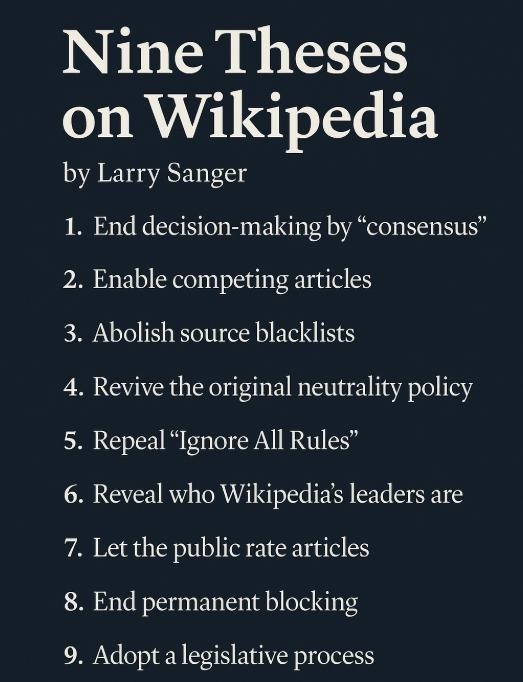
- Nine Theses on Wikipedia
- 1. End decision-making by “consensus.”
- 2. Enable competing articles.
- 3. Abolish source blacklists.
- 4. Revive the original neutrality policy.
- 5. Repeal “Ignore all rules.”
- 6. Reveal who Wikipedia’s leaders are.
- 7. Let the public rate articles.
- 8. End indefinite blocking.
- 9. Adopt a legislative process.
- Further theses
1. End decision-making by “consensus.”
Wikipedia’s policy of deciding editorial disputes by working toward a “consensus” position is absurd. Its notion of “consensus” is an institutional fiction, supported because it hides legitimate dissent under a false veneer of unanimity. Perhaps the goal of consensus was appropriate when the community was small. But before long, the participant pool grew so large that true consensus became impossible. In time, ideologues and paid lackeys began to declare themselves to be the voice of the consensus, using this convenient fiction to marginalize their opponents. This sham now serves to silence dissent and consolidate power, and it is wholly contrary to the founding ideal of a project devoted to bringing humanity together. Wikipedia must repudiate decision-making by consensus once and for all.
2. Enable competing articles.
Neutrality is impossible to practice if editors refuse to compromise—and Wikipedia is now led by such uncompromising editors. As a result, a favored perspective has emerged: the narrow perspective of the Western ruling class, one that is “globalist,” academic, secular, and progressive (GASP). In fact, Wikipedia admits to a systemic bias, and other common views are marginalized, misrepresented, or excluded entirely. The problem is that genuine neutrality is impossible when one perspective enjoys such a monopoly on editorial legitimacy. I propose a natural solution: Wikipedia should permit multiple, competing articles written within explicitly declared frameworks, each aiming at neutrality within its own framework. That is how Wikipedia can become a genuinely open, global project.
3. Abolish source blacklists.
An anonymous “MrX” proposed a list of so-called perennial sources [a] just seven years ago, which determine which media sources may, and may not, be used in Wikipedia articles. The page is ideologically one-sided and essentially blacklists disfavored media outlets. Wikipedians now treat this list as strict—but unofficial—policy. This approach must be reversed. Wikipedia should once again explicitly permit citations even from sources that the page currently blacklists. Rather than outright banning entire sources that can contain valid and important information, Wikipedia articles should use them when relevant, while acknowledging how different groups assess them. Neutrality requires openness to many sources; such openness better supports readers in making up their own minds.
4. Revive the original neutrality policy.
In short, Wikipedia must renew its commitment to true neutrality. The present policy on neutrality [a] should be revised to clarify that articles may not take sides on contentious political, religious, and other divisive topics, even if one side is dominant in academia or mainstream media. Whole parties, faiths, and other “alternative” points of view must no longer be cast aside and declared incorrect, in favor of hegemonic Establishment views. Solid ideas may be found in some of the first policy statements, including the first fully elaborated Wikipedia policy [a] and the Nupedia policy of 2000. [a]
5. Repeal “Ignore all rules.”
On February 6, 2001, [a] I wrote this humorous rule—“Ignore all rules”—to encourage newcomers. Ironically, my joke now serves to shield insiders from accountability. It no longer supports openness; it protects power. Wikipedia should repeal it.
6. Reveal who Wikipedia’s leaders are.
It is a basic principle of sound governance that we know who our leaders are. So why are the 62 Wikipedia users with the most authority—“CheckUsers,” “Bureaucrats,” and Arbitration Committee members—mostly anonymous? Only 14.5% of such users reveal a full, real name. These high-ranking individuals obviously should be identified by their real and full names, so they can be held accountable in the real world. After all, Wikipedia is now one of the world’s most powerful and well-funded media platforms. Wikipedia’s influence far exceeds that of major newspapers, which follow basic standards of transparency and accountability. Such standards are not mere ideals but real requirements for any media organization of Wikipedia’s stature. As of 2023, Wikipedia’s endowment was $119 million, its annual income $185 million. Therefore, if safety is a concern, funds should be used to indemnify and otherwise protect publicly identified editorial leaders. Wikipedia, admit that your leaders are powerful, and bring them out into the open; great power requires accountability. If you continue to stymie accountability, government may have to act.
7. Let the public rate articles.
A system of public rating and feedback for Wikipedia articles is long overdue. Articles now boldly take controversial positions, yet the public is not given any suitable way to provide feedback. This is disrespectful to the public. There is an internal self-rating system, not visible to readers. The platform experimented with an external ratings system but scrapped it after a few years, and it didn’t help readers. Wikipedia does not need a complex system to get started. An open source AI rating system would not take long to develop. The platform already collects relevant objective data such as number of edits and word count: make that public. As to human raters, they should be provably human, unique, and come from outside of the editor community. When articles are evaluated by a diverse audience, content quality and neutrality will be improved.
8. End indefinite blocking.
Wikipedia’s draconian practice of indefinite blocking—typically, permanent bans—is unjust. This is no small problem. Nearly half of the blocks in a two-week period were indefinite. This drives away many good editors. Permanent blocks are too often used to enforce ideological conformity and protect petty fiefdoms rather than to serve any legitimate purpose. The problem is entrenched because Administrators largely lack accountability, and oversight is minimal. The current block appeals process is ineffective; it might as well not exist, because it is needlessly slow and humiliating. These systemic failures demand comprehensive reform. Indefinite blocks should be extremely rare and require the agreement of three or more Administrators, with guaranteed periodic review available. Blocks should nearly always be preceded by warnings, and durations should be much more lenient.
9. Adopt a legislative process.
Wikipedia’s processes for adopting new policies, procedures, and projects are surprisingly weak. The Wikimedia Foundation (WMF) has launched initiatives, but these do not establish major editorial policy. Incremental policy tweaks cannot deliver the bold reforms Wikipedia needs. No clear precedents exist for adopting significant innovations. The project is governed by an unfair and anonymous oligarchy that likes things just as they are. This stagnation must end. Wikipedia needs an editorial legislature chosen by fair elections: one person, one vote. To establish legitimate and fair governance, the WMF should convene a constitutional convention to create an editorial charter and assembly. This assembly would be empowered to make the sorts of changes proposed in these “Nine Theses.”
Further theses
When I began this project, I had more than nine ideas, of course. The following are some further theses, which I submit undeveloped. The fact that so many plausible proposals for improvement come so readily to mind underscores the platform’s dysfunction.
Wikipedia should join the Encyclosphere.
The Encyclosphere is a project I started in 2019 to collect all the encyclopedia articles in the world in a single decentralized network, with each article shared according to the ZWI (Zipped WIki) file format. This is an enormous and very worthwhile project, and, by supporting both EncycloReader [a] and EncycloSearch, [a] the Knowledge Standards Foundation [a] has made a credible start on this network. While the Encyclosphere has collected some 65 encyclopedias so far, Wikipedia could motivate the rest to contribute to the world’s knowledge—by their own lights—by running an Encyclosphere node. If Wikipedia does not enable competing articles (i.e., Thesis 2), this would be an excellent fallback position.
Implement term limits.
Administrators, as a class, tend to become too impressed with their own power on Wikipedia. If this really is a “janitorial” sort of duty (see Thesis 6), then a much larger body of people should be called upon to help. Therefore, I believe Administrators—and other positions of power and authority—should be subject to some system of term limits. I am not dogmatic about the length. One idea would be: two-year terms; may be elected to back-to-back terms; cannot be elected three times in a row; cannot be elected more than three times in a ten year period; otherwise, no limit to number of times one may serve as an Administrator. But there are many ways to implement such a system. Whichever is chosen, the election process would have to be made easier for experienced Wikipedians to get on board in this role.
Require yearly Administrator performance reviews.
Administrators, as a condition of their continuance in the role, should be subject to annual anonymous reviews of their Administrator work. Open source LLMs and other automated tools could be very useful in collecting data for such reviews.
Partner with an independent organization to handle appeals.
This is a much more ambitious way to solve the problems introduced in Thesis 8. Establish a fully and provably independent appeals body, which is nationally, politically, and religiously balanced. It must be answerable neither to the Wikipedia community nor to the Wikimedia Foundation. This body would oversee appeals against repeated blocking and on select editorial issues, ensuring decisions are balanced, just, and transparent—free from the internal politics of current administrative structures in which the foxes are guarding the henhouse.
End IP editing.
From the beginning, Wikipedia has allowed people to edit without logging in. This initially helped to attract contributors, but it is no longer needed and is now counterproductive. IP editing is now widely abused by insiders as a tool of gamesmanship, rather than making it easier for outsiders to contribute. It is long past time for this startup feature to be retired. Wikipedia has grown up. It is time for the community to act like it.
Replace or augment the edit counter with work assessments.
The edit counter has helped create an insider class that does not deserve the degree of power it wields in the system. Some of the most qualified people in the world have little time to edit Wikipedia, and so they will naturally not make many edits. But their opinion about their field of expertise ought to be worth more than that of a teenager with 50,000 edits. If not replaced, then maybe the edit counter could be augmented by independent work assessments (i.e., performance evaluations) by open source LLMs and other automated tools. It would be best to move away from the simplistic metric of edit counts and towards a more nuanced evaluation of contributions based on content quality and impact. This would reflect a true measure of a contributor’s value to the project, if that is regarded as important. The use of automated tools for this task would help keep it free of corruption and cronyism.
End or loosen restrictions on “meat puppetry.”
My understanding is that off-wiki collaboration is a thing that insiders do all the time anyway; the rule is selectively enforced, in a way that is extremely hypocritical. It should be possible to have meaningful discussions of how the Wikipedia article should look outside of Wikipedia. It is time for Wikipedia to become an open and explicit part of larger, off-wiki conversations. This is already happening. If this is not acknowledged, the conversations will take place sub rosa among secret confederates, which is much worse.
Label pages that are not appropriate for children under 13.
“Adult” content on Wikipedia should be labeled as such. By implementing age-appropriate labels to ensure the safety and appropriateness of content for younger audiences, Wikipedia would meet societal standards of protection for minors. The encyclopedia does not do so now. This is a problem I brought to Wikipedia’s attention in 2012, [a] when I proposed a solution. The proposal was never implemented.
Allow memorial articles about elders and deceased friends and family.
I claim that our elders are all noteworthy. Regardless of whether they were ever in the news, they have had a lifetime’s impact on the rest of us. Therefore, the children, other relatives, and friends of persons over 65 years old should be permitted to memorialize their lives, but only if their next of kin agree. Existence could be confirmed through public records or reliable testimony. Such articles could be placed in a new namespace. Articles could be written based on oral histories. While the latter primary sources would not meet traditional reliability policies, they would be a valuable record of what family and friends said about our elders and dear departed, as permanent lore about a person. The result would be an amazing resource for future historians.
Embrace inclusionism.
The firm tendency to delete perfectly good articles because somebody thinks the topic is not “noteworthy” enough (called deletionism) is an innovation. Deletionist tendencies are toxic to a healthy, free, and open encyclopedia. Generally speaking, if someone can be found to write an article on a topic, and it otherwise meets Wikipedia’s standards, it is best to include the article. Thus, Wikipedia’s rules on what counts as “noteworthy” need to be revised, to be made more lenient and inclusive.
37 responses to “Nine Theses on Wikipedia”
-
Warm greetings Larry Sanger,
I read your “Nine Theses on Wikipedia” and agree with your proposals. I especially support term limits for all the wiki administrators, as well as making their names public and accessible.
Over the last decade (perhaps longer) Wikipedia has devolved into a self-serving liberal-oriented resource. I would harken it to the current U.S. political anti-American Democrat party whose intent is to subvert the freedoms of all Americans. Perhaps this is why the word ‘RAT’ is in the Democrat party name.
Over the last decade, Wikipedia has deliberately suppressed, disenfranchised, impugned and ignored alternate and mostly conservative opinion – much like the current “RAT” party consistently does to conservative voices.
As a result, (and I can only speak for myself – but I strongly believe many other conservative users share this truth) I deliberately do NOT provide financial support during the wiki “please give us more money” campaigns. What a SMART MOVE to deliberately ALIENATE half (or more) of your audience who will NOT financially support you because of your deliberate Bias. This is Pure Business Genius.
Bottom Line: if there ever is a ‘realignment’ of policy at Wikipedia, they will have an uphill climb to get ANY CONSERVATIVE USERS to financially support their liberal biased resource.Although Elon’s Grokipedia is only one month old, it has garnered the eyeballs and support as the resource of choice for most (if not all) conservative computer users. And yes, currently it’s GUI IS spartan but I’m convinced that it will ‘flower’ and quickly be more fully-functional. The point is that there is a ‘new kid in town’ and one that doesn’t insult Conservative users with biased data.
As an exercise, I recommend that you look up “Climate Change” on both Wikipedia and Grokipedia. Read them both to understand how radically different the two responses are. Wikipedia is heavy with political narrative and fear, and Grokipedia is balanced, measured, and far more scientific.
Unless the misguided Wiki ‘controllers’ Quickly change their attitude and openly come ‘hat in hand’ to apologize for their Byzantine behavior – AND publicly announce what they will do to make MEANINGFUL changes and WHEN, they will quickly be relegated to the dust bin of history.
-
Larry, this isn’t reform; it’s a blueprint for epistemic suicide, demanding that Wikipedia trade verifiable fact for ideological noise and turning the encyclopedia into a free-for-all for every discredited conspiracy theory and partisan source. You are advocating for the destruction of the very neutrality you claim to champion by creating a false equivalence between academic consensus and marginal opinion, which would instantly transform a shared global resource into a chaotic, unusable battleground of warring factions. If these theses were adopted, you would succeed only in permanently undermining public trust in the information you helped bring into the world, leaving a legacy of intentional intellectual fragmentation.
-
I am approving this only as an example of the sort of high-handed, arrogant, and intolerant presumptuousness often seen in the new Wikipedians’ repudiation of neutrality as such. They really do want to control what others think, and they arrogantly claim the right to decide for all what may be reduced to and dismissed as “conspiracy theory” and mere “partisan” hackery.
Free people want to be allowed to decide such things up for themselves, and to be supported and assisted in such decisions. You are on the side of the totalitarians. For shame.
-
-
I am merely a user, a retiree who looks things up with some frequency for no purposes other than my own edification. In the same way I trusted my government until I didn’t, I trusted wikipedia until I didn’t. It took Mr. Trump to begin a reversal of the first problem. It appears Mr. Sanger and Mr. Musk may begin a reversal of the second. It would be delightful to have an information resource that I could trust.
-
good
-
Something like this is long overdue.
-
Great idea, this will improve the internet, and will help get society on a slightly better track than it is on currently! Wikipedia needs great reform, as it has become ideologically compromised as a source of reliable information.
-
I’m looking for a more reliable way of researching people, places, and famous events that aren’t woke like X.
-
I don’t agree every infosite should be in Encyclosphere. What if a similar clicque you talk about or the opposite could “conquer” it in the future? We’ll have no more alternatives.
-
The Knowledge Standards Foundation is unlikely to be conquered. In any event, it’s just a layer on top of many individual, entirely independent organizations, a combination of a search engine, archive, and (very loosely joined) network.
-
-
One way to vote against Wikipedia’s biased policy is to simply quit donating to them.
-
I met you when I became a Wikipedian in 2001. I followed you to Citizendium then I joined Justapedia after meeting the founder through your Knowledge Standards Foundation (KSF). 24 years later, the field of knowledge standards continues to be one of my most active hobbies. I applaud you for the work you have done to create these nine theses. Bravo! I wish you had made it an even 10 and that the 10th thesis was for WP to join the Encyclosphere project.
-
Thanks, Tim!
The notion that WP should join the Encyclosphere? Thatwas the first of a supplemental set of theses (see above, it’s there).
-
Leave a Reply to Jan Larsson Cancel reply