“There is none else beside him”

10 comments

This is an essay on whether there are multiple gods, according to the Bible. Suffice it to say that there were strong opinions about the May 18 previous version of this; the following day, I revised it, removing the name of a certain Bible scholar. This is just a blog post, not my final word on the subject; it’s just some summary remarks.

In what follows, I argue that it is both heretical and philosophically confused to maintain that there are multiple gods. Some people who are, or at least seem to be, Christian, do in fact endorse such claims as “There are multiple gods” and “The Bible correctly refers to multiple gods.” Such statements—not any one person’s body of work—are my target.
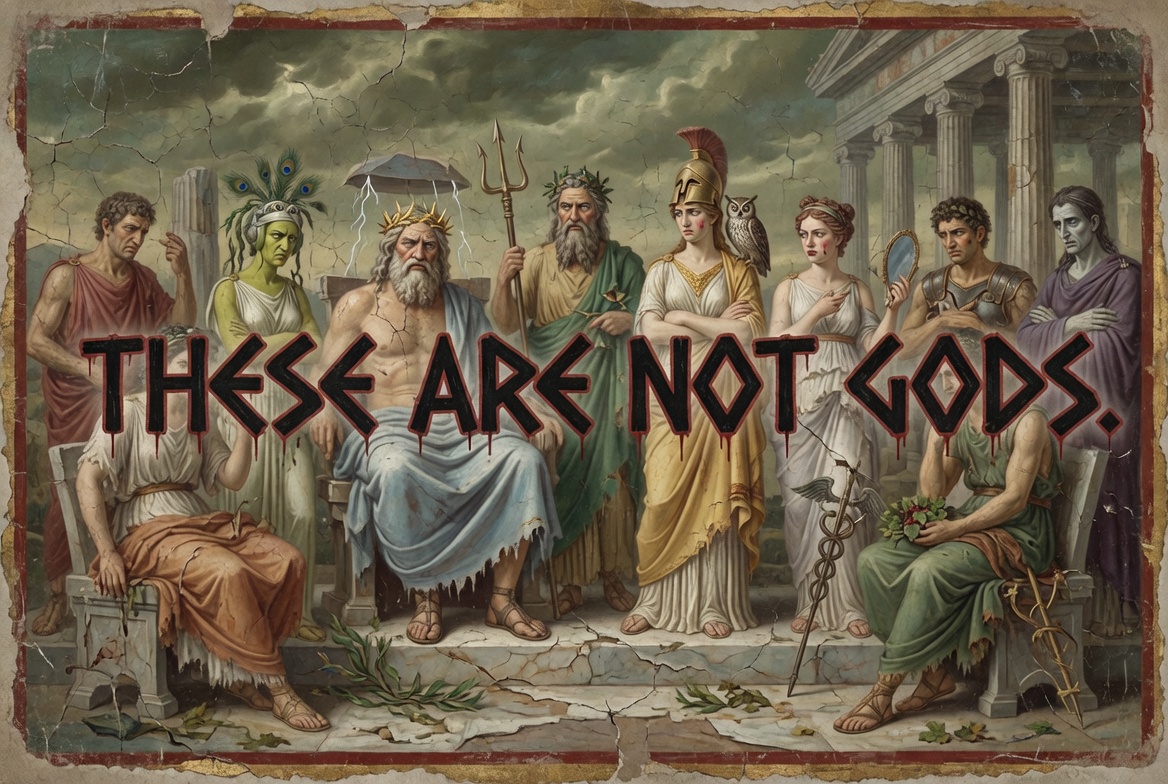
1. The general background of words for “God” and “gods” in Scripture

My view, and that of Christians (full stop), and that of the Bible (also full stop), is this: There is exactly one God, and no other gods exist; but I acknowledge that some pagans worship or worshipped demons, some of which may exist or have existed, and which they wrongly called “gods” (Hb. elohim, Gk. theoi, Lat. deī, etc.). This is the traditional view (full stop again). It is the view of the traditional, orthodox branches of Christianity, Protestant, Catholic, and Eastern Orthodox, going back to Scripture and the early Church Fathers.

Polytheism is an ontological position, not a position about your personal objects of worship. Monotheism means belief in one God (i.e., that one exists), period. If you think there are multiple gods but you only worship one of them, you are a nonstandard kind of polytheist (maybe a henotheist)—not a monotheist. Do you believe there are many entities that are properly called “gods”? Then you’re a polytheist. That’s the standard definition you’ll find discussed in any philosophy of religion, theology, or religious studies context. The issue obviously does not turn on the question whether certain spiritual entities exist. The issue turns on the question whether (in our doctrine) we should, or are permitted to, call them “gods.”

The key issue is whether our doctrine must acknowledge that other entities that we call “gods” exist. Answer: no. Others call them “gods”; we call the same beings “demons.” If Scripture does call them “gods,” and if we do so as well, then we and Scripture do so quotationally: They are “gods,” but not really. Or, in some other cases, we call them “gods” metaphorically (see below).

Nevertheless, there is a certain view, fashionable among some Christians, about what we are to make of scriptural usage of the words for “gods” (Hebrew elohim, Greek theoi). Christians have always believed in a robust spiritual realm; for over a century, modern secular Bible scholars sought to restrain such beliefs, but such people were heretical anyway. Now, some careless readers have observed that the Bible applies elohim to various kinds of entities and then immediately conclude, “The ancient Hebrews believed in many gods!” But it just doesn’t follow in any immediate, simple way from the data; you must construct a case. The OT is willing to call created beings that “the nations” worship, as well as carved idols, the spirits of the dead, and even human judges elohim. So elohim does not always mean literally “god.” Even when it does mean “god,” in some reasonable sense of this word, it is often used in a quotational way; that is, it is as if the prophets would write, if they had the modern English idiom, “the nations worship demons that they are pleased to call gods.” That is my view and, I think, that of Scripture and Church tradition. Just because the Bible speaks of these entities quotationally as elohim, that hardly means that the writers themselves held them properly to be what we Christians would call “gods.” Sometimes, by the way, you might translate elohim as “spiritual being” or perhaps “entity taken as an object of worship, rightly or wrongly.” (The latter is appropriate for when Scripture calls dumb carved idols elohim, as for example at Ex 34:17.) But the force of calling them the pagan deities “gods” is not to endorse them as being gods, but to say that that is what the pagans called them.

This complex linguistic situation might seem to permit us to make the edgy move renaming demons (and angels as well) “gods” (because indeed, angels and demons are sometimes called elohim) and to say that, for this reason at least, the ancient Hebrews believed in multiple gods. Such claims can be downplayed in terms of their doctrinal significance, treating them as purely about Bible exegesis. It is not just that. It is certainly a doctrinal claim, and if taken seriously, it would require massive rewrites of theological tomes. But it is true that, for many years, “critical” naturalistic Bible scholars, who do not concern themselves with confessions or systematic theology, have said that the Bible endorses many gods, on grounds that Hebrew monotheism emerged out of pre-existing polytheism. This sort of speculative theory has long been touted by liberal and skeptical Bible critics. It was in part due to the popularity of this view among Bible scholars in general that some Christian scholars introduced the idea that the angels and demons found in the Bible are, in fact, simply the gods of the polytheistic milieu of the ancient Near East (ANE). My view is that this doctrine smuggles in a theological framework for a kind of polytheism in a Christian context. If taken seriously in the Church, it would lay the foundation for the sort of pantheon of “spiritual beings” that esoteric, New Age, and other liberal “Christians” often discuss.

My view, then, is that a significant difficulty on this subject is rooted in the fact that the words elohim and theoi are applied to entities just because the Gentiles worshipped them. And, again on my view, this undisputed fact has resulted in a simplistic position (not to say all such positions are simplistic) that is both heretical and philosophically uninformed—particularly as regards the distinction between literal and quotational uses of a word or phrase.

Let us see if we can make better sense of what is going on here. Consider the quotational use of words; this is a universal feature of language. When we describe the beliefs of other people, the straightforward way is to use the words that they use, even if we do not share the same beliefs. If I condemn your belief and say, “Look at all of the wicked gods you believe in,” it simply does not follow from what I said that I believe in the gods that you believe in. We can accurately say the ancient Romans worshipped many gods—thousands of them. Are we thereby saying that those gods existed? Of course not. Or if I want to refer to my Hindu friend’s god Shiva, I might well use the word “god,” but that doesn’t commit me either to the existence of Shiva or to the idea that Shiva is properly called a “god.” I’m just using the word quotationally: my Hindu friend’s god Shiva. The basic idea of quotational use is itself not terribly complicated. But it causes all sorts of problems; it is just confusing enough that it is the reason people have introduced what are called scare quotes: my Hindu friend’s “god” Shiva. Yet the Bible writers did not have scare quotes.

Now, combine this complex and confusing linguistic situation with the fact that the prevailing ANE worldview was polytheistic. No one disputes this. Now, on the orthodox view, the one and only God, the creator of the universe, revealed himself to Abraham and said, essentially, “Only I am God.” Ever after, the orthodox Hebrew (and then Christian) view has been: There is one God, full stop. Sure, there are demons that rule the nations, and these might be called “gods” by their Gentile worshippers, and that description might be repeated quotationally by the Bible writers. Similarly, sure, God has angels—messengers—who, because they speak for the one true God, are called “gods.” But this is metaphorical, i.e., it is to say that it serves as a kind of symbol or representation of the real thing. Thus angels are metaphorically, not literally, elohim; they are called that because they are representatives of the one true elohim. Similarly, there were men called “gods” because they were tasked with the godly responsibility of judging other men; this use is metaphorical as well. But none of that stands in any tension with the fundamental truths that there is one God and that no other literal gods exist. So, in short, there are quotational and metaphorical uses of “gods” in the Bible, yes; but there are no literal, non-quotational and non-metaphorical uses of the plural, because Scripture is entirely consistent and it says, “there is one God,” period.

With this essential context and position statement in place, let us defend the claim that the Bible really is committed to one and only one God.

2. Why think the Bible is committed to one and only one God

As Moses said essentially and most emphatically, there is but one God: “The Lord he is God; there is none else beside him” (Deut 4:35). And this essential point is repeated in several places (see also Deut 6:4; Isa 45:5; 1 Cor 8:4; and Gal 4:8).

As I indicated earlier, when the Lord speaks of and Moses writes of “gods” (elohim), in the plural form, they are using the term either metaphorically or quotationally. Since Hebrew did not have quotation marks or other indicators of the quotational use of words, when they were forbidding and deploring worship of the pagan “gods,” how else were they supposed to make their points clear? Similarly, it was unusual to make the metaphorical use of words explicit. Men who judged the people of Israel were called “gods” because they were in God’s place (cf. Ex 18:19); thus, such a use was metaphorical (more on this below in connection to Psalm 82).

When we discuss such non-literal uses of the word “god,” I’m not even saying that we need to use another term. I’m simply saying that we need to understand that such uses might very well be quotational or metaphorical, and not literal. In other words, when the Bible writers and God himself speak of certain entities, they say not that they are gods, but that the Gentiles take them to be gods. Again, for modern precision and to understand the intent, we would use scare quotes: all the “gods” of Egypt. But we have increasingly seen the frankly heretical idea that there really were many pagan gods. There were and are demons that were and still are called “gods” by some. But so called by Christians? No. No pagan gods exist.

Now, let me make a challenge to those who say the Bible endorses the existence of entities really, properly called “gods.” Find me any place in the OT where the elohim of the nations are mentioned in way that must be understood non-quotationally—that is, where a biblical writer, speaking in his own voice, calls a pagan deity elohim. Also, find me any quotation from Jesus, the Apostles, or any NT writer speaking of the theoi of the Gentiles in their own voice rather than quotationally. Find me any quotation from the Church Fathers in which the “gods” (again theoi, or deī in Latin) of the Gentiles are so called in their own voice and not quotationally. I’m aware of no such place. Prove me wrong; I’ll be grateful.

Consider some verses that are presented as strong examples.

You might raise Exodus 20:3: “Thou shalt have no other gods before me.” The whole context—this is God, creator of heaven and earth, infinitely above all things—makes a reading of ontological peers of God impossible. Again, the difficulty is that ancient Hebrew had no scare quotes, no “so-called,” no italics. When the available word for “entity that pagans worship” is elohim, the word will appear in contexts where the speaker obviously does not endorse the ontological claim. The absence of quotational markers—since none were available—does not entail the absence of quotational intent.

Here, too, we must not ignore the context: The first two commandments are precisely the context in which God claims to be the one and only God. Again, see Deut 4:35 and the other verses cited above on this point.

You might point to Deuteronomy 32:17: “They sacrificed unto devils, not to God; to gods which they knew not.” But notice that Moses calls these same entities “devils” (shedim) in the very same verse. That is his own classification. The word elohim sits alongside it as a label for what their worshipers called them; “devils” is what Moses (and later inspired Bible writers) calls them.

You might point to 1 Corinthians 8:5: “For though there be that are called gods, whether in heaven or in earth, (as there be gods many, and lords many), but to us there is but one God.” But look at what Paul does here. He opens with “called” (legomenoi)—which is as close to an explicit quotational marker as you’ll find in the Bible—and closes with “but to us there is but one God.” Paul’s parenthetical words merely describe what pagans believe, and he is unambiguous about what he believes in: one God. Paul explicitly declared that he did not believe in other gods. He spoke of entities that might either be dumb idols or demons, and he acknowledged that the Gentiles called them “gods”; but he did not call them gods himself.

Let us consider an essential exegetical point that applies to confessional Christians. Let secular Bible scholars say what they will, but if you are committed to analogia fidei, then you must interpret the OT mentions (not uses!) of elohim consistently with what Paul says. If he calls them “wood and stone” and “demons,” and that the Gentiles call them “gods,” that is the stance we must find in the rest of Scripture. And that is why the Nicene Creed affirms clearly and unmistakably: “We believe in one God.”

In the Fathers you will find no pussyfooting around with the notion that the theoi of the Gentiles really were theoi. The word is used, but in no place are we required to believe that they really are gods. Much of later demonological theology goes back to Augustine in City of God, where he goes on for many pages discussing the common Roman belief in daimones that were sometimes good, sometimes bad. In Book VIII, Ch. 14, he introduces the topic and then argues that, while considered to be gods, they are no gods at all. Exegeting Psalm 96:5, Augustine writes, “He said, ‘above all gods,’ but added, ‘of the nations’; that is to say, above all those whom the nations count gods, in other words, demons.”

The passage that precedes this is possibly clearer on the point:

If the Platonists prefer to call these angels gods rather than demons, and to reckon them with those whom Plato, their founder and master, maintains were created by the supreme God, they are welcome to do so, for I will not spend strength in fighting about words. For if they say that these beings are immortal, and yet created by the supreme God, blessed but by cleaving to their Creator and not by their own power, they say what we say, whatever name they call these beings by. And that this is the opinion either of all or the best of the Platonists can be ascertained by their writings. And regarding the name itself, if they see fit to call such blessed and immortal creatures gods, this need not give rise to any serious discussion between us…

Another often-cited passage is Psalm 82, where the psalmist says that God “judgeth among the gods” and “Ye are gods.” It is claimed—to my mind, with puzzling confidence—that these refer to spiritual beings, perhaps demons.

I take the absolutely, unquestionably traditional view (going back at least to Augustine again) that Psalm 82 was referring to human judges, just as Exodus 21–22 does in three places (21:6, 22:8–9, 22:28). The words of Jesus himself in John 10 may guide us. There, he affirmed that some men are dignified with the title theoi (gods). In John 10:34, Jesus quotes “ye are gods” from Psalm 82:6, clearly referring to the judges or rulers of Israel. You make nonsense of Jesus’ point if you take “ye are gods” to refer to “spiritual beings.” The Jews are accusing Jesus: “Thou, being a man, makest thyself God.” Jesus responds not by agreeing that he is God, but by quoting the text and then saying, “He called them gods, unto whom the word of God came.” That is, the persons called “gods,” i.e., representatives of God, were those who received the word of God, the judges who were judging in Moses’ stead, and this is why human judges were called elohim in Exodus 21:6 and 22:8–9, 28. Jesus’ response to his accusers would be much more on point—it would have much more rhetorical impact—if all understood the psalm to be speaking of human judges. Indeed, that’s the obvious reading. The “spiritual beings” reading is strained for these reasons.

Moreover, Jesus claimed rather to be the divinely appointed spokesman for God—a classic feature of human judges—who could be called Son of God because “the word of God came” to him. In Psalm 82, God says the elohim will “die like men,” which is an odd thing to say to angels. But it is not odd at all; it is the sobering and biting verbal irony to dignify human judges as “gods” and then to turn around and say they will die like the men they are. Again, this is, it should be noted, the traditional reading—the only reading of the Church Fathers and of orthodox commentators down through the centuries. Are we supposed to ignore that? The “spiritual beings” interpretation of Psalm 82 is the strained novelty, not the other way around.

To sum up: Since no demon is properly called a god, when Scripture refers to them as “gods,” the use of this word is quotational. The Bible writers sometimes did followed the ANE pagan usage of words, and indeed not their own preferred words in their own voice. Ironically, this was so they would be clearly understood by their audience. Scripture might call angels and men “gods” as well, but here the meaning is metaphorical: They are messengers and representatives of the one and only God. In short, in no place in Scripture and in no place in the Fathers does anyone ever speak of the “gods” of the Gentiles as gods in their own voice. The prophets, Jesus, the Apostles, and the Fathers are unanimous: There is exactly one God, and no other gods exist.

Let me leave you with some recommendations.

The view I urge here is ultimately quite simple. If your theology causes you to say there are many actual gods—entities that really should be called “gods”—you’re wrong, a polytheist (not just a henotheist), and taking a fundamentally heretical position. I’m not accusing anyone of taking this position, but if the shoe fits, wear it.

By contrast, if all you’re saying is that the pagans worshipped real entities that Scripture called “gods” to clarify that the Gentiles considered them such, then your position is not polytheism and you don’t really believe in multiple gods. Perhaps you’re just philosophically confused, but that’s common and resolved easily enough. (I hope this essay will help.)

If you are not sure what to think here, then let’s at least be clear about what decision you face: What should you put in your ontology, i.e., the set of things you believe actually do exist, in terms you use them to describe them literally? Among other things, you should consider whether you think you ought to embrace an orthodox ontology. We Christians believe in one and only one God and that no other gods exist (at all). I recommend you join us in this (orthodox) belief.

But please—don’t start calling demons gods. They’ll like that, you know.

Appendix: some of my arguments, reduced to logical form

The basic argument for Christian monotheism

  1. All the “gods” of the Gentiles (whether they exist or not and regardless of their powers and functions) are false.
  2. Thus, the “gods” of the Gentiles are not “gods” in any sense, other than a quotational sense (i.e., in the sense in which they are called that by their worshippers). (From 1.)
  3. If nothing is x in any but a quotational sense, then x does not really exist.
  4. So, the “gods” of the Gentiles do not really exist. (From 2 and 3.)
  5. God exists.
  6. The only (literal) “gods” we need consider are God and those of the Gentiles.
  7. Thus, only God exists; that is, there is only one God. Scripture is very clear about this. (From 4, 5, and 6.)
  8. That only God exists is stated very clearly in the classical formularies of the Church (i.e., accepted by all orthodox denominations).
  9. So, the proposition that there are many gods (of the Gentiles) is contrary to the classical formularies of the Church. (From 8.)
  10. Whatever is contrary to the classical formularies of the Church is certainly heretical.
  11. Thus, the proposition that there are many gods is certainly heretical. (From 9 and 10.)
  12. Therefore, there is only one God, and the proposition that there are many gods is certainly heretical. (From 7 and 11.)

What follows are three different arguments for premise (2), which I suppose is probably the most controversial one here. Of these, I think the third is the strongest, and is maybe clearer than what I wrote above on the same topic.

Argument from the false expert analogy

2a. A false god is to a god as a false expert is to an expert.

2b. A false expert is not really an expert at all (I am a “false Hegel expert,” and therefore not a Hegel expert).

2c. Thus, a false god is not really a god at all. (From 2a and 2b.)

2d. The “gods” of the Gentiles are false gods. (From 1.)

2e. Therefore, the “gods” of the Gentiles are not really gods at all—that is, not “gods” in any sense other than a quotational one. (From 2c and 2d.)

Argument from biblical usage

2f. When Moses refers to the entities worshipped by the Gentiles, he calls them shedim (“devils”) in his own voice (Deut 32:17).

2g. In the same verse, the word elohim appears alongside shedim as a label for what the worshippers called them.

2h. Thus, Moses’ own classification is “devils”; his use of elohim is quotational. (From 2f and 2g.)

2i. Paul, similarly, marks the Gentiles’ use of “gods” as explicitly quotational with legomenoi (“called”) and concludes “but to us there is but one God” (1 Cor 8:5).

2j. So, the biblical writers themselves treat “gods” as applied to pagan deities as quotational, not literal. (From 2h and 2i. These are only two examples. There is more and similar data.)

2k. Therefore, the “gods” of the Gentiles are not “gods” in any sense other than a quotational one. (From 2j.)

Argument from analogia fidei

2l. Scripture applies elohim and theoi to the gods of the Gentiles (e.g., Ex 20:3; Deut 32:17; 2 Chron 25:15; Acts 14:11, 17:18).

2m. Scripture also declares, repeatedly and emphatically, that there is only one God and that pagan deities are not gods (Deut 4:35; Deut 6:4; Isa 45:5; 1 Cor 8:4; Gal 4:8).

2n. The principle of analogia fidei requires that (2l) and (2m) be made consistent, i.e., a truth-preserving way to interpret Scripture so that the gods of the Gentiles may in some sense be called “gods” and also to deny that they are gods (since there is only one God).

2o. Specific verses indicate exactly how to make them consistent: Moses calls the Gentile gods “new gods that newly came up,” but names the same entities shedim (“devils”) in his own voice (Deut 32:17).

2p. Similarly, Paul explicitly marks “gods” with legomenoi (“that are called gods”) and concludes “but to us there is but one God” (1 Cor 8:5).

2q. Thus, the best application of analogia fidei is the one Scripture itself suggests: the uses in (2o) and (2p) are quotational. (From 2n, 2o, and 2p.)

2r. Therefore, the “gods” of the Gentiles are not “gods” in any sense other than a quotational one. (From 2q.)


by

Posted

in

, ,

Comments

Please do dive in (politely). I want your reactions!

10 responses to “”There is none else beside him””

  1. I pray that your Christian journey goes well. We likely mostly agree theologically, so this might be a matter of semantics. I will try to explain my position and why the position is important. The majority of ancient Israelites in the Old Testament were polytheistic for most of the existence of the kingdoms of Israel and Judah. The Hebrews did not truly embrace monotheism until the period of exile. *Quick disclaimer, when I use the term “gods” I will be using it under the same definition of you. The “gods” were demonic beings that people worshipped and called “gods.”* Throughout the book of Judges, there is constant chaos, wars, and famines caused by God removing this protection from Israel because they were worshipping other gods. King David worshipped YHWH however his son Solomon turned away from God. “For when Solomon was old his wives turned away his heart after other gods, and his heart was not wholly true to the Lord his God, as was the heart of David his father. For Solomon went after Ashtoreth the goddess of the Sidonians, and after Milcom the abomination of the Ammonites. So Solomon did what was evil in the sight of the Lord and did not wholly follow the Lord, as David his father had done. ” 1 Kings 11:4-6 Throughout 1 and 2 Kings, 1 and 2nd Chronicles there is a constant refrain (there were zero righteous kings listed in the kingdom of Israel in those 4 books and two or three righteous kings in the kingdom of Judah) : “He did evil in the eyes of the Lord, following the ways of his father and committing the same sin his father had caused Israel to commit.” as well as verses saying the people served and sacrificed other gods. This is why God allowed the two nations to be conquered and for the people to be exiled. Why is this important: Secular historicians ,who likely never read the Bible carefully, have “groundbreaking” discoveries, that archaeological evidence including idols and shrines to other gods prove that Israel was polytheistic. They will use that evidence to claim that the Bible is false. People, who also never carefully read the Bible, often fall for that trick. The truth is the Bible is reliable and confirms what archaelogists have found. The prophets of the Old Testament wrote about God warning Israel and Judah to come back to Him. They were warned to turn from foreign gods. The exile happened because of God’s judgment and people who returned to the land had prayers of repentance (Ezra and Nehemiah). The Hebrew community as a whole never permanently embraced monotheism until they were exiled. *After this post has been approved I will address why it is important to acknowledge the reality of the gods of the nations (fallen angels/demons)*

    1. The reality of the gods of the nations (again with the disclaimer that I mean that term in the way the Biblical writers meant): The Bible definitely describes those gods as real entities. Exodus 12:12 “‘For I will pass through the land of Egypt on that night, and will strike all the firstborn in the land of Egypt, both man and beast; and against all the gods of Egypt I will execute judgment: I am the Lord.” Jeremiah 46:25: “The Lord of hosts, the God of Israel, says: “Behold, I will bring punishment on Amon of No, and Pharaoh and Egypt, with their gods and their kings—Pharaoh and those who trust in him.” 1 Corinthians 10:20 “Rather, that the things which the Gentiles sacrifice they sacrifice to demons and not to God, and I do not want you to have fellowship with demons.”
      Deuteronomy 32:16-17: “They provoked Him to jealousy with foreign gods;
      With abominations they provoked Him to anger.
      They sacrificed to demons, not to God,
      To gods they did not know,
      To new gods, new arrivals
      That your fathers did not fear.”
      Now I know that you already clarified that those gods could be real, but the fact that they are demonic beings makes them not actual gods. But here is why this is important and why the theologian whose name you removed was gaining in popularity: Modern-day Western Christianity, especially Protestants and in particular Evangelicals, tend to downplay the role that the spiritual realm plays in our lives. They tend to portray angels and demons as playing a minimal role in everyday life when the Scriptures say the opposite. As I don’t want to get into a debate about so-called end-times theology, I will present a simplified version: In the book of Daniel and the book of Revelation, beasts are used to symbolize oppressive empires. In Daniel 7, the first beast is the Babylon Empire, the second beast is the Medo-Persian Empire, the third beast is the Greek Empire of Alexander the Great which split into 4 after his death, and the fourth empire is the Roman Empire, which had an inventive way to turn normal iron ore into steel (iron teeth). In Daniel 9, Daniel has a vision of a man dressed in linen who say he was delayed by the Prince of Persia and that the Prince of Persia was in battle with the Archangel Michael. This suggests that spiritual forces are behind the empires. The Whore of Babylon who rides the Beast, is recognized by Biblical scholars as being a portrayal of the patron goddess of Rome, Roma. Isaiah 14 is talking about the king of Babylon but influencing the king of Babylon is the fallen one of heaven. So those gods who are demons are the ones who pulling the strings (which is why God was judging the gods of Egypt as well as the Pharoah and his people). This is why our battle is not against flesh and blood but “against principalities, against powers, against the rulers of the darkness of this world, against spiritual wickedness in high places.” Ephesians 6 The battle of ideas: The Western world in which atheism is gaining popularity (although there is also the rise of the New Age movement), also is full of spiritual warfare. If demons cannot get people to worship them directly, they will get people to worship inanimate objects and ideas like money and popularity. There is also spiritual warfare in the battle of ideas and philosophies (Colossians 2:8). I see the warfare in the form of increased apathy and depression among Millennials (which I am part of) and the younger generation. People can bring up the rise of social media, the instant gratification culture, lack of community, etc. All these things could be true, but there is a spiritual force of wickedness that is behind all of this. One of the fastest-growing branches of Christianity is Pentecostalism and it is because that tradition addresses the spiritual realm and its connection to everyday living. The issue with Pentecostalism is that it lacks the stability of the creedal and confessional theology that is found in Eastern Orthodox, Roman Catholicism, Coptic Orthodox, as well as certain forms of high-church Lutheran, Presbyterian, and Anglican Churches.

      1. Thanks for the contribution here. Agreed 100%.

  2. Tom Dill

    If all Heiser had been claiming was that the nations around Israel were polytheistic and that many of the Israelites adopted their beliefs (and were condemned for it), then I can’t imagine why he would have felt any urge to write books about it—unless they were the sort written in very simple language with a picture on every page.

    Likewise, if his thesis is simply that the Hebrew word elohim might refer to a category of being of which YHWH is the principle archetype, but might also be extended to include some of the most powerful beings that He created, then I don’t feel inclined to argue the point. God certainly created angelic beings that seem sufficiently godlike to us mortals that every time we see them they have to assuage our fears and remind us not to worship them. And the prophets give us a few glimpses into heavenly councils of God and his angels.

    I don’t really have a problem with the notion that the word elohim can, at least in some contexts, refer to both YHWH and his angels, but what I would like someone to explain is why the “Divine Council” crowd can’t ever seem to mention that idea without immediately talking about how similar that supposedly is to the beliefs of pagan ANE cultures. How exactly is that relevant to our understanding of Biblical theology? Ugaritic mythology is older than our written Scripture. I suppose it’s possible their stories about a Divine Council may be distant descendants of true prophetic revelations about God and his angels that are now forgotten. I could just as easily conjecture that Snow White and her poison apple are dim echoes of Eve in the Garden, but none of these things should color our understanding of Scripture in the slightest. What possible reason is there to mention ANE mythology in this way unless it’s to suggest that the Bible might have evolved from that? If you don’t believe that, then let your arguments about the word elohim stand on their own instead of appealing to false gods for support.

    1. Agreed, Tom—you raise some uncomfortable questions. My own view is that the “there are many gods” crowd are divided (sometimes in their own minds), some admitting that this is a kind of polytheism and shrugging off accusations of heresy (they like the thought that they’re heretics), and some angrily denying the suggestion, trying to have it both ways. But you raise an interesting prior question: why are they so bent on modeling their doctrine after that of ancient pagans? That is, after all, essentially what they are doing.

      1. Tom Dill

        Whether or not they admit it or even realize it, I believe they’re being influenced by the ideas of Wellhausen and his ilk that monotheistic Judaism wasn’t really established until after the exile. As I’m sure most people who read this will already know, the predominant view among liberal scholars is that the Hebrew Scriptures were compiled from a plethora of written and oral traditions long after the largely fictional events they describe. In that framework, passages that hint at a divine council are vestiges of the old polytheistic and henotheistic religions, and the clearly monotheistic ones are later inventions. I know most of the DCW folks will flatly deny they believe this, and I won’t accuse them of lying, but I can’t help thinking they’re trying to syncretize traditional Christianity with the so-called higher criticism. It’s an old pattern—not entirely unlike the one Israel kept falling into.

        Again, no one who believes the Bible will argue that God didn’t create great hosts of extremely powerful beings who do many things in both the heavenly and earthly realms that we don’t understand. And absolutely no one is arguing that the pre-exilic Israelites were all faithful monotheists, but I’m absolutely willing to die on the hill that they ought to have been because that’s what their scriptures and prophets taught. Elijah’s test of fire wasn’t designed to prove YHWH was a superior god to Ba’al; the whole test was predicated on the notion that if YHWH was a god then Ba’al wasn’t, and if Ba’al was a god then YHWH wasn’t.

  3. jeffrey lawrence

    Dr. Sanger,

    I’ve read your argument, and I think the central concern driving it is understandable: Christians should not drift into polytheism, and Yahweh’s uniqueness must be protected at all costs. Agreed. Scripture is unambiguous here. God is uncreated, incomparable, sovereign, and alone worthy of worship. No angel, demon, principality, or spiritual being stands alongside Him as a rival deity.

    But I think your argument solves that concern by narrowing biblical language more than Scripture itself narrows it. The real issue here is not whether there is one true God. There is. The issue is whether Scripture ever permits the language of “gods” (elohim) to refer to created beings in a real, but clearly subordinate, sense without collapsing into polytheism.

    You argue no. More specifically, you argue that whenever Scripture refers to “gods,” it is speaking quotationally, metaphorically, or simply reporting pagan belief. That seems too strong to me, and I do not think the text will bear that much weight. Certainly, there are passages where quotation pressure is obvious. When Moses speaks of “the gods of Egypt,” nobody serious thinks he is affirming Egyptian theology. Fine. But the move from “some uses are quotational” to “all plural uses are quotational” does not follow.

    Psalm 82 is the clearest problem for your thesis. Whatever interpretation one lands on, this is not pagan speech. This is not Israel repeating what pagans think. God Himself is speaking: “I said, ‘You are gods, sons of the Most High, all of you; nevertheless, like men you shall die.’” At minimum, your claim that Scripture never uses this language in its own voice immediately runs into trouble here.

    Now, I know your response: human rulers. Again fine, but let’s examine that honestly. That reading explains some things very well. The language of unjust judgment, oppression, failure to defend the weak, and corruption clearly fits earthly rulers. “You shall die like men” also lands naturally if the point is that rulers who imagine themselves untouchable will still fall under judgment.

    But the human-ruler reading creates pressures elsewhere in the psalm that should not be waved away. Why begin with “God has taken His place in the divine council; in the midst of the gods He holds judgment”? Why the courtroom of heaven? Why “sons of the Most High”? Why the elevated cosmic framing? And why does the psalm end with “Arise, O God, judge the earth; for You shall inherit all nations”? The scope expands dramatically. We move from corrupt judgment to universal inheritance. The psalm feels larger than municipal judges.

    Now, to be clear, I am not arguing for speculative angelic bureaucracy here. I am not arguing for a cosmic org chart, nor am I saying Heiser is automatically right about every inference he makes. Heiser can overextend. Some of his followers definitely overextend. But I do think Psalm 82 resists flattening. A purely human reading explains the social justice language but strains the cosmic setting. A purely heavenly-being reading explains the divine council imagery but strains the earthly injustice language. The text appears to sustain pressure in both directions.

    And Scripture already gives us precedent for this kind of overlap. Daniel 10 presents earthly kingdoms and spiritual opposition without forcing us to choose one layer against the other. Persia is real. The prince of Persia is also real. The categories are distinct but related.

    Deuteronomy 32 creates similar pressure. You argue that Moses calls these beings demons and therefore “gods” is merely pagan terminology. But the text itself is more textured than that: “They sacrificed to demons, not God, to gods they had never known.” Notice the distinction. The text does not say, “these are literally nothing.” Nor does it say, “these are rival deities to Yahweh.” Instead, it presents false worship directed toward hostile spiritual realities that are emphatically not God. Paul intensifies this in 1 Corinthians 10: what pagans sacrifice, they sacrifice to demons. The idol is nothing as an idol. But idolatry is not spiritually neutral. That matters.

    I think the deepest issue here is semantic closure. You seem to assume: if only one true God exists, then no other being may ever be called “god” in any real sense. But that does not necessarily follow. Shared naming does not entail shared ontology. Christ is uniquely Son by nature. Believers are called sons of God by grace. The title broadens without collapsing distinction. Likewise, acknowledging that Scripture sometimes applies elohim language more broadly does not diminish God’s uniqueness. Yahweh remains utterly singular: Creator, uncaused, sovereign, incomparable, worship-worthy alone. That is not in dispute.

    The question is whether biblical language is allowed to remain broader than our theological discomfort sometimes permits. My concern with your argument is not that it protects monotheism. It should. My concern is that it protects monotheism by flattening textual distinctions the Bible itself appears willing to maintain.

    Plainly put, I think you are right to resist polytheism. I think you are right to warn against speculative supernaturalism. I think you are wrong to insist that every use of “gods” language outside Yahweh must collapse into quotation, metaphor, or fiction. The text appears more complicated than that. And if the text is more complicated than that, we should let it remain complicated rather than resolving the tension too quickly.

    1. Thanks for an articulate and reasoned response (one that is much more so than the vast majority of what I saw on X).

      May I ask what denomination you are? I’m a confirmed member of the ACNA (orthodox Anglican).

      My central concern is not merely that the Lord God’s “uniqueness must be protected at all costs,” because that view is subtly consistent with henotheism (worship of one above other gods), which is a kind of polytheism. My central concern needs no revision: maintaining that there are no other gods, period. And I maintain that denying this is rather obviously heretical, like it or not. Similarly, this—”No angel, demon, principality, or spiritual being stands alongside Him as a rival deity”—is simply too weak. Rather, there are no other (literal) deities at all. They are angels and demons, not deities.

      But I think your argument solves that concern by narrowing biblical language more than Scripture itself narrows it.

      I disagree. When Scripture uses language quotationally and metaphorically, and I accurately report these facts, it does not follow that I “narrow biblical language.” To say I do is to beg the question.

      The real issue here is not whether there is one true God. There is. The issue is whether Scripture ever permits the language of “gods” (elohim) to refer to created beings in a real, but clearly subordinate, sense without collapsing into polytheism. You argue no.

      Sorry to be a Negative Nelly, but—wrong again. That is not the real issue. The issue is not whether the language of “gods” refers to real created beings—of course it does, demons exist—but whether those beings should properly be called “gods.” That’s the distinction I keep pointing out, and which you don’t seem to notice.

      More specifically, you argue that whenever Scripture refers to “gods,” it is speaking quotationally, metaphorically, or simply reporting pagan belief.

      That’s correct. But it is not equivalent to what you said.

      That seems too strong to me, and I do not think the text will bear that much weight. Certainly, there are passages where quotation pressure is obvious. When Moses speaks of “the gods of Egypt,” nobody serious thinks he is affirming Egyptian theology. Fine. But the move from “some uses are quotational” to “all plural uses are quotational” does not follow.

      If you’ll more carefully read my piece, you’ll see that I did not say all plural uses are quotational. At least I hope I didn’t say that. As I said, Scripture applies elohim to the following categories: (1) God; (2) the demons worshiped as gods by pagan idolators; (3) men placed in positions of judicial authority in place of God, i.e., judges and kings; (4) very rarely, angels; (5) once or twice, the spirits of dead people; and (6) frequently, carved idols.

      (1) is literal. (2) is quotational: they’re called “gods” only because idolators bow down before them. (3) and (4) are metaphorical or representational (which is more or less to say the same thing), (3) because judges are agents of and should be inspired by the word of God, and (4) because they are messengers of God. Use (5) is metaphorical as well: spirits are like God because they are spiritual persons, as God is. Finally, (6) is metaphorical, but derivative from sense (2), because idolators bow down before idols.

      There are other ways to analyze what’s going on here, but as I pointed out especially in the Argument from Analogia Fidei (last item in the appendix), we are absolutely constrained by the fact that Scripture clearly says that there is one God and that the other beings sometimes called “gods” are no gods at all. Since Scripture must be rendered consistent (so goes the argument), the view that fails to affirm this—by insisting that the pagan gods really are properly called gods, which certainly is the basic position you are taking—fails to respect analogia fidei. My view preserves the truth of claims made in terms of “gods,” by making such claims quotational. Your view by contrast fails to preserve the truth of “There is none else beside him.”

      There are a few ways you might try to escape this problem. First, if you maintain that the latter means “Only Yahweh is God” with a capital G, then you ignore the fact that Hebrew had no capital letters or other such orthographic markers of proper nouns. Second, if you maintain that it means “There is no spiritual being like Yahweh,” then you are the one “flattening” language. The language says there is none else, period. That’s a definitive refusal to allow that something exists at all, and you would be setting this feature of the claim aside. Similarly, Isaiah says, “there is no God beside me” (45:5); Paul says, “there is none other God but one” (1 Cor 8:4); and these are not the only examples. Remember, the point is not made in terms of the name Yahweh but in terms of elohim and theos. Your view cannot take account of these.

      And need I really point out—but of course I do, as I have learned—that this is no minor side-issue in theology and in our statements of doctrine. This is the first thing stated at the beginning of systematic theologies: there is one God, there are no others.

      Psalm 82 is the clearest problem for your thesis.

      Not really. As I explained, I take the traditional view. It’s not just one traditional view of the psalm; it’s the only traditional view. You and the scholars you are drawing on—who are, as uncomfortable as it is for me to say, quite dominated by naturalists—are showing just how completely separated you are from the roots of confessional Bible scholarship if you think Psalm 82 is strong support for your view that the Bible really calls angels and demons “gods” in its own voice.

      Now, I know your response: human rulers. Again fine, but let’s examine that honestly. That reading explains some things very well. The language of unjust judgment, oppression, failure to defend the weak, and corruption clearly fits earthly rulers. “You shall die like men” also lands naturally if the point is that rulers who imagine themselves untouchable will still fall under judgment.

      But the human-ruler reading creates pressures elsewhere in the psalm that should not be waved away. Why begin with “God has taken His place in the divine council; in the midst of the gods He holds judgment”? Why the courtroom of heaven? Why “sons of the Most High”? Why the elevated cosmic framing? And why does the psalm end with “Arise, O God, judge the earth; for You shall inherit all nations”? The scope expands dramatically. We move from corrupt judgment to universal inheritance. The psalm feels larger than municipal judges.

      First, the words in Ps 82:1 are not well rendered “divine council,” because that has all sorts of weird theological freight not contained in the actual words, which are ba’adat-‘el, literally translated, “the assembly [or congregation] of God.”

      Anyway, the detail is easy and far easier on the traditional reading to capture than on yours. We are invited to imagine the judges sitting “in the gate,” and God sitting among them. They are called “gods” and “the mighty,” because they are judges dispensing life and death, as God does, presumably according to his law and inspired by his Spirit (or that’s how it’s supposed to work). There is no “courtroom of heaven” mentioned here. It is the assembly of God, no more, no less. They are the “sons of the Most High” because these are Israelite judges, and as the leaders, they represent Israel himself, who was adopted by God: “Thus saith the Lord, Israel is my son, even my firstborn” (Ex 4:22). Similarly, “Ye are the children of the Lord your God.” (Deut 14:1) We can acknowledge a certain kind of “elevated cosmic framing,” because we are invited to think of God himself among the judges, thus elevating their assembly by his presence, which he condescends to bestow because they are, again, “children of the most High.” (Ps 82:6) Yes, well spotted, these are no mere municipal judges, they are the leaders of a “nation of priests”—and they are coming under exactly the sort of rough justice that God threatened by his prophets and then meted out in the Exile.

      This is the traditional reading and it is obvious and 100% complete to anybody who reads Scripture repeatedly in context (and believes it—that helps).

      Now on your view, this is the one and only place in all of Scripture in which God takes angels to task for “judging unjustly” and “accepting the persons of the wicked.” Where are they shown even possibly delivering the poor and needy? That’s something human judges could do—this is a theme repeated about the judges practically to point of boredom. Never once is it said of any fallen angels.

      Now, to be clear, I am not arguing for speculative angelic bureaucracy here. I am not arguing for a cosmic org chart, nor am I saying Heiser is automatically right about every inference he makes. Heiser can overextend. Some of his followers definitely overextend. But I do think Psalm 82 resists flattening. A purely human reading explains the social justice language but strains the cosmic setting. A purely heavenly-being reading explains the divine council imagery but strains the earthly injustice language. The text appears to sustain pressure in both directions.

      I’m going to have to turn the tables on you here. The traditional reading is richer, more detailed, and more nuanced, and it shows more interlinear robustness than the idea that this is a one-off chiding by God of some angels (that a human psalmist was made privy to).

      And Scripture already gives us precedent for this kind of overlap. Daniel 10 presents earthly kingdoms and spiritual opposition without forcing us to choose one layer against the other. Persia is real. The prince of Persia is also real. The categories are distinct but related.

      Well, I can concede that Scripture presents us with a situation in which angels are (somehow) assigned to rulers, or perhaps to whole kingdoms. This makes your reading possible; but it does not provide an actual second example of God taking the angels to task. You can also point to God speaking to angels here and there, even in assemblies (1 Kgs 22:19–22 at least), yes, which is one of the more interesting features of Scripture; but never taking them to task in this way. That’s just weird and implausible.

      Deuteronomy 32 creates similar pressure.

      All the pressure is on your side, my friend. You’re the one saying there are multiple gods and defending an extremely adventuresome reading of Ps 82, against the entire history of the Church.

      You argue that Moses calls these beings demons and therefore “gods” is merely pagan terminology. But the text itself is more textured than that:

      Allowing a rich assortment of quotational and metaphorical interpretations is rather more “textured,” and consistent with the nuance we can see in the text, I’d say, than applying one definition to several of the aforementioned categories. Ironically, the example you give is one I considered above and put into my column:

      “They sacrificed to demons, not God, to gods they had never known.” Notice the distinction. The text does not say, “these are literally nothing.” Nor does it say, “these are rival deities to Yahweh.” Instead, it presents false worship directed toward hostile spiritual realities that are emphatically not God. Paul intensifies this in 1 Corinthians 10: what pagans sacrifice, they sacrifice to demons. The idol is nothing as an idol. But idolatry is not spiritually neutral. That matters.

      This is weak sauce, I’m afraid. I believe demons exist, I believe idolatry is not spiritually neutral, I believe sacrifices to pagan “gods” are really directed to demons. That’s what I said myself. If you were saying that there more than nothing but less than gods, then you’d be agreeing with me. Do you have a point in the above?

      On this verse, I suppose I can’t do much better than what I already wrote, so I’ll just repeat it:

      > But notice that Moses calls these same entities “devils” (shedim) in the very same verse. That is his own classification. The word elohim sits alongside it as a label for what their worshipers called them; “devils” (in the KJV) is what Moses (and later inspired Bible writers) calls them.

      So the text presents both labels. My view, and the view of the Church for 2,000 years, is that these are actually demons and not properly called gods, though their worshippers call them that.

      I think the deepest issue here is semantic closure.

      You’ve simply labeled my position; since I (and our confessions all) say that there is only one God, and that elohim literally refers only to God, I have “closed” the range of meaning. I would say only that it’s God’s truth, as recognized by the Church and every orthodox theologian before Heiser (indeed, the jury is out on whether Heiser deserves the name), that has closed the range of meaning.

      You seem to assume: if only one true God exists, then no other being may ever be called “god” in any real sense. But that does not necessarily follow. Shared naming does not entail shared ontology.

      If what you’re saying is that an ambiguous word can have multiple literal referents, then sure, that’s right. But it’s not part of my argument that the word can have only one literal referent. It’s that Scripture itself forecloses the idea that angels and demons are gods. The demon case is found in several places: they’re no “true gods” at all, ergo not gods at all. As to angels, they can be called elohim but they aren’t worshipped (they reject worship). If there is one necessary condition that would unite the various uses of “god” in general, it’s that it’s the sort of thing one bows down before. In any event, we know why they’re called elohim: they are messengers of God. That’s why.

      Christ is uniquely Son by nature. Believers are called sons of God by grace. The title broadens without collapsing distinction. Likewise, acknowledging that Scripture sometimes applies elohim language more broadly does not diminish God’s uniqueness. Yahweh remains utterly singular: Creator, uncaused, sovereign, incomparable, worship-worthy alone. That is not in dispute.

      So there’s an analogy: Christ is Son by nature, we are sons by grace; this term is broadened in its application; so why not broaden the application of “god” itself?

      Well, the analogy breaks down. We are called “sons of God” by God himself. He’s the one who extended the application. Meanwhile, God and his prophets and apostles specifically and repeatedly assert that he is one, and that the “gods” of the Gentiles are no gods at all, but demons. God never calls his angels “gods.”

      But let me try to be charitable here and agree that the extension of the word “god” is not artificially (as by some Church Council) restricted to the Lord God. That’s true, and I have said so. But this does not advance your case at all. It does not establish that demons may be called “gods” in any except a quotational use. Nor does it establish that angels are called “gods” in anything more than a metaphorical sense. That’s my position. In other words, my position puts a proper interpretation on yours, but in addition, I get to say that (with the whole Church) the only (literal) god is God. You can claim to agree with the latter, but because you wouldn’t permit the word “literal” here, you have no way to make good on the claim. You say that angels, demons, and God are all literal gods (and in the same sense, if I’m not mistaken), though God is the greatest, is sui generis for other reasons, and he alone deserves our worship. I do not say that; I say that the only god is God; we are not the same.

      The question is whether biblical language is allowed to remain broader than our theological discomfort sometimes permits.

      Of course, it depends on what you mean by this. This is very vague. I am being specific—you are not. I am saying that demons ain’t literally gods—you apparently are, but you dance around it.

      My concern with your argument is not that it protects monotheism. It should. My concern is that it protects monotheism by flattening textual distinctions the Bible itself appears willing to maintain.

      You’re just endorsing your own view as rounded or textured, and labeling mine as “flat,” with no good ground on which to attach the labels. Indeed, I’ve explained why mine is quite “textured,” whatever that ultimately means and whether it should be the grounds on which we decide such things.

      My concern with your argument is that it is polytheistic, period. You can deny it, but if you say demons really are, literally, gods, then you’re taking a position that is called polytheism. And this matters. Children, beginners, and students will inevitably hear this and say, “Hey! We need to rewrite all these outdated old confessions and theology books and take account of the fact that angels are a lesser kind of god! And maybe we don’t worship them, but they deserve a special kind of respect…they are gods, after all…”

      We know where this goes. That’s why so many New Age and occult types so love a certain Bible scholar who shall remain unnamed. You can claim to be orthodox…except for this little point. But again: it’s not a little point. Not at all.

  4. CS Bodan

    Dr. Sanger,

    I appreciate your vigorous defense of biblical monotheism—“there is none else beside Him” (Deut 4:35)—and your concern that certain interpretations risk blurring the Creator/creature distinction. As a new believer with a philosopher’s training, your commitment to clarity on this foundational doctrine is commendable. You rightly highlight legitimate risks: some popularizers of Michael Heiser’s work engage in ‘vain speculation’ (1 Tim 1:6-7; 6:20; 2 Tim 2:16), overreach into New Age-adjacent territory, or treat the Divine Council Worldview (DCW) as a trendy “edgy” upgrade rather than careful exegesis. Heiser himself repeatedly corrected such excesses. He was an orthodox evangelical who affirmed the Nicene Creed, Yahweh’s unique ontological status as the uncreated Creator, and that worship belongs to Him alone. He would have sharply rebuked anyone turning his work into polytheism or idolatry.

    That said, your article appears to engage more with a secondhand or popularized caricature than with Heiser’s actual arguments in The Unseen Realm, his academic papers, or his responses to similar critiques. Heiser did not claim multiple self-existent, co-equal deities worthy of worship. He argued that elohim is a class-of-being term (like “spirit” or “human”) denoting inhabitants of the unseen realm. Yahweh is an elohim, but no other elohim is Yahweh. The lesser beings are created subordinates—some loyal, some rebellious—who exercise delegated authority. This draws on mainstream Semitic scholarship, Ugaritic parallels, Deuteronomy 32:8-9 (DSS/LXX reading), Psalm 82, and intertextual patterns. It recovers the Bible’s own supernatural worldview in its Ancient Near Eastern context without importing pagan ontology.

    Properly understood, Heiser’s framework does nothing to undermine orthodox monotheism in practice. It affirms:
    – One uncreated, self-existent, incomparable God (Yahweh).
    – All other spiritual entities as created and accountable to Him.
    – Exclusive worship of Yahweh alone.

    This is fully compatible with classical Trinitarian monotheism (one God in essence, three Persons). Many readers, including pastors and scholars, report that it strengthens their faith by making sense of the Bible’s “weird” passages without demythologizing them into mere metaphor or quotation. Heiser explicitly rejected the liberal evolutionary “polytheism → monotheism” narrative. Biblical writers were not henotheists or polytheists in the ontological sense; they practiced monolatry (worship of one) while acknowledging real spiritual powers in a hierarchical cosmos under the one true God.

    You rightly emphasize the use/mention (quotational) distinction—a basic tool of analytic philosophy. Heiser addressed this. While some biblical uses of elohim, for pagan entities are quotational or metaphorical, others (in the authors’ own voice) treat council members as real agents who can rebel and face judgment (e.g., Psalm 82; the allotment of nations). Dismissing all of it as quotational flattens the textual data. The challenge you issue—to find non-quotational uses—has been met in the scholarly literature Heiser engaged; the debate is exegetical, not a Trojan horse for heresy.

    As a man of letters and philosophy, you of all people should appreciate nuance in deep, contested subjects like ancient Semitic language, ANE context, and biblical theology. Labeling Heiser’s careful, decade-spanning scholarship—rooted in primary texts, his dissertation work, and peer-reviewed contributions—as mere “schtick” is insulting at the least and risks libel at worst. It dismisses a serious attempt to let the whole Bible speak (supernatural elements included) rather than imposing modern categories or overly strict modern English definitions of “God” backward onto Hebrew.

    Your core concern—that we must never compromise “one God, full stop”—is valid and shared by Heiser. The risk of misuse exists with any recovered biblical truth (e.g., charismatic gifts, eschatology, or even justification by faith). The solution is not to reject the scholarship but to insist on orthodox guardrails, as Heiser did. Vain speculation should be corrected; faithful exegesis that enriches our grasp of Scripture should be welcomed.

    Readers would benefit from engaging Heiser directly (The Unseen Realm is accessible; his academic work clarifies boundaries) alongside critics like yourself. This is a substantive debate about how best to read the Bible in context—not a binary choice between strict monotheism and paganism. Iron sharpens iron when we engage the strongest form of each position.

    Respectfully,

    A student of Scripture who values both orthodoxy and careful scholarship.

    1. I appreciate your irenic response. I am, however, going to have to push back on a few points.

      You mention my alleged “concern that certain interpretations risk blurring the Creator/creature distinction.” This is not actually a concern that I expressed; it seems to have been your interpretation, albeit a reasonable one. I simply insisted that there are no pagan gods, and that this is an absolute, ancient, and orthodox doctrine. In terms of words, I simply maintain that Christian orthodoxy, not about a Hebrew word but an English one, recognizes two correct uses of ‘god’: (1) as the most common English name of God (capitalized as a proper noun); and (2) a quotational use as applied to “the gods of the Gentiles.”

      You rightly highlight legitimate risks: some popularizers of Michael Heiser’s work engage in ‘vain speculation’ (1 Tim 1:6-7; 6:20; 2 Tim 2:16), overreach into New Age-adjacent territory, or treat the Divine Council Worldview (DCW) as a trendy “edgy” upgrade rather than careful exegesis. Heiser himself repeatedly corrected such excesses. He was an orthodox evangelical who affirmed the Nicene Creed, Yahweh’s unique ontological status as the uncreated Creator, and that worship belongs to Him alone. He would have sharply rebuked anyone turning his work into polytheism or idolatry.

      If true, that’s great. But if he simply maintains that there are many gods—i.e., spiritual beings that not just have been called gods by their worshippers, but really are gods according to Heiser—then I might have to disagree with his self-description.

      That said, your article appears to engage more with a secondhand or popularized caricature than with Heiser’s actual arguments in The Unseen Realm, his academic papers, or his responses to similar critiques.

      That’s not quite accurate. I do not claim to know what Heiser said. I am, rather, responding to certain basic claims that have, rightly or wrongly, been attributed to him. So I am not actually intending to respond to Heiser. I am intending to take a stand on certain broad questions, on which anyone with adequate knowledge of Scripture, theology, and philosophy might address.

      Heiser did not claim multiple self-existent, co-equal deities worthy of worship. …

      I know that, and nothing in my piece suggested that I think that of him (or even of his defenders). So, as a characterization of my blog post, this would fall into the “straw man” bucket.

      Properly understood, Heiser’s framework does nothing to undermine orthodox monotheism in practice. It affirms:
      – One uncreated, self-existent, incomparable God (Yahweh).
      – All other spiritual entities as created and accountable to Him.
      – Exclusive worship of Yahweh alone.

      Yes, I’ve heard this many times. It seems probably true; not having read Heiser himself, I do not take and have not taken a position on that.

      This is fully compatible with classical Trinitarian monotheism (one God in essence, three Persons).

      But now you’re simply ignoring the problem. You’ve listed several doctrines, attributed them to Heiser, and basically claimed that they’re orthodox. Yes, that’s true. But it is neither here nor there. The question—and again, I don’t even really want to accuse Heiser of this—is about a proposition, i.e., whether claiming “there are many gods” is consistent with classical Christian orthodoxy. I am inclined not to think so.

      Many readers, including pastors and scholars, report that it strengthens their faith by making sense of the Bible’s “weird” passages without demythologizing them into mere metaphor or quotation.

      Er, no. Now you’re changing your point. First, I think you mean “mythologizing,” not “demythologizing”; if one calls human judges “gods” a “metaphor” (which I think it obviously is; see the verses and arguments mentioned above), you’re not taking the use quite seriously. Similarly, if you call demonic pagan gods “gods” quotationally (just because that’s what the Greeks called them), then you are saying their status qua anything that actually deserves the epithet “gods” is closer to myth than reality, even if they actually exist, are worshiped, are associated with particular nations, can be found in hierarchies perhaps, etc.

      Heiser explicitly rejected the liberal evolutionary “polytheism → monotheism” narrative. Biblical writers were not henotheists or polytheists in the ontological sense; they practiced monolatry (worship of one) while acknowledging real spiritual powers in a hierarchical cosmos under the one true God.

      By the way, is “true God” your phrase or Heiser’s? Because if you say Zeus was a false god, then insofar as you cannot really be a god unless you are truly a god and thus a “true god,” it seems clear that Zeus was not really a god. If you want to call him a “false god,” that’s fine, and about as legitimate as calling me a “Heiser expert.” I’m a false Heiser expert, not a true one, and therefore I’m not really a Heiser expert at all. Get it?

      As a man of letters and philosophy, you of all people should appreciate nuance in deep, contested subjects like ancient Semitic language, ANE context, and biblical theology. Labeling Heiser’s careful, decade-spanning scholarship—rooted in primary texts, his dissertation work, and peer-reviewed contributions—as mere “schtick” is insulting at the least and risks libel at worst. It dismisses a serious attempt to let the whole Bible speak (supernatural elements included) rather than imposing modern categories or overly strict modern English definitions of “God” backward onto Hebrew.

      It is clear to me that Heiser has become popular partly because he’s an excellent writer and speaker (I’ve been exposed to enough of his work to know that)—but it’s also because he has a certain schtick, and my saying that is not, of course, the slightest bit libellous (LOL). It’s not even particularly insulting; lots of people have a schtick. A schtick can be perfectly legitimate. It’s the hook, the catchy bit, the thing that gets attention. And, yes: the main thing that has gotten Heiser attention is the suggestion (whether it really is true of him is another question altogether) that he believes that there are many (lower-case g) gods, and that this is the correct interpretation of Scripture as well. I need make no apologies for that.

      Your core concern—that we must never compromise “one God, full stop”—is valid and shared by Heiser.

      You can say this and it sounds awfully nice, doesn’t it? But you have not engaged with my central challenge, which is that if you call the pagan gods “gods” in your own voice, then you are rejecting the claim to including just one god, namely the holy Lord God, in your pantheon. All right? If you respond again, I hope you’ll address this central question more explicitly.

      The solution is not to reject the scholarship but to insist on orthodox guardrails, as Heiser did.

      I do not take a back seat to anyone in my concern for high-quality scholarship. I think a lot of Bible scholarship is appallingly bad, and the standard generally speaking needs to be improved.

      Having finished replying to this, and having consulted Claude on the question, I have to say that I suspect that you used AI to help craft a response. Please don’t do that again. I’ll be checking.

      I leave you and my readers with the following, additional little argument:

      If Heiser is saying that there is only one God and many elohim, there are two ways this might go. If he wants to deny that the demons are gods (though they are indeed elohim), then his position simply reiterates what the Bible says and does not have any theological freight. That’s fine, but we haven’t been told anything we didn’t already know. I mean, maybe people who haven’t studied much about the Bible have learned something, which is nice, it’s good popularizing and pastoral work. For what it’s worth, though, it’s nothing new to me; I learned about elohim as applied to the pagan gods on my first time all the way through the Bible in 2019–20, if I didn’t know it before, as I probably did, come to think of it. I noticed the business about the elohim, the “gods of the nations,” and what is written in Daniel about the elohim and angels on the first or second pass through. Anybody reading the text carefully enough as a scholar does will get this quickly enough.

      But if he affirms that the angels and demons are gods (e.g., Satan really is and should be with full literality called a god of this world), then he is clearly saying something with massive theological freight, which is not routinely said in the systematic theologies. Rather, he is called a demon, or a devil, or a fallen angel—but literally a god? No. That is not part of orthodox Christian theology.

Reply to “"There is none else beside him"”

Your email address will not be published. Required fields are marked *